
In February of this year (1988), I was contacted by Dr. Robert Faurisson for Mr. Ernst Zundel and asked to consider an assignment to investigate and forensically evaluate the extant crematoria and alleged execution gas chambers operated by the Nazis in Poland and to render an engineering opinion as to their feasibility and efficacy.
Method and sampling
3.0 Introduction
Report context 3 passages

After a meeting with Mr. Zundel, defense lawyer Douglas H. Christie and staff members, in which the project was discussed, I was told that my findings were to be used in conjunction with the case of the Queen v Zundel, then before the District Court in Toronto.
Understanding this, it was determined that the investigation would include Auschwitz, Birkenau and Majdanek (Lublin), and all associated crematoria and alleged execution gas chambers. I accepted the assignment and on February 25, 1988, I led a party of investigators to Poland. This party consisted of myself; my wife Carolyn Leuchter; Mr. Howard Miller, draftsman; Mr. Jurgen Neumann, cinematographer; and Mr. Tijadar Rudolph, Polish language interpreter. We returned on March 3, 1988 after inspecting all the required facilities at Auschwitz, Birkenau and Majdanek. This report and my findings are resultant to those investigations conducted in Poland.
3.1 Purpose
Report context 1 passage

The purpose of this report and the investigation upon which it is based is to determine whether the alleged execution gas chambers and crematory facilities at three (3) sites in Poland, namely Auschwitz, Birkenau and Majdanek, could have operated in the manner ascribed them in Holocaust literature.
This purpose includes the investigation and inspection of the physical facilities, design of these facilities, and a description of procedures utilized at these facilities with an eye to determining the quantities of gas utilized, the times involved in these usages (i.e. execution and ventilation times), the physical sizes of chambers relative to the inclusion of occupants and the procedures and times involved in handling and cremating corpses with the intent of determining the veracity and credibility of unsupported operational reports.
Functional equivalence is missing from the comparison
The report names relevant variables, then transfers requirements from systems it has not shown to be equivalent. American execution chambers, insect-fumigation procedures, civilian crematories, and weathered 1988 ruins answer different questions.
The report provides no controlled reconstruction that connects those comparisons to the wartime construction record. It treats differences from American execution hardware and civilian cremation cycles as evidence of impossibility without first establishing that either was a governing benchmark.
The later corrections test those premises separately: carrier release, carbon-monoxide pressure, muffle loading, and construction records.
Sources: Auschwitz Museum: Leuchter · NI-9912 fumigation rules
Report context 1 passage
This purpose does not include a determination of any numbers of persons who died or were killed by means other than gassing or as to whether an actual Holocaust occurred. It, further, is not the intent of this author to redefine the Holocaust in historical terms, but simply to supply scientific evidence and information obtained at the actual sites and to render an opinion based on all available scientific, engineering and quantitative data as to the purpose and usages of the alleged execution gas chambers and crematory facilities at the investigated locations.
3.2 Background
Report context 1 passage

The principal investigator and author of this report on design and fabrication of execution hardware has specifically worked on and designed hardware in the United States used in the execution of condemned persons by means of hydrogen cyanide gas.[See the Third Leuchter Report: A Technical Report on the Execution Gas
The investigator has inspected the facilities at Auschwitz, Birkenau and Majdanek, made measurements, taken forensic samples, reviewed design and procedural literature on DEGESCH delousing chambers and procedures, Zyklon B gas, and materials on execution procedures. Much of the reviewed material was literature purchased and viewed at the sites in Poland, including copies of original drawings of Kremas I, II, III, IV and V.
The site visit lacks a reproducible forensic method
The report documents a trip, not a reproducible forensic method. It does not record each sample's surface area, depth, substrate, weathering history, or chain of custody well enough to reconstruct the chemical comparison.
A visual inspection in 1988 also could not establish which fittings had existed before wartime destruction and postwar alteration. The report needed to test its observations against the surviving plans, inventories, orders, and installation records. It does not do so. The missing sampling fields are exposed in the protocol comparison, and the construction-record matrix states what each surviving record can establish.
Sources: Markiewicz et al., 1994 · Auschwitz Museum: Leuchter
3.3 Scope
Report context 1 passage
The scope of this report includes a physical inspection and quantitative data obtained at Auschwitz, Birkenau and Majdanek, literature supplied by the officials at the three (3) museum sites, blueprint copies of Kremas I, II, III, IV and V obtained at the museums, material relative to DEGESCH delousing chambers and facilities (including equipment and procedures utilized with Zyklon B gas), a description of operational procedures at the facilities in question and forensic samples taken at the Kremas investigated.

Additionally, data on the design of U.S. gas chambers and operational procedures coming from the investigator's own personal knowledge and work in the field, as well as, an investigation of U.S. crematories and procedures, were utilized in the production of this report. Utilizing all of the above data, the investigator has limited the focus of this study to a determination of:
American execution hardware supplies no universal HCN design code
The comparison cannot establish universal requirements without showing functional equivalence. American execution chambers generated HCN by reacting cyanide salt with sulfuric acid. The report itself describes a small installation for two prisoners, and its later sections specify permanent generating and monitoring hardware plus interlocked access-control systems. Zyklon B released the same HCN from a carrier under different operating conditions.
The American hardware is one design, not a law of chemistry. A civilian crematory's one-body, ash-separated service cycle likewise cannot set the limit for multi-muffle camp furnaces run under different loading and ash-handling practices.
Sources: Auschwitz Museum: Leuchter · June 28 capacity letter
Report context 2 passages

(a) the capability of the alleged execution gas chambers to have accomplished the mass murder of human beings by the use of Zyklon B gas in Auschwitz I and Birkenau and carbon monoxide and/or Zyklon B gas in Majdanek;

(b) the capability of the investigated kremas to have accomplished the alleged number of human cremations in the alleged time period.
3.4 Synopsis and Findings
After a study of the available literature, examination and evaluation of the existing facilities at Auschwitz, Birkenau and Majdanek, with expert knowledge of the design criteria for gas chamber operation, an investigation of crematory technology and an inspection of modern crematories, the author finds no evidence that any of the facilities normally alleged to be execution gas chambers were ever used as such, and finds, further, that because of the design and fabrication of these facilities, they could not have been utilized for execution gas chambers.
The synopsis rests on premises contradicted by the record
The synopsis announces a verdict built on premises the report cannot sustain. The point-of-use evidence appears with the relevant claim: the construction-record matrix, measured carrier-release table, flammability arithmetic, carbon-monoxide data, and chemical-protocol comparison.
Each source has limits stated beside it. Even within those limits, the synopsis cannot derive impossibility from universal rules that its own appendix and arithmetic contradict, or from missing fittings in damaged 1988 fabric.
Sources: Crematorium II blower inventory · Gas-tight door order · Gas-tester telegram · Wire-mesh device inventory · NI-9912 fumigation rules

Additionally, an evaluation of the crematory facilities produces conclusive evidence that contradicts the alleged volume of corpses cremated in the generally alleged time frame. It is, therefore, the best engineering opinion of the author that none of the facilities examined were ever utilized for the execution of human beings and that the crematories could never have supported the alleged work load attributed to them.
The three-cremations ceiling is an unsupported assumption
The later tables impose Leuchter's chosen civilian service cycle on camp furnaces.
A June 28, 1943 construction-office letter gives a nominal 4,416 corpses per 24 hours for Birkenau's four crematoria, or 4,756 including old Crematorium I at Auschwitz. Those ratings do not prove continuous output. They contradict the claim that Leuchter's civilian cycle was the administrative operating limit. The contemporary records and their limits are set out together here.
Sources: June 28 capacity letter
3.5 Method
Report context 1 passage

The procedures involved in the study and forensic analysis which resulted in the report were as follows:

1. A general background study of the available material.
The source review omits records that test its conclusions
The report states no search method, inclusion criteria, or reason for omitting building-office records that directly test its claims about ventilation, doors, gas testers, and the four wire-mesh insertion devices with four covers. Several of those records contradict the negative claims made later in the report. Their operative content is shown in the record matrix.
The bibliography comparison identifies the specific records absent from the printed list. The phrase “available material” is broader than that documented review can support.
Sources: Jan. 29, 1943 letter · Crematorium II blower inventory · Gas-tight door order · Wire-mesh device inventory · Gas-tester telegram

2. An on-site inspection and forensic examination of the facilities in question which included the taking of physical data (measurements and construction information) and a considered removal of physical sample material (brick and mortar) which was returned to the United States for chemical analysis.
Undocumented chunk geometry prevents a valid chemical comparison
This is not a controlled sampling design. Thirty-one questioned samples were compared with one unmatched delousing comparator. There were no unexposed negative controls or site-matched controls. Outdoor ruins were compared with a sheltered, visibly blue room.
The report also omits the depth and surface-to-mass ratio of each chunk. James Roth, the laboratory manager who supervised the tests, later said the lab received thumb- to fist-sized chunks, broke them up, and did not know which face had been exposed. He estimated that a surface reaction might extend only about 10 microns and said bulk crushing diluted that layer by orders of magnitude. That estimate is Roth's later account, not a prediction of what the walls should contain. Grinding chunks of different, undocumented geometry eliminated the recorded surface-to-mass relationship needed to compare the reported numbers.
| Procedural point | Roth's account |
|---|---|
| Chunk size | From roughly thumb-sized to half a fist |
| Subsampling | The chunks were broken with a hammer |
| Exposed face | The laboratory did not know which face had been exposed |
The trial transcript reproduces a television interview with James Roth. It supports these procedural points only. Roth's separate 10-micron estimate is treated as his estimate rather than a measured penetration depth.
Sources: Markiewicz et al., 1994 · James Roth: later account of the laboratory procedure
Report context 5 passages

3. A consideration of recorded and visual (on-site) logistic data.

4. A compilation of the acquired data.

5. An analysis of the acquired information and comparison of this information with known and proven design, procedural and logistic information and requirements for the design, fabrication and operation of actual gas chambers and crematories.

6. A consideration of the chemical analysis of the materials acquired on site.

7. Conclusions based on the acquired evidence.
Hydrogen cyanide and American execution chambers
3.6 Use of HCN and Zyklon B as a Fumigant
Report context 5 report items
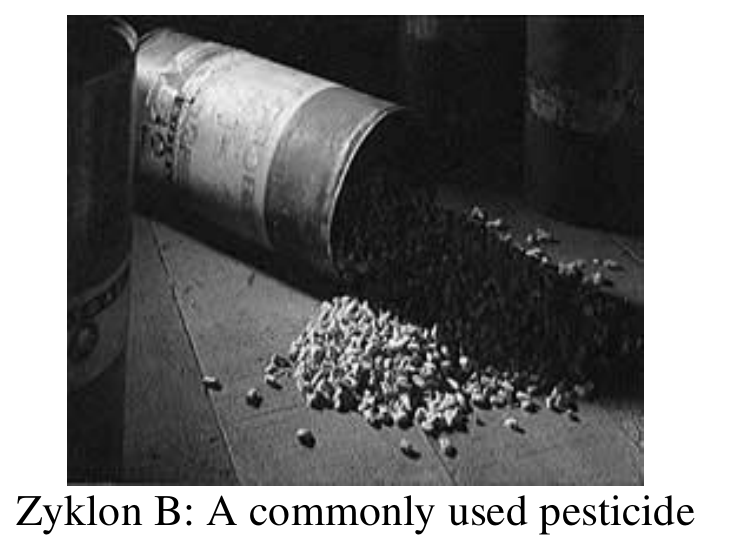

Hydrogen cyanide gas (HCN or hydrocyanic acid) has been utilized as a fumigant since before WWI. It has been used side by side with steam and hot air and during WWII with D.D.T. by the United States and its Allies.

HCN is generally manufactured by a chemical reaction of sodium cyanide with dilute sulfuric acid. The chemical reaction results in HCN being given off into the air with a remainder of prussic acid (hydrocyanic acid). This reaction is normally contained in a ceramic crock pot.
This procedure has been utilized for pest and vermin control on ships, in buildings and in specially designed chambers and structures. Special design and handling considerations must be followed to ensure the safety of the users (technicians). Hydrogen cyanide is one of the most powerful and dangerous of all fumigation chemicals. Buildings especially constructed or modified for this purpose were used by all militaries and health organizations throughout the world. HCN has been used everywhere for disease control; specifically for plague and typhus i.e. rat, flea and lice control.
Special chambers were used since WWI in Europe and the United States. Some of these chambers were used by the German Army in Europe before and during WWII and much earlier by the United States Immigration Service at Ellis Island, New York Harbor. Many of these fumigation chambers were made for DEGESCH, a German firm located in Frankfurt am Main, Germany. During the war, DEGESCH supervised the distribution of Zyklon B. DEGESCH presently manufactures HCN.
Zyklon B was a special commercial preparation containing hydrocyanic acid. The name "Zyklon B" was itself a trade name. HCN was prepared at the factory and delivered in a form where the HCN was absorbed in a porous carrier, either wood pulp or diatomaceous earth (chalk). It was supplied either in discoids or snippets or pellets. This preparation was sealed in an airtight can which required a special can opener. In this form the HCN Zyklon B was much safer and easier to handle. The resultant Zyklon B gas was HCN.
Carrier form alone supplies no release schedule
This is a broad physical description rather than a quantitative release claim. It is incomplete if treated as an exhaustive account of the carriers. The report's NI-9912 appendix identifies small blue Erco cubes, and Irmscher's 1942 DEGESCH paper tests both Erco cubes and cardboard discs.
This paragraph by itself states no universal schedule. The later temperature and time claims require the measured carrier, temperature, and moisture data shown in the next correction.
Sources: NI-9912 fumigation rules · Irmscher, DEGESCH, 1942
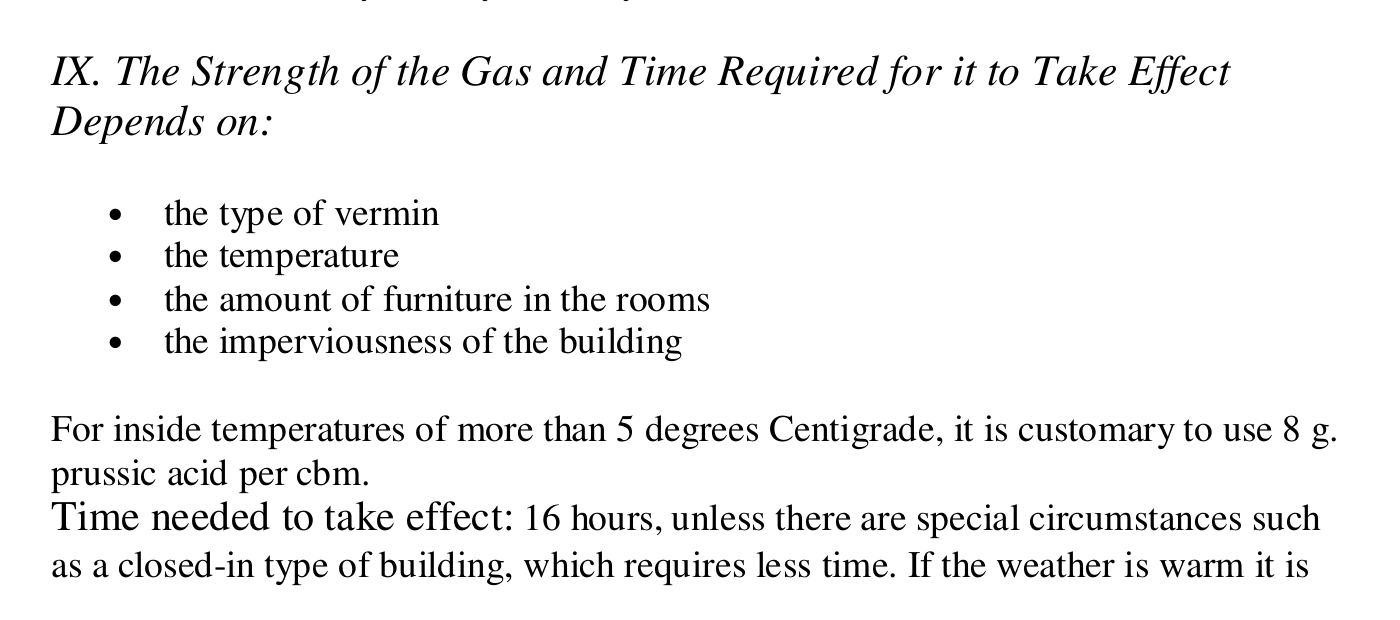
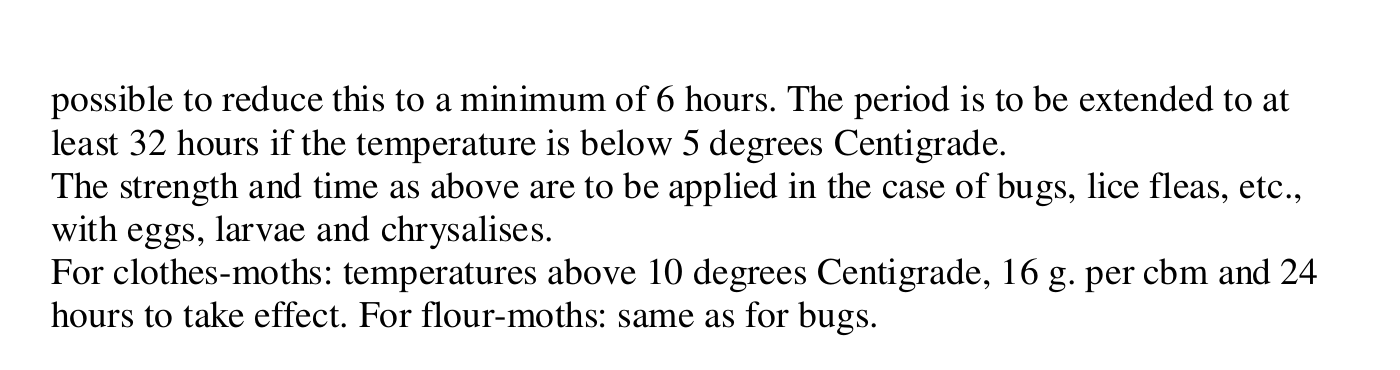
The discoids, snippets or pellets had to be spread on the floor of the area to be fumigated or utilized in a chamber which circulated and heated the air within the chamber in excess of 78.3 degrees Fahrenheit (25.7 degrees Centigrade). If used in buildings, ships, or tents to fumigate trees and produce, the area must be heated to an excess of 78.3 degrees Fahrenheit temperature, the boiling point of HCN. Failure to do this will result in a much longer time to complete the fumigation. Fumigation takes a minimum of 24 to 48 hours.
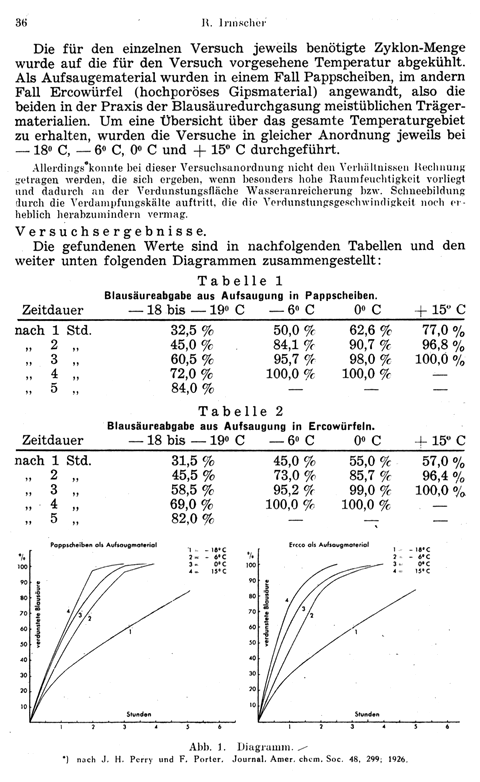
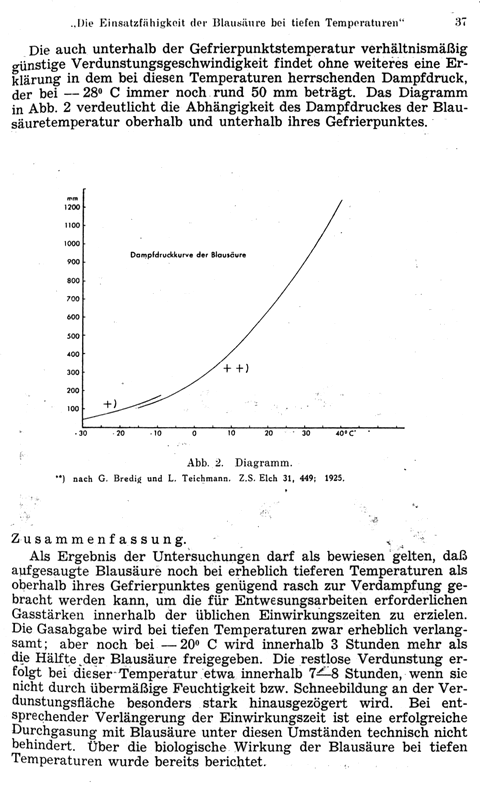
HCN evaporates below its boiling point; the report's threshold is false
Boiling point is not an evaporation switch. HCN evaporates below 25.6°C because its vapor pressure remains substantial below that temperature.
Richard Irmscher's 1942 DEGESCH tests measured release from both common Zyklon carriers at −18/−19°C, −6°C, 0°C, and +15°C. About 32% was released after one hour even at −18/−19°C. At +15°C, 57–77% was released after one hour and about 96% after two. Cold and moisture slowed release; they did not stop it. The archive notes a possible reversal of the carrier labels. Combining both carrier ranges leaves the temperature result unchanged.
NI-9912 is an official wartime fumigation directive, not a DEGESCH manual. It says HCN remains effective at 5°C and permits a six-hour exposure under warm conditions. These delousing records do not reconstruct a homicidal exposure. They directly disprove the report's 25.7°C release threshold and universal 24–48 hour minimum.
| Temperature | Cardboard, 1 h | Erco, 1 h | Cardboard, 2 h | Erco, 2 h |
|---|---|---|---|---|
| −18/−19°C | 32.5% | 31.5% | 45.0% | 45.5% |
| −6°C | 50.0% | 45.0% | 84.1% | 73.0% |
| 0°C | 62.6% | 55.0% | 90.7% | 85.7% |
| +15°C | 77.0% | 57.0% | 96.8% | 96.4% |
Values are transcribed from Irmscher's table on p. 36. The archive flags a possible reversal of the carrier labels. The combined ranges still show substantial release below 25.7°C. Irmscher also excluded carrier exposed to excessive dampness or covered with snow. The test does not establish a concentration-time profile for a particular room.
Within the report: The body requires temperatures above 78.3°F and at least 24–48 hours. Appendix III permits HCN use at 5°C and a six-hour exposure.
Sources: NIOSH emergency card · NI-9912 fumigation rules · Irmscher, DEGESCH, 1942
After the fumigation, the ventilation of the area must take a minimum of ten hours, depending on the location (and volume), and longer if the building has no windows or exhaust fans. The fumigated area must then be chemically tested for the presence of gas before entering. Gas masks are sometimes used, but are not safe and should not be used for more than ten (10) minutes. A complete chemical suit must be worn to prevent skin poisoning. The warmer the temperature and the drier the location, the faster and safer the handling will be.
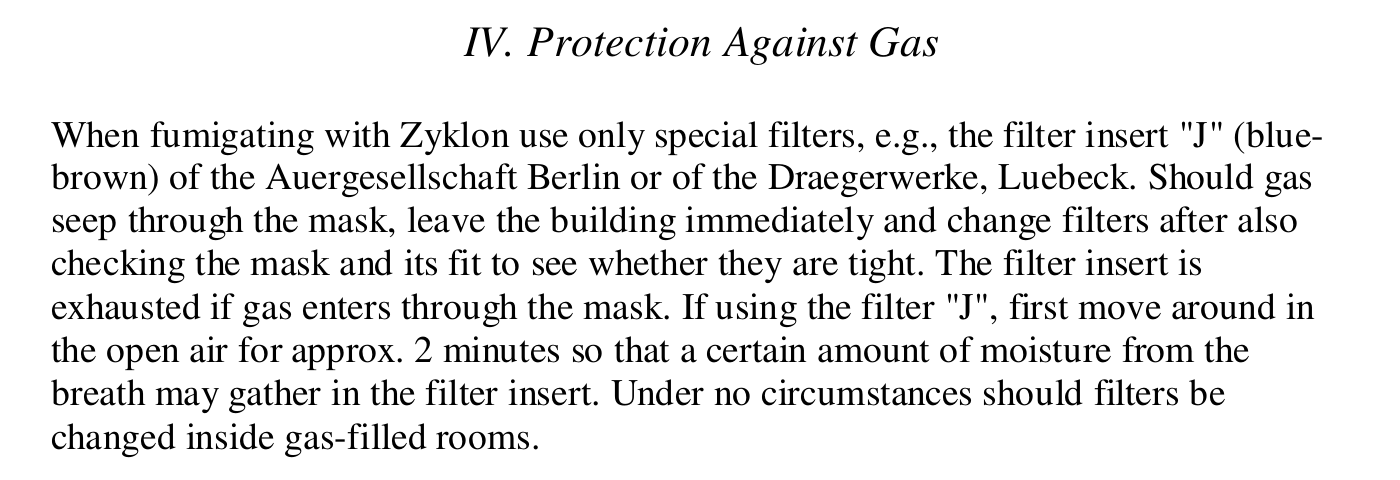
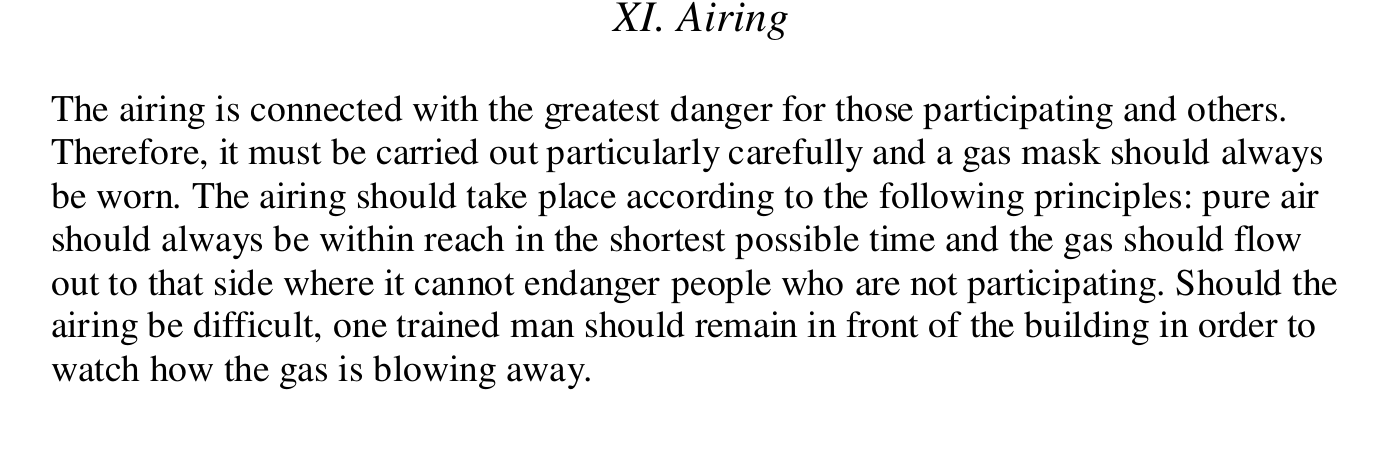
No evidence supports the ten-hour airing rule or ten-minute mask limit
NI-9912 makes insect-fumigation time depend on temperature, contents, vermin, and the building's resistance to gas. Its long airing schedule concerns that specific use; it does not establish a universal clearance time for every room and exposure.
Leuchter supplies no measured air-change rate or clearance calculation for his ten-hour figure. NI-9912 specifies a special “J” filter. The relevant appendix instructions are transcribed together. Modern NIOSH guidance selects respiratory protection by exposure condition. Neither source imposes his blanket ten-minute mask limit.
Sources: NI-9912 fumigation rules · NIOSH: hydrogen cyanide
Report context 1 passage

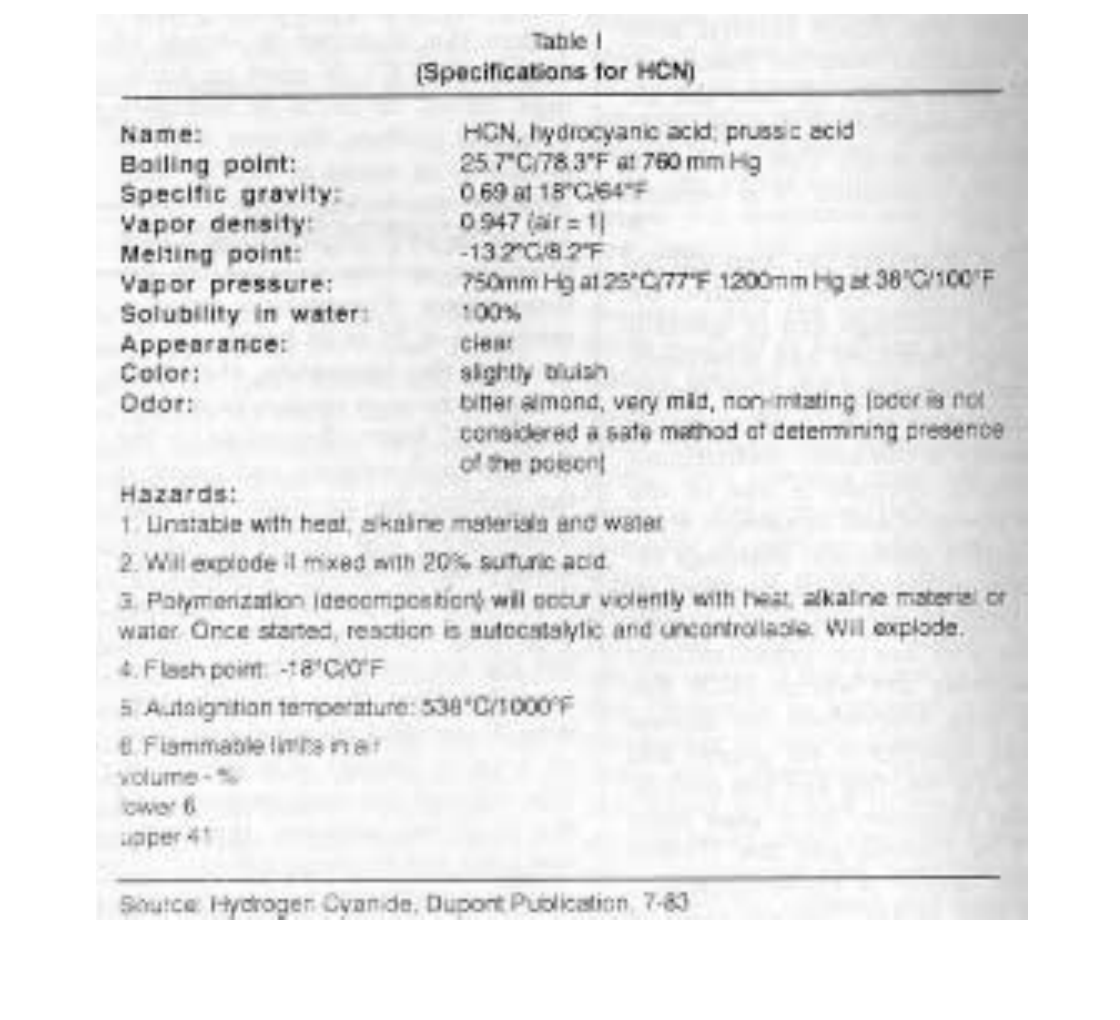
The specifications for the gas are found in Table 1:
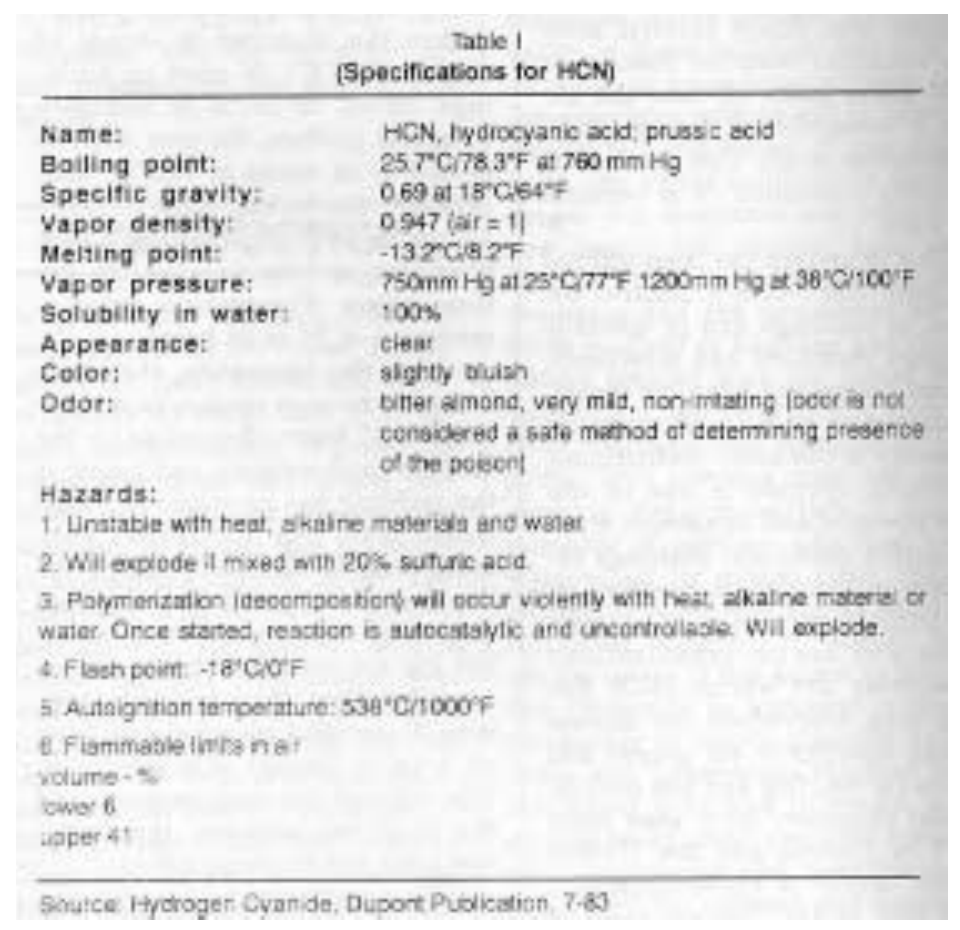
Table I puts the explosion threshold nineteen times above 3,200 ppm
Table I puts HCN's lower flammability limit at 6% by volume, or 60,000 ppm. The body later calls 3,200 ppm, or 0.32%, an explosion danger without calculating a local flammable mixture. The report's own threshold is almost nineteen times higher.
Sources: Leuchter Table I · NIOSH emergency card
3.7 Design Criteria for a Fumigation Facility
Report context 2 report items

A fumigation facility, whether a building or a chamber, must adhere to the same basic requirements. It must be sealable, heatable, have both circulation and exhaust capability for the air, must have a sufficiently high stack for the exhaust and a means for distribution of the gas evenly (likewise the Zyklon B material).
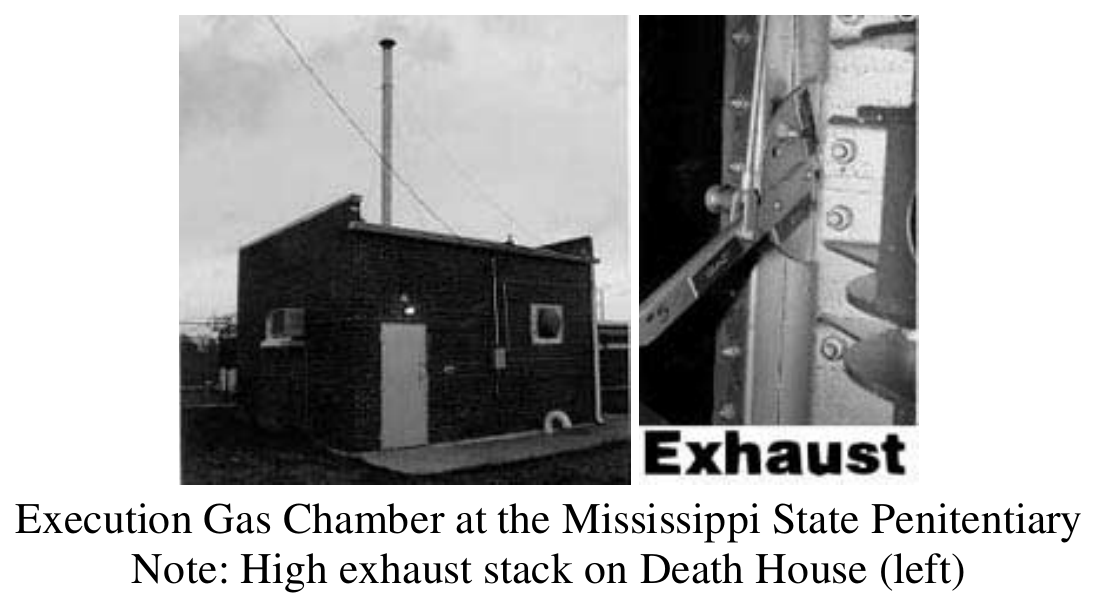
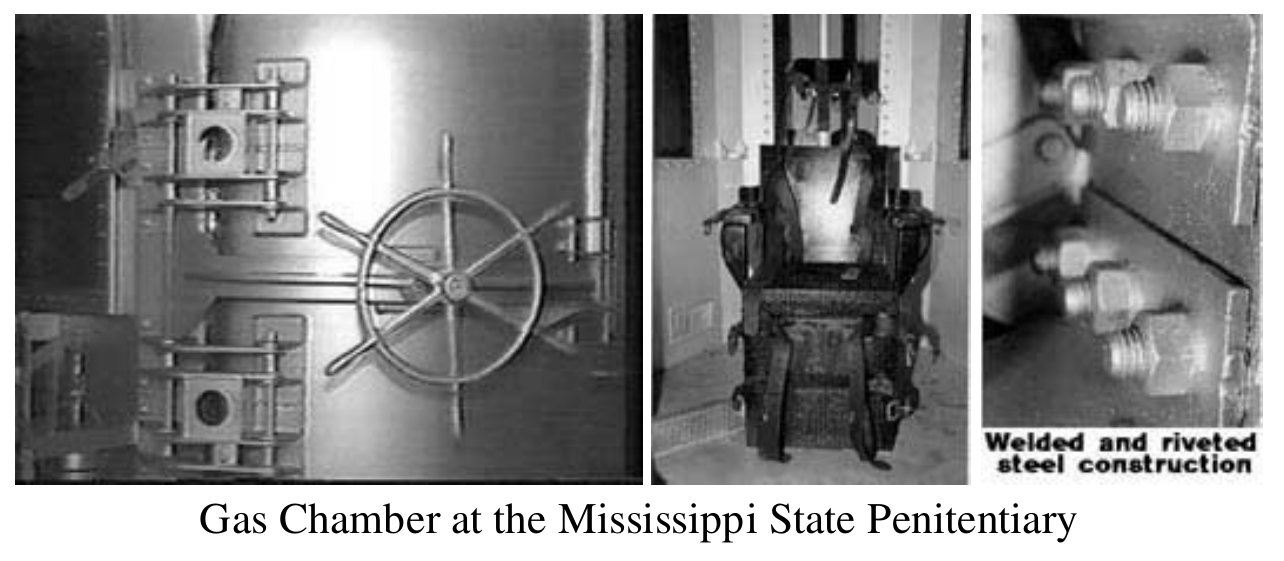
First, if a chamber is used today, it must be a welded and pressure tested vessel coated with an inert (epoxy) paint or stainless steel or plastic (PVC). The doors must be gasketed with an HCN resistant material (pickled asbestos, neoprene or Teflon®). If a building, it must be made of brick or stone and coated both inside and out with an inert (epoxy) paint or pitch, tar or asphalt. The doors and windows must be gasketed or sealed with a rubberized or pitched canvas and sealed with neoprene sealant or tar. In either case, the area must be extremely dry. The term 'sealing' has two meanings: first, to mechanically prevent leakage from the facility; and second, to render the exposed, porous surfaces of the facility impervious to impregnation by Zyklon B gas.
Modern chamber specifications describe one engineered system
A welded, pressure-tested, epoxy-coated chamber describes one modern design. Those specifications are not chemical requirements for holding a lethal HCN concentration.
The report's own appendix directs fumigators to seal ordinary buildings temporarily. Markiewicz and his colleagues later found that HCN retention was material-specific: mortar bound it more readily, while old brick bound it poorly, and moisture changed the result. Those experiments do not make porous masonry an automatic bar to a lethal atmosphere. The method and material results appear in the study comparison. The exposed state of a decades-old ruin cannot by itself establish wartime containment.
Within the report: The body presents welded or coated containment as mandatory and later applies that checklist to wartime rooms. Appendix III shows wartime HCN fumigation of ordinary buildings sealed temporarily with paper, cloth, strips, and paste.
Sources: NI-9912 fumigation rules · Auschwitz Museum: delousing · Markiewicz et al., 1994
Report context 1 report item
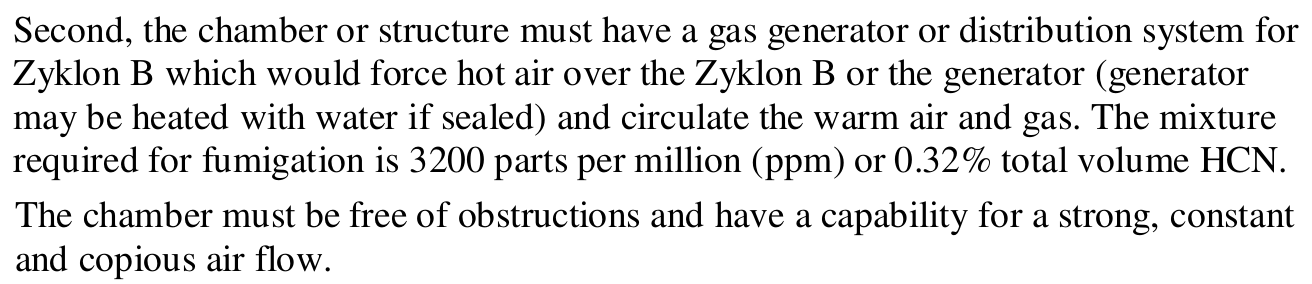
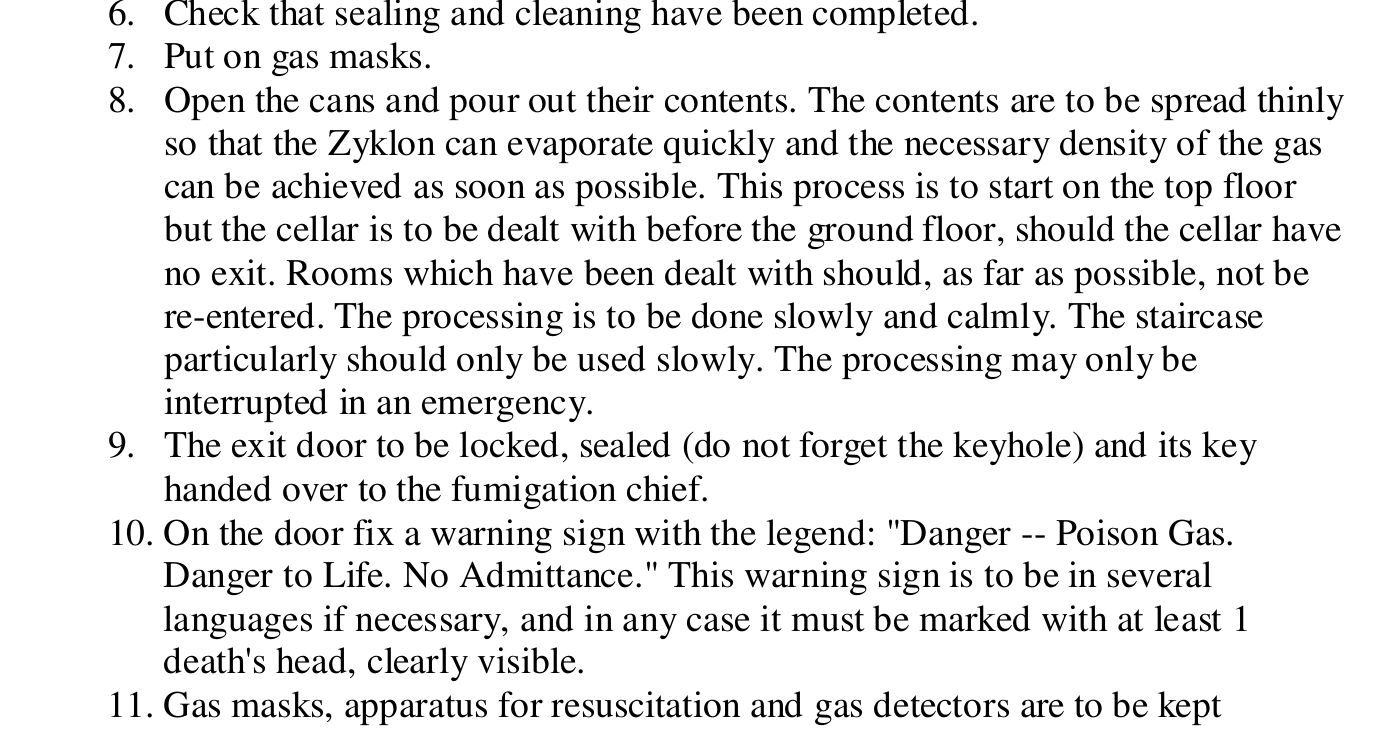
Second, the chamber or structure must have a gas generator or distribution system for Zyklon B which would force hot air over the Zyklon B or the generator (generator may be heated with water if sealed) and circulate the warm air and gas. The mixture required for fumigation is 3200 parts per million (ppm) or 0.32% total volume HCN. The chamber must be free of obstructions and have a capability for a strong, constant and copious air flow.
Zyklon B releases HCN without forced hot-air generation
Irmscher measured release from Zyklon carriers at temperatures down to −18/−19°C without making a hot-air generator a condition of release. Both carrier series and all four temperatures are transcribed here.
The report's own appendix tells operators to spread the carrier and adjust dose and duration for temperature. The cited 3,200 ppm is one American rapid-execution figure, not a universal lethal minimum.
Within the report: The body treats forced hot-air generation as necessary and applies that requirement to the wartime rooms. Appendix III instead instructs operators to spread the carrier and adjust dose and time for temperature.
Sources: NI-9912 fumigation rules · NIOSH: hydrogen cyanide · NIOSH emergency card · Irmscher, DEGESCH, 1942
Report context 3 report items
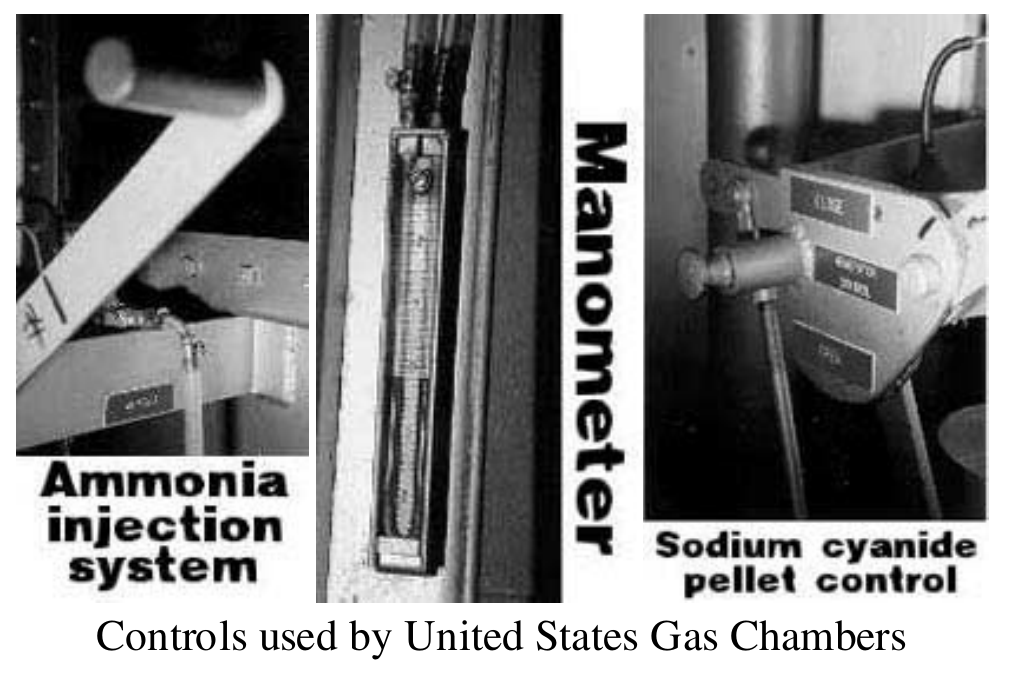
Third, the chamber or structure must have a means for evacuating the poisonous air/gas mixture and replacing it with fresh air. Generally, this is done with an exhaust or intake fan with either exhaust or intake valves or louvered ports of sufficient size to allow reasonable air change per hour. Usually, a sufficient cubic feet per minute (cfm) fan and intake and exhaust aperture should permit a complete air change in 1/2 hour and should be run for at least twice the required time of one hour, or two hours. The larger the facility, the less practical this becomes (due to the size of available fans) and exhaust times may take several hours or longer.

The exhaust must be vented at a safe distance above the facility where the air currents can disperse the gas. This is normally 40 feet above the structure, but it should be more if the structure is sheltered from the wind. If an incinerator is used, the stack may be only several feet in height. It is generally too costly to incinerate the HCN because of the air volume it must handle in a short time period.
The temperature of the walls and the air within the facility, and the intake air, must be kept at least 10 degrees above the boiling point of the hydrocyanic acid (78.3 degrees F) to prevent condensation of HCN on the walls, floor and ceiling of the facility, as well as in the exhaust system. If the temperature is below 79 degrees F and condensation occurs, the facility must be decontaminated with chlorine bleach or ammonia, the former being the most effective. This is accomplished by spraying the walls either automatically or manually. If done manually, protective suits (generally neoprene) must be worn and the technicians must utilize air breathing cylinders, as gas masks are unsafe and dangerous. The interior of the building must be evacuated longer to allow the chlorine bleach vapors to neutralize the liquid HCN in the exhaust system. The interior of the building must be washed with water and thoroughly mopped and dried before the next use.
HCN retains substantial vapor pressure below its boiling point
NIST's phase data show substantial pure-HCN vapor pressure below the normal boiling point. The displayed calculation defeats the report's categorical rule that HCN requires surfaces above 88.3°F.
A particular wall condenses HCN only when its surface conditions and the gas partial pressure permit it. A room-specific conclusion would require wall temperature, HCN partial pressure, humidity, adsorption, airflow, and time. The report supplies none of those inputs.
NI-9912's cold-weather schedules and J-filter instruction separately defeat the universal bleaching, shutdown, and mask claims. Those fumigation rules do not calculate clearance in a homicidal chamber.
| Temperature | Calculated vapor pressure | Share of 1 atm |
|---|---|---|
| 0°C | 0.353 bar | 34.9% |
| 15°C | 0.670 bar | 66.1% |
| 20°C | 0.817 bar | 80.6% |
| 25.6°C | 1.012 bar | 99.8% |
Values are calculated from NIST's Antoine relation for pure HCN, valid from 256.73 to 319.38 K. Carrier release has separate kinetics. The calculation tests the report's claim that boiling point acts as an evaporation or condensation switch.
Sources: NIOSH emergency card · NI-9912 fumigation rules · NIST: HCN phase-change data
Report context 1 passage
Additionally, a check of the air inside the building must be done to determine whether all of the HCN has been removed. The test may be either by gas detector or by the copper acetate/benzidene test. In the former, an electronic readout is provided with detection to 10 ppm. In the other, a benzidene solution is mixed with a copper acetate solution and is used to moisten a piece of test paper which turn blue in varying degrees if HCN is present
3.8 Design Criteria for an Execution Gas Chamber
Many of the same requirements for the fumigation facility apply to an execution facility. Generally, however, the execution facility will be smaller and more efficient. Zyklon B is not recommended for use in an execution gas chamber generally because of the time it takes to drive the gas from the inert carrier. Up until now, the only efficient method has been to generate the gas on-site by chemical reaction of sodium cyanide and 18% sulfuric acid. Recently, a design for a gas generator has been completed which will be utilized in the two (2) man gas chamber at the Missouri State Penitentiary, Jefferson City, Missouri. The author is the design consultant for this execution gas chamber.
Delivery hardware changes release profile; HCN toxicity remains
Both systems produce HCN. American chambers generated it from cyanide salt and sulfuric acid; Zyklon B released it from a carrier. The delivery hardware changes the release profile, not HCN's toxicity.
The hardware difference alone does not establish that Zyklon B could not create a lethal concentration. Leuchter's proposed Missouri installation is one modern design, not a physical rule for every HCN killing system.
Sources: NIOSH emergency card · NI-9912 fumigation rules · Auschwitz Museum: Leuchter
Report context 7 passages
This generator employs an electrically heated water jacket to pre-boil HCN in a cylindrical vessel. At the time of use, the HCN is already vaporized and is released through valves into the chamber. A nitrogen burst system clears the plumbing after use. The total time of the execution is less than four minutes. The chamber is evacuated at a rate of once every two minutes for a 15 minute time period, providing some seven (7) complete air changes.
The chamber may be of welded steel construction or of plastic PVC. The doors and windows should be of standard marine watertight construction. The door is gasketed with a single handle pressure seal. All lighting and electrical hardware is explosion- proof. The chamber contains the gas distribution plumbing, the gas generator with the bottle of liquid HCN, electronic heart monitoring equipment, two (2) seats for the condemned and a gas detector reading externally, electronically to 10 ppm.
Because the chamber contains so lethal a gas, it is operated at a negative pressure to guarantee that any leak would be inward. The chamber pressure is controlled by a vacurizer system which should hold the chamber at a partial vacuum of 10 pounds per square inch (psi) (operational: 8 psi plus 2 psi of HCN). The negative pressure is maintained utilizing the outward ambient as a standard. This system is controlled electrically and supported by a 17.7 cfm displacement vacuum pump. Additionally, a pressure switch is set to trigger emergency systems if the chamber pressure reaches 12 psi, 3 psi above the operational limit.
The inlet and exhaust system is designed for an air change every two (2) minutes. The air is supplied by a 2000+ cfm fan on the inlet side of the chamber and exhausted through the top of the chamber. The inlet and exhaust valves are both of the inwardly closing type to prevent vacuum loss and are timed to electrically open in sequence, the exhaust valve first. This is evacuated through a 40 foot high 13 inch diameter PVC pipe where the wind disperses the gas harmlessly. The intake air should have preheat capability to guarantee that no HCN will condense and thereby escape evacuation.
Gas detectors are utilized for safety. First, in the chamber where it will electrically prohibit the door from opening until the chamber is safe, second, outside the chamber in the witness and personnel areas where they sound alarms and initiate an air exhaust and intake system to protect the witnesses, as well as, abort the execution and evacuate the chamber. The safety systems contain warning bells, horns, and lights, as well.

Further, emergency breathing apparatus (air tanks) is available in the chamber area, as well as, special HCN first aid kits, emergency medical equipment for HCN and a resuscitator in an adjacent area for medical personnel.

Execution gas chamber design requires the consideration of many complicated problems. A mistake in any area may, and probably will, cause death or injury to witnesses or technicians.
3.9 United States Execution Gas Chambers Since 1920
Report context 4 passages
The first gas chamber for execution purposes was built in Arizona in 1920. It consisted of an airtight chamber with gasketed doors and windows, a gas generator, an explosion proof electrical system, an air intake and exhaust system, provision for adding ammonia to the intake air and mechanical means for activating the gas generator and air exhaust. The air intake consisted of several mechanically operated valves. Only the hardware has changed to the present.

The gas generator consisted of a crockery pot filled with a dilute solution (18%) of sulfuric acid with a mechanical release lever. The chamber had to be scrubbed with ammonia after the execution, as did the executee. Some 25 13-gram sodium cyanide pellets were used and generated a concentration of 3200 ppm in a 600 cubic foot chamber.
In the years that followed, other states adopted the HCN gas chamber as a mode of execution and design techniques changed. Eaton Metal Products designed, built and improved most of the chambers. Most had two chairs and were fitted with a vacuum system to guarantee a negative pressure and only inward leakage. All systems employed the gas generator technique because it was the most effective and simplest procedure available up until the late 1960's. No system ever was designed to use, or ever used, Zyklon B.

The reason for this is quite simple. Zyklon B takes too long to evaporate (or boil off) the HCN from the inert carrier and requires heated air and a temperature controlled system. Not only is the gas not instant, but a danger of explosion always exists.
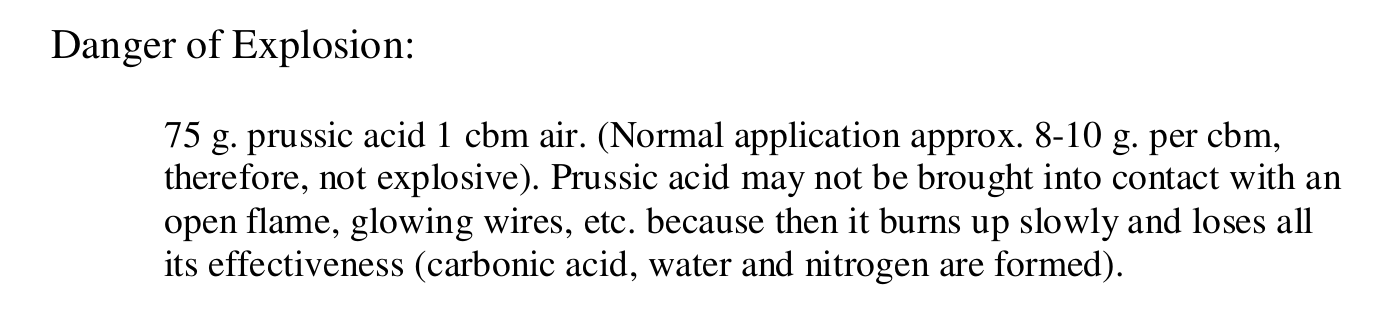
The overall gas mixture is generally below the lower explosion limit (LEL) of the gas air mixture of 0.32% (since the mixture should not normally exceed 3200 ppm), but the concentration of the gas at the generator (or as in the case of Zyklon B, at the inert carrier) is much greater and may well be 90% to 99% by volume. This is almost pure HCN and this condition may exist at points of time in pockets in the chamber. The ambient air temperature or the heated air temperature must be considerably higher and artificially controlled for Zyklon B (since evaporation is strictly a physical process), where, with the gas generator, the temperature can be lower and uncontrolled since the chemical reaction in the generator is self-catalytic after starting. Electrical contacts and switches must be kept at a minimum, explosion-proof and outside the chamber. Technology available only since the late 1960's has enabled the Missouri system, which will be the most advanced system ever built, to utilize a gas vaporizer and delivery system for liquid HCN, eliminating the dangerous of handling and disposal of the prussic acid residual after the execution.
3,200 ppm is 17.5 times below HCN's lower explosive limit
3,200 ppm is 0.32% by volume. NIOSH puts HCN's lower flammability limit near 5.6%, or about 56,000 ppm. The report is wrong by about eighteenfold.
A hypothetical rich pocket near a carrier does not establish an explosion. That claim requires the actual quantity, geometry, mixing, and ignition path. The report calculates none of them.
| Quantity | Percent by volume | Parts per million |
|---|---|---|
| Report's rapid-execution concentration | 0.32% | 3,200 ppm |
| NIOSH lower explosive limit | 5.6% | 56,000 ppm |
| Ratio | 17.5 times higher | 17.5 times higher |
A local pocket could differ from the room average. Establishing that hazard would require quantity, mixing, geometry, and an ignition path.
Within the report: Table I puts the lower flammability limit near 6%. This paragraph calls 0.32% the lower explosion limit.
Sources: Leuchter Table I · NIOSH: hydrogen cyanide · NIOSH emergency card
Report context 3 passages
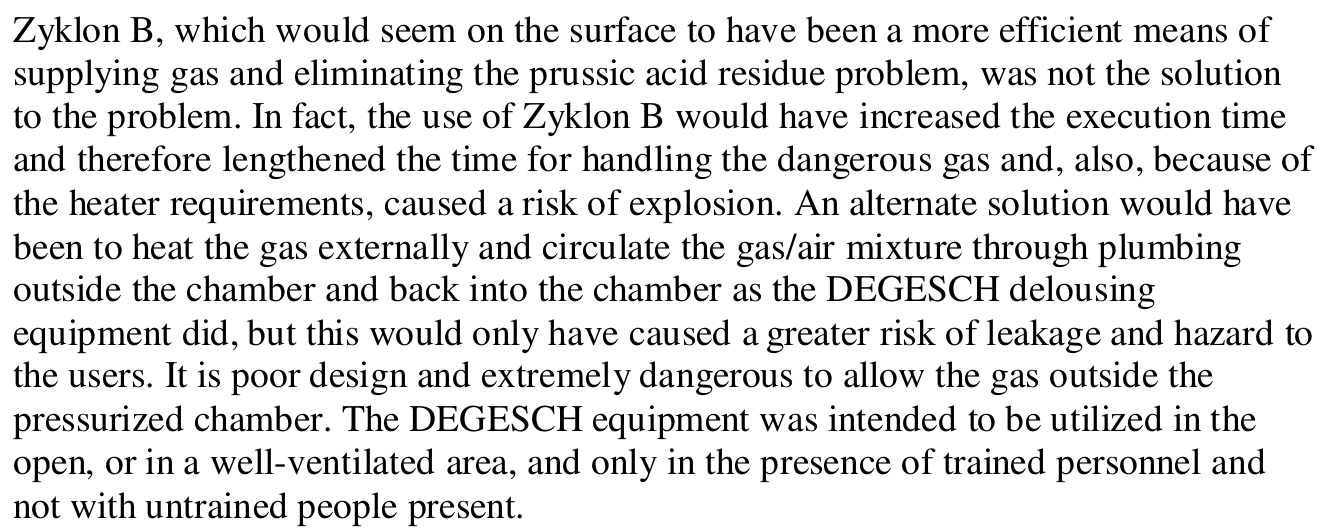
Zyklon B, which would seem on the surface to have been a more efficient means of supplying gas and eliminating the prussic acid residue problem, was not the solution to the problem. In fact, the use of Zyklon B would have increased the execution time and therefore lengthened the time for handling the dangerous gas and, also, because of the heater requirements, caused a risk of explosion. An alternate solution would have been to heat the gas externally and circulate the gas/air mixture through plumbing outside the chamber and back into the chamber as the DEGESCH delousing equipment did, but this would only have caused a greater risk of leakage and hazard to the users. It is poor design and extremely dangerous to allow the gas outside the pressurized chamber. The DEGESCH equipment was intended to be utilized in the open, or in a well-ventilated area, and only in the presence of trained personnel and not with untrained people present.
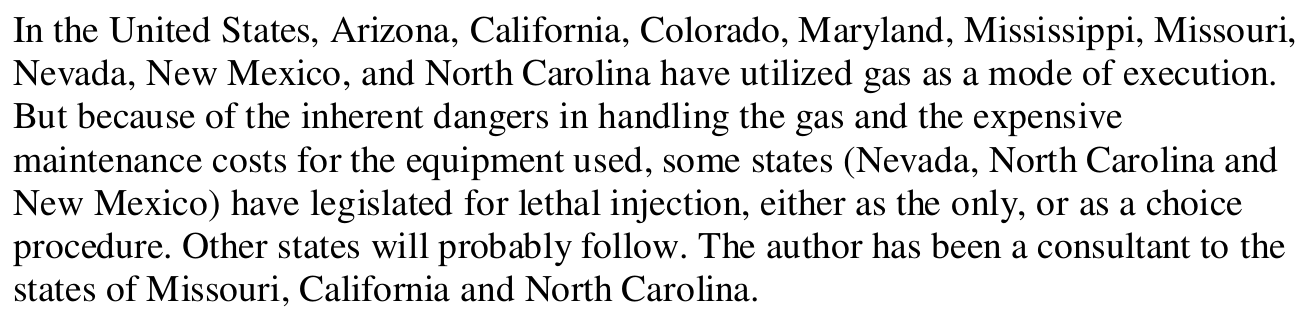
In the United States, Arizona, California, Colorado, Maryland, Mississippi, Missouri, Nevada, New Mexico, and North Carolina have utilized gas as a mode of execution. But because of the inherent dangers in handling the gas and the expensive maintenance costs for the equipment used, some states (Nevada, North Carolina and New Mexico) have legislated for lethal injection, either as the only, or as a choice procedure. Other states will probably follow. The author has been a consultant to the states of Missouri, California and North Carolina.

In any event, because of the cost of manufacture of HCN gas, and because of the excessive hardware and maintenance costs of the equipment, gas has been in the past, and still is, the most expensive mode of execution.
3.10 Toxic Effects of HCN Gas
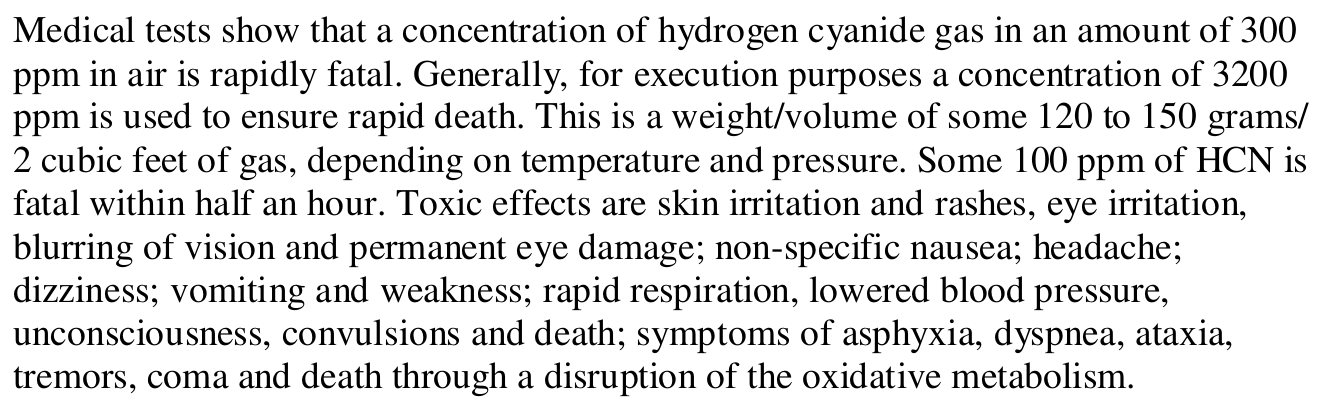
Medical tests show that a concentration of hydrogen cyanide gas in an amount of 300 ppm in air is rapidly fatal. Generally, for execution purposes a concentration of 3200 ppm is used to ensure rapid death. This is a weight/volume of some 120 to 150 grams/ 2 cubic feet of gas, depending on temperature and pressure. Some 100 ppm of HCN is fatal within half an hour. Toxic effects are skin irritation and rashes, eye irritation, blurring of vision and permanent eye damage; non-specific nausea; headache; dizziness; vomiting and weakness; rapid respiration, lowered blood pressure, unconsciousness, convulsions and death; symptoms of asphyxia, dyspnea, ataxia, tremors, coma and death through a disruption of the oxidative metabolism.
The mass calculation is wrong
Under either plausible reading, the numbers fail. Two cubic feet of air at 3,200 ppm contains about 0.2 grams of HCN under ordinary conditions. Two cubic feet of pure HCN gas is roughly 63 grams. Neither produces the claimed 120–150 grams.
HCN can kill rapidly at hundreds of parts per million, far below its flammability limit.
| Step at 25°C and 1 atm | Result |
|---|---|
| Two cubic feet converted to litres | 56.63 L |
| Total gas, using 24.47 L per mole | 2.315 mol |
| HCN at 3,200 ppm by volume | 0.0032 × 2.315 mol |
| HCN mass, using 27.03 g per mole | 0.200 g |
| If all two cubic feet were pure HCN | 62.6 g |
| Report's printed value | 120–150 g |
This is an ideal-gas illustration with every assumption shown. Neither plausible reading of “two cubic feet of gas” yields the printed mass.
Sources: NIOSH: hydrogen cyanide · NIOSH emergency card

Hydrocyanic acid does not have to be breathed to be fatal. In concentrations of over 50 ppm, the user must wear a chemical suit to completely protect his body and breathe bottled air. Gas masks are generally ineffective and should never be utilized. Specialized first aid kits and medical supplies are available and should be present in all areas where a person may contact the gas.
NI-9912 disproves the blanket claim that masks fail
HCN can enter through the lungs and skin, especially as liquid or at high vapor concentrations. That can require protective clothing. It does not make every gas mask useless.
The report's NI-9912 appendix specifies a “J” filter for fumigators. NIOSH likewise specifies respirator types by concentration and emergency condition. The directive's operative instructions contradict the blanket claim while preserving the real limits: cartridge type, concentration, exposure duration, fit, oxygen level, and skin protection determine whether a respirator is adequate.
Within the report: The body says masks cannot be used safely. Appendix III specifies a “J” filter and masked entry.
Sources: NIOSH: hydrogen cyanide · NI-9912 fumigation rules
Buildings and wartime records
3.11 A Brief History of the Alleged German Execution Gas Chambers
Report context 4 passages

Based on material available to the author, it has been determined that the Germans allegedly constructed a series of large (three or more executees) gas chambers for execution purposes beginning sometime in late 1941 and utilized them until late 1944.
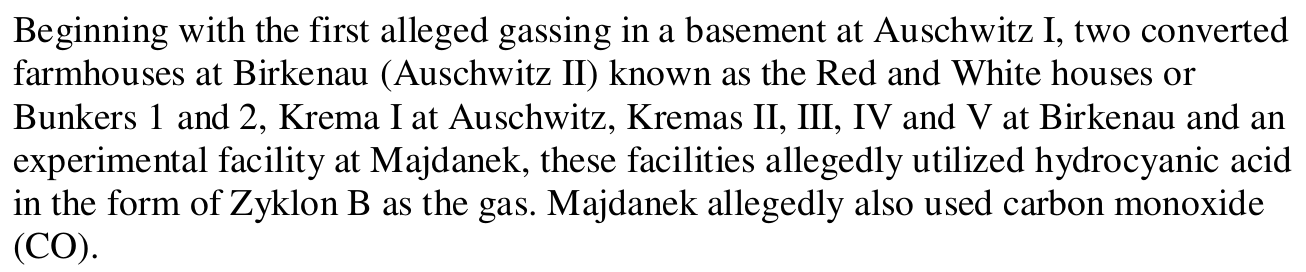
Beginning with the first alleged gassing in a basement at Auschwitz I, two converted farmhouses at Birkenau (Auschwitz II) known as the Red and White houses or Bunkers 1 and 2, Krema I at Auschwitz, Kremas II, III, IV and V at Birkenau and an experimental facility at Majdanek, these facilities allegedly utilized hydrocyanic acid in the form of Zyklon B as the gas. Majdanek allegedly also used carbon monoxide (CO).

According to official literature obtained at the Auschwitz and Majdanek State Museums, these execution facilities were located in concentration camps constructed in highly industrial areas and their inmates supplied forced labor to the factories producing materials for the war effort. These facilities also included crematories for the disposal of the remains of those allegedly executed.

Additionally, other alleged facilities which only utilized CO as the execution gas were located at Belzec, Sobibor, Treblinka and Chelmno (gas vans). These additional facilities were allegedly destroyed either during or after WWII, have not been inspected and are not directly the subject of this report.
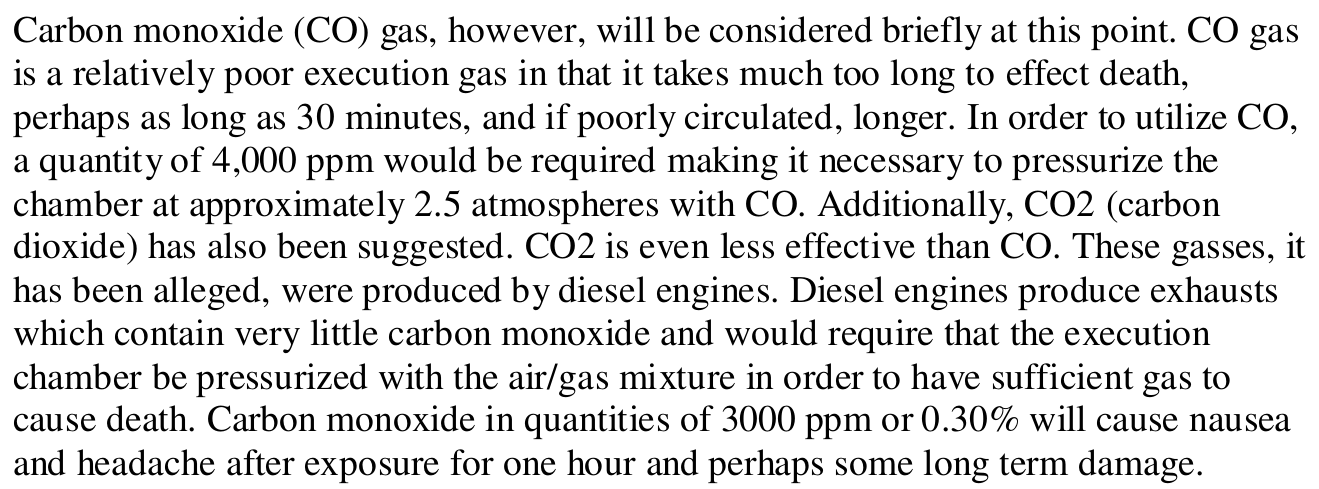
Carbon monoxide (CO) gas, however, will be considered briefly at this point. CO gas is a relatively poor execution gas in that it takes much too long to effect death, perhaps as long as 30 minutes, and if poorly circulated, longer. In order to utilize CO, a quantity of 4,000 ppm would be required making it necessary to pressurize the chamber at approximately 2.5 atmospheres with CO. Additionally, CO2 (carbon dioxide) has also been suggested. CO2 is even less effective than CO. These gasses, it has been alleged, were produced by diesel engines. Diesel engines produce exhausts which contain very little carbon monoxide and would require that the execution chamber be pressurized with the air/gas mixture in order to have sufficient gas to cause death. Carbon monoxide in quantities of 3000 ppm or 0.30% will cause nausea and headache after exposure for one hour and perhaps some long term damage.
4,000 ppm carbon monoxide equals 0.4% at ordinary pressure
At 4,000 ppm, carbon monoxide makes up 0.4% of the air and has a partial pressure of 0.004 atmosphere when total pressure is one atmosphere. The report's 2.5-atmosphere requirement is a concentration-to-pressure error.
NIOSH's 1,200-ppm IDLH is an emergency escape and respirator benchmark rather than a direct lethality threshold. The NRC review supplies the concentration-time evidence: a 600-ppm 30-minute AEGL-3 and an ISO estimate of 2,500–4,000 ppm for 30 minutes, with the source limits shown below.
Those data do not identify a historical engine, exhaust concentration, enclosure, or exposure time. They defeat the pressure calculation and the claimed one-hour lower bound.
| Check | Published value | What it tests |
|---|---|---|
| 4,000 ppm as a fraction | 0.004 = 0.4% | Concentration |
| CO partial pressure at 1 atm total | 0.004 atm | No chamber pressurization |
| NIOSH revised IDLH | 1,200 ppm | Immediate danger benchmark |
| NRC AEGL-3, 30 minutes | 600 ppm | Life-threatening or fatal threshold |
| ISO estimate reviewed by NRC | 2,500–4,000 ppm for 30 min | Healthy adult, light activity |
The NRC notes that the ISO estimate relied largely on animal data and did not address susceptible groups. These values do not identify a historical engine or exhaust concentration. They directly test the claims that 4,000 ppm needs 2.5 atmospheres and requires more than one hour to kill.
Sources: NIOSH: carbon monoxide · NRC acute CO review
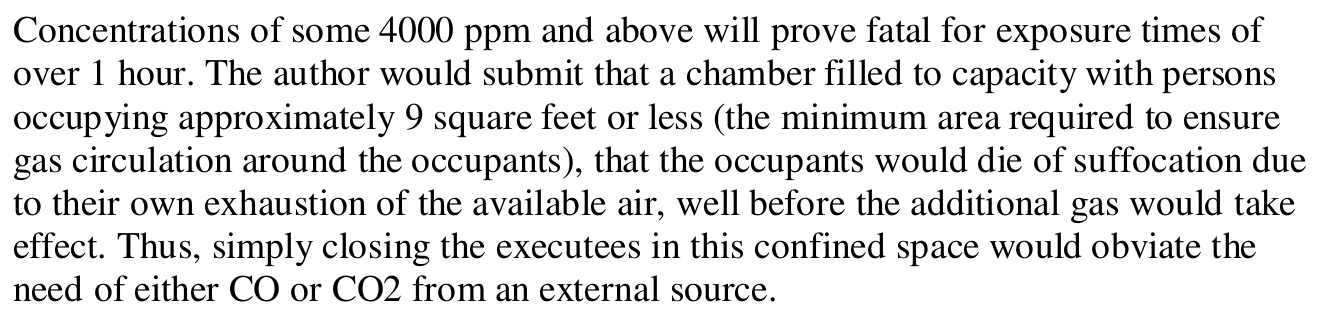
Concentrations of some 4000 ppm and above will prove fatal for exposure times of over 1 hour. The author would submit that a chamber filled to capacity with persons occupying approximately 9 square feet or less (the minimum area required to ensure gas circulation around the occupants), that the occupants would die of suffocation due to their own exhaustion of the available air, well before the additional gas would take effect. Thus, simply closing the executees in this confined space would obviate the need of either CO or CO2 from an external source.
Floor area alone cannot determine suffocation time
The 4,000-ppm sentence continues the carbon-monoxide discussion. The NRC review gives a 600-ppm 30-minute AEGL-3 and reports an ISO estimate of 2,500–4,000 ppm for 30 minutes in a healthy adult doing light activity. The report supplies no basis for “over one hour” as a lower bound.
The suffocation claim has no mass balance. Nine square feet is floor area. Time requires ceiling height, initial air, occupancy, activity, leakage, incoming exhaust, heat, and mixing. The disclosed sensitivity check below assigns an illustrative eight-foot height. Two published closed-atmosphere methods then reach 3% carbon dioxide in about two to three hours, a level NIOSH describes as survivable in an emergency. That result cannot support death by air depletion “well before” a cited 30-minute carbon-monoxide exposure.
An exhaust-fed room is also an open mass-balance problem rather than a sealed fixed volume. Carbon monoxide, oxygen depletion, carbon dioxide, heat, and other exhaust constituents can act together.
| Disclosed input or comparison | Value |
|---|---|
| Report's floor area per person | 9 ft² |
| Illustrative ceiling height absent from the claim | 8 ft |
| Illustrative air volume per person | 72 ft³ |
| MSHA example scaled to 72 ft³ | 1.98 h to 3% CO₂ |
| U.S. Navy formula applied to 72 ft³ | 2.88 h to 3% CO₂ |
| NIOSH description of 3% CO₂ | Survivable in an emergency |
| ISO lethal CO estimate reviewed by NRC | 2,500–4,000 ppm for 30 min |
This is a sensitivity check rather than a historical chamber model. The eight-foot height is stated only to expose the missing variable. Activity, initial air, leakage, incoming exhaust, heat, and mixing would change the result. The published examples do not support death by air depletion “well before” carbon monoxide.
Sources: NIOSH: carbon monoxide · NRC acute CO review · NIOSH: closed-atmosphere variables
The alleged execution facilities in Auschwitz I (Krema I), and Majdanek still exist, in allegedly original form. In Birkenau, Kremas II, III, IV and V are collapsed or razed to the foundations; Bunker I (the Red House) is gone and Bunker II (the White House) is now restored and utilized as a private residence. At Majdanek, the first oil- fired crematory has been removed and the crematory with the alleged gas chamber has been rebuilt with only the ovens being original.
The 1988 fabric cannot establish which wartime fittings were absent
The preservation history limits what the 1988 inspection could establish. The Auschwitz Museum's dated account records the destruction of the Birkenau crematoria and the wartime alteration and postwar reconstruction of Crematorium I; the aligned phases appear in the phase table. The Majdanek Museum distinguishes reconstructed crematorium fabric from the separate surviving gas-chamber building, summarized in the topology table.
These are institutional reconstructions from plans, dated records, photographs, and surviving fabric. They require phase-specific testing of each feature. The report instead treats missing 1988 fabric as proof of missing wartime equipment.
Sources: Auschwitz Museum: gas chambers · Majdanek Museum timeline · Majdanek Museum: former camp grounds
Report context 1 passage

Krema I at Auschwitz, Kremas II, III, IV and V at Birkenau, and the existing crematory at Majdanek were allegedly crematories and gas chambers combined. The Red and White houses at Birkenau were allegedly only gas chambers. At Majdanek, the experimental gas chambers were not adjacent to a crematory and there was a separate crematory which is not now extant.
3.12 Design and Procedures at the Alleged Execution Gas Chambers
Report context 3 report items

It appears, through investigation of the available historical documents and the facilities themselves, that most of the alleged execution gas chambers were converted from an earlier design, purpose and structure. This is true except for the so-called experimental chambers at Majdanek, which were allegedly specifically built as gassing facilities.
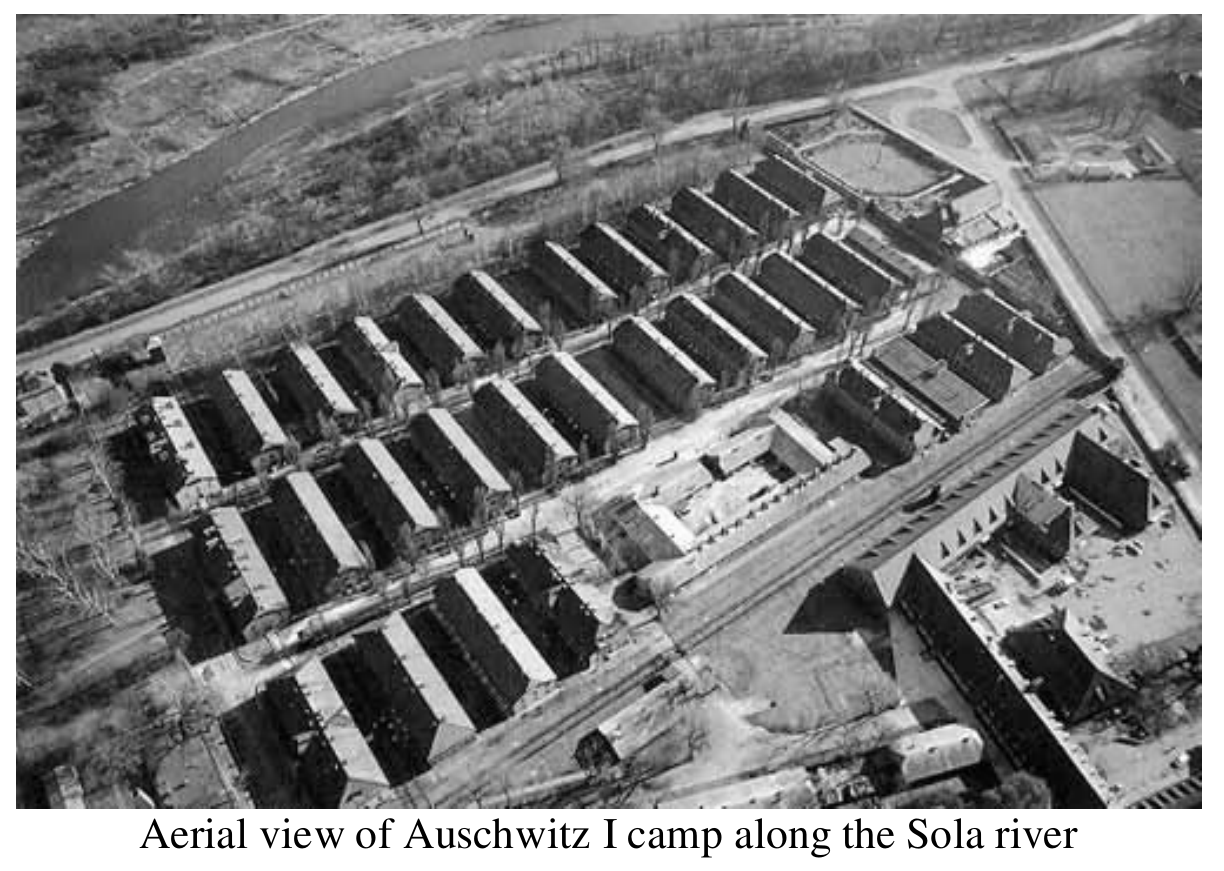
Bunkers I and II are described in Auschwitz State Museum literature as converted farm houses with several chambers and windows sealed. These do not exist in their original condition and were not inspected. Kremas I, II, III, IV and V are described historically and on inspection were verified to have been converted mortuaries or morgues connected and housed in the same facility as crematories. The on-site inspection of these structures indicated extremely poor and dangerous design for these facilities if they were to have served as execution gas chambers. There is no provision for gasketed doors, windows or vents; the structures are not coated with tar or other sealant to prevent leakage or absorption of the gas. The adjacent crematories are a potential danger of explosion.
The exposed porous brick and mortar would accumulate the HCN and make these facilities dangerous to humans for several years. Krema I is adjacent to the S.S. Hospital at Auschwitz and has floor drains connected to the main sewer of the camp which would allow gas into every building at the facility. There were no exhaust systems to vent the gas after usage and no heaters or dispersal mechanisms for the Zyklon B to be introduced or evaporated. The Zyklon B was supposedly dropped through roof vents and put in through windows not allowing for even distribution of gas or pellets. The facilities are always damp and not heated. As stated earlier, dampness and Zyklon B are not compatible.
The construction file contains ventilation-equipment records
The construction record contradicts the categorical ventilation denial. A January 29, 1943 Crematorium II letter says the supply and exhaust plant awaited installation. The signed building inventory lists electric-motor blowers. The claim-to-record matrix keeps those two findings separate. They establish planned and building-level mechanical equipment. They do not establish the final room connection or air-change rate.
The temperature claim is also false. DEGESCH measured substantial HCN release from Zyklon carriers below freezing. The handover inventory separately lists four wire-mesh insertion devices and four wooden covers. Leuchter substitutes missing equipment in altered or destroyed 1988 fabric for the wartime record.
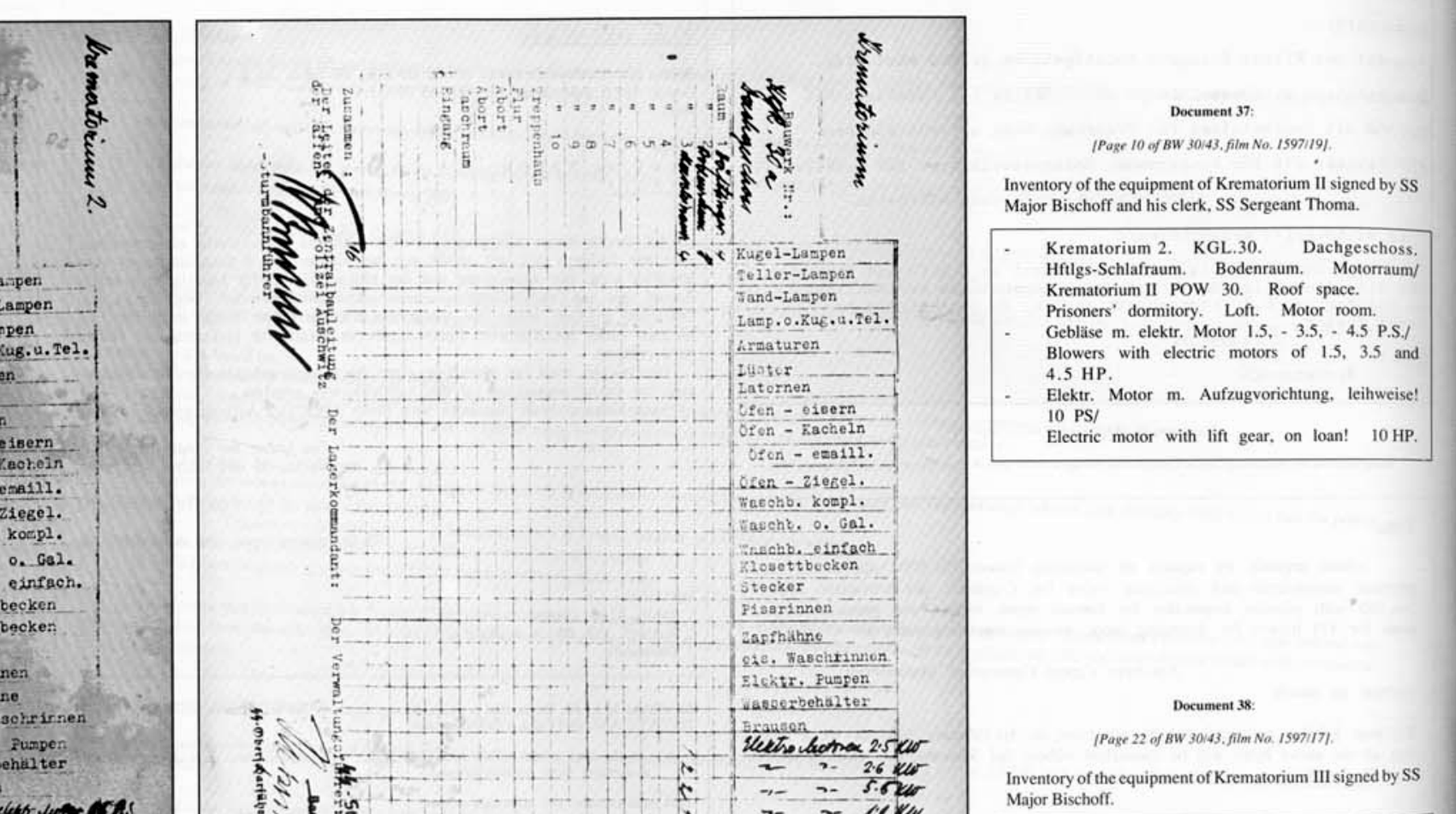
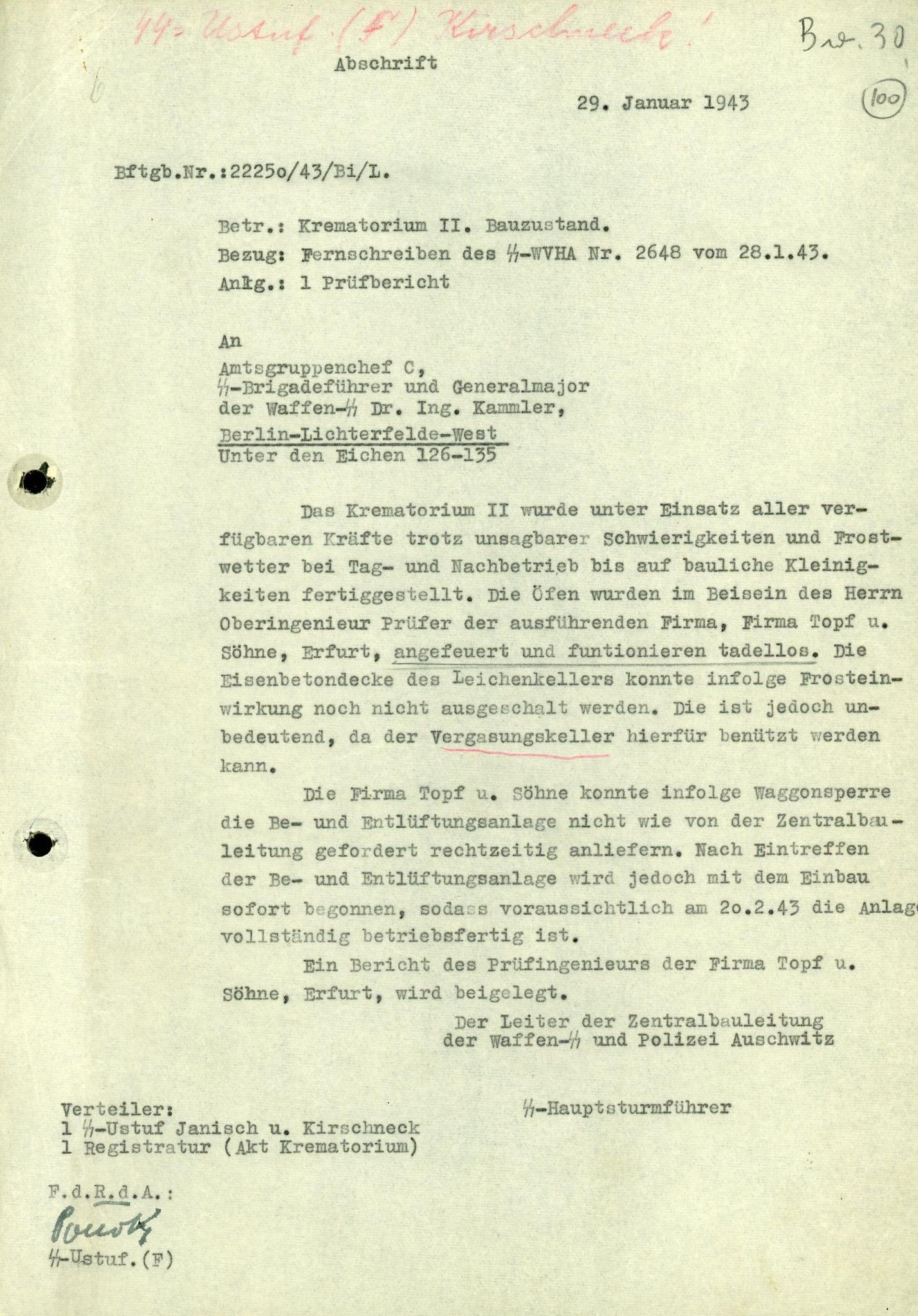
Sources: NI-9912 fumigation rules · NIOSH emergency card · Crematorium II blower inventory · Wire-mesh device inventory · Jan. 29, 1943 letter · Irmscher, DEGESCH, 1942
The chambers are too small to physically contain the occupants claimed and the doors all open inward, a situation which would inhibit removal of the bodies. With the chambers fully packed with occupants, there would be no circulation of the HCN within the room. Additionally, if the gas eventually did fill the chamber over a lengthy time period, those throwing Zyklon B in the roof vents and verifying the death of the occupants would die themselves from exposure to HCN. None of the alleged gas chambers were constructed in accordance with the design for delousing chambers which were effectively operating for years in a safe manner. None of these chambers were constructed in accordance with the known and proven designs of facilities operational in the United States at that time. It seems unusual that the presumed designers of these alleged gas chambers never consulted or considered the United States technology; the only country then executing prisoners with gas.
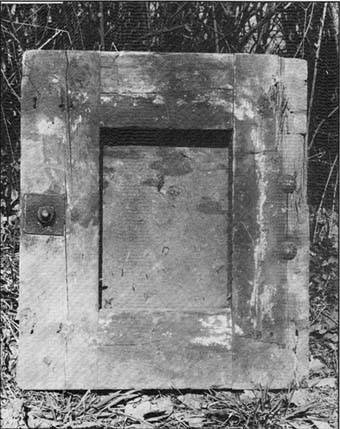
The report later records outward-opening Majdanek doors
The absolute door claim fails inside the report. In §3.17, Leuchter describes four steel doors at Majdanek with gasket rabbets and writes that they “open out.” That later observation directly contradicts “the doors all open inward.” It does not establish the function of any room.
The remaining claims also lack their required calculations. Nine square feet is an assumed floor allowance, and the report gives no packing or circulation model. Operator risk was real, but risk alone cannot establish impossibility without a release, exposure, ventilation, and protective-equipment analysis. American execution hardware supplies a comparison case rather than a governing wartime design code.
Within the report: This paragraph says every door opened inward. Section 3.17 says four steel chamber doors at Majdanek opened outward.
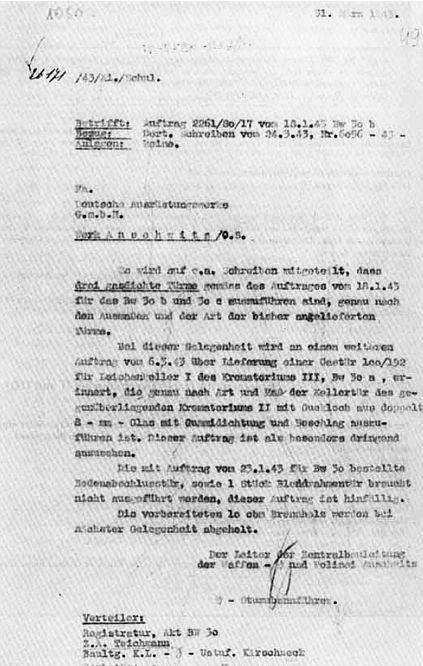
Sources: Leuchter §3.17: Majdanek doors
Report context 1 report item
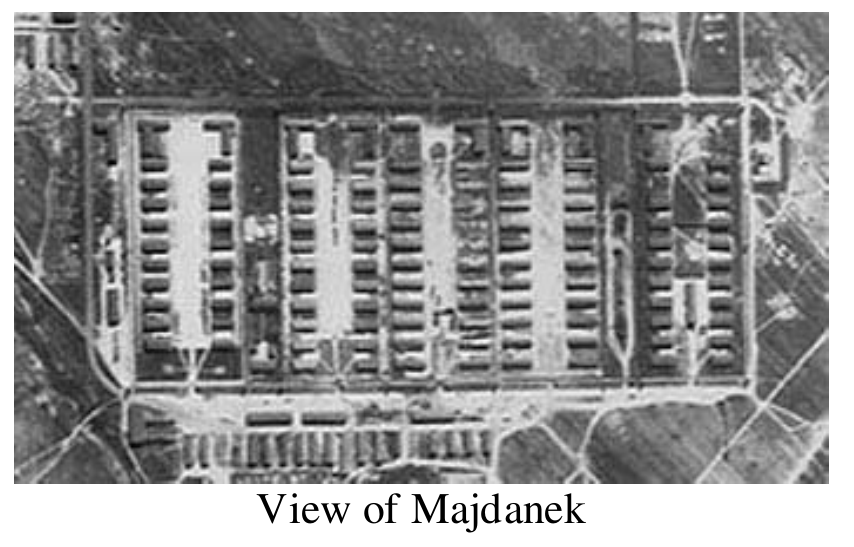
The facilities at Majdanek are likewise incapable of fulfilling the alleged purpose. First, there is a rebuilt crematory with an alleged gas chamber. The only portions of the building which existed prior to the rebuilding were the cremation ovens. Allegedly, the building was reconstructed from plans which do not exist. The facility is built in such a manner that gas could not have been contained within the alleged chamber, the chamber itself is too small to have accommodated the volume of victims attributed to it. The building is too damp and cold to utilize Zyklon B gas effectively. The gas would have reached the ovens, and after killing all the technicians, would have caused an explosion and destroyed the building. Further, the construction, poured concrete, is radically different from the other buildings at the facility. In short, the building could not be used for its alleged purpose and fails to follow even minimal gas chamber design.
Majdanek's crematorium and gas-chamber building are separate structures
The paragraph examines Majdanek's reconstructed crematorium and then generalizes to the whole camp. The State Museum identifies a separate concrete gas-chamber building near the men's bathhouse, built in 1942 and used with Zyklon B and carbon monoxide.
Irmscher's 1942 tests show that cold and moisture slowed HCN release from Zyklon carriers but did not stop it. Reconstructed concrete in one building cannot establish the function of the separate wartime bunker.
| Structure | Recorded location and phase |
|---|---|
| Gas-chamber building | Economic sector beside the bathhouses; operational September 1942 |
| First crematorium and morgue | Mid-field I; a separate structure |
| New crematorium criticized in this paragraph | Near field V; operational around the turn of 1943–44 |
The Museum's chronology and topography establish that these were different structures. The identification does not by itself prove the operating history of every chamber.
Sources: Majdanek Museum history · Majdanek Museum timeline · NIOSH emergency card · Irmscher, DEGESCH, 1942
The second facility at Majdanek is shown on maps to be a U-shaped building and is now, in reality, two separate buildings. This complex is designated Bath and Disinfection Building 1 and 2. One of the buildings is strictly a delousing facility and is designed as were the other accepted delousing facilities at Birkenau. The second building of the complex is somewhat different. The front portion of the building contains a shower room and an alleged gas chamber. The existence of blue stains in this room is consistent with the blue stains found in the Birkenau delousing facility. This room has two roof vents which were for venting the room after a delousing procedure. The Zyklon B would have been placed by hand on the floor. This chamber is clearly not an execution chamber. It has provision for air circulation but no stack for venting.
The accepted delousing room defeats the claimed universal HCN checklist
The accepted delousing room defeats Leuchter's universal checklist. He accepts Zyklon B use in a room that he says lacked his required tall exhaust stack. Leuchter describes visible blue staining there, and the Markiewicz study explains that such staining can contain stable cyanide reaction products. The study's controls and material tests are shown in the protocol comparison. Color alone does not measure dose, frequency, or purpose. The accepted use still disproves the claim that the missing stack made HCN use impossible.
Within the report: The report calls a tall stack necessary, then accepts Zyklon B delousing in a room it says had no stack.
Sources: Majdanek Museum history · Majdanek Museum timeline · NI-9912 fumigation rules · Markiewicz et al., 1994
Report context 1 passage
It, like the other facilities, is not designed for, or capable of being used as, an execution gas chamber. In the back of this building are the experimental gas chambers. This area includes a breezeway, control booth and two chambers allegedly used as gas chambers. A third room was sealed and not available for inspection. These chambers are unique in that both have piping for allegedly using carbon monoxide gas controlled from the booth. One of the chambers has a potential vent in the ceiling that was apparently never cut through the roof. The other chamber has a heating circulatory system for moving heated air into the chamber. This circulatory system is ineffectively designed and constructed with the intake and outlet too close together to function properly and has no provision for a vent. Remarkable about both chambers is what appears to be a rabbet or groove cut into the four (4) steel doors, which is consistent with the placement of a gasket. Purportedly, both chambers were used for Zyklon B or carbon monoxide. This cannot be true.
Of the two chambers, one was not completed and never could have been used for carbon monoxide. It is also not designed for HCN, even though it allegedly was utilized for this purpose. The larger chamber was not designed for HCN. Notwithstanding the sign at the door saying "experimental," this chamber would have been incapable of providing execution by CO because of the need to produce 4,000 ppm (the lethal concentration) at the required 2.5 atmospheres of pressure. Both chambers failed to meet the design requirements for venting, heating and circulating, and leakage. Nowhere were the bricks, stucco and mortar ever coated with a sealant, inside or out.
4,000 ppm specifies a 0.4% concentration
At 4,000 ppm, carbon monoxide makes up 0.4% of the mixture and can exist at ordinary atmospheric pressure. Its partial pressure is 0.004 atmosphere when total pressure is one atmosphere. The concentration-time table distinguishes that arithmetic from published toxicity benchmarks. No 2.5-atmosphere chamber is needed.
The same paragraph repeats the unsupported epoxy requirement. Incomplete features in one room cannot prove that neither room was used.
Sources: NIOSH: carbon monoxide · NRC acute CO review · NI-9912 fumigation rules · Majdanek Museum timeline

A most remarkable characteristic of this complex is that these chambers were surrounded on three sides by a depressed concrete walkway. This is totally inconsistent with intelligent gas handling design in that gas seepage would accumulate in this trench and, being sheltered from the wind, would not dissipate. This would make the entire area a death trap, especially with HCN.
No leak or dispersion calculation supports the trench claim
The report's relative-density figure does not by itself establish what concentration would accumulate in the walkway. Leuchter supplies no leak rate, source concentration, temperature, wind, geometry, or dispersion calculation. He therefore has no basis for calling the walkway an inevitable lethal reservoir.
Sources: Leuchter Table I · NIOSH emergency card

The author must therefore conclude that this facility was never intended for even the limited use of HCN gas.
The Majdanek verdict has no supporting measurement
The verdict adds no evidence. It depends on the preceding unmodeled trench plume and on treating American execution safeguards as universal. Neither premise supports a categorical engineering conclusion.
Sources: Majdanek Museum timeline · NIOSH: carbon monoxide · NIOSH emergency card · NI-9912 fumigation rules
Cremation and chemical analysis
3.13 Crematories
Report context 5 report items
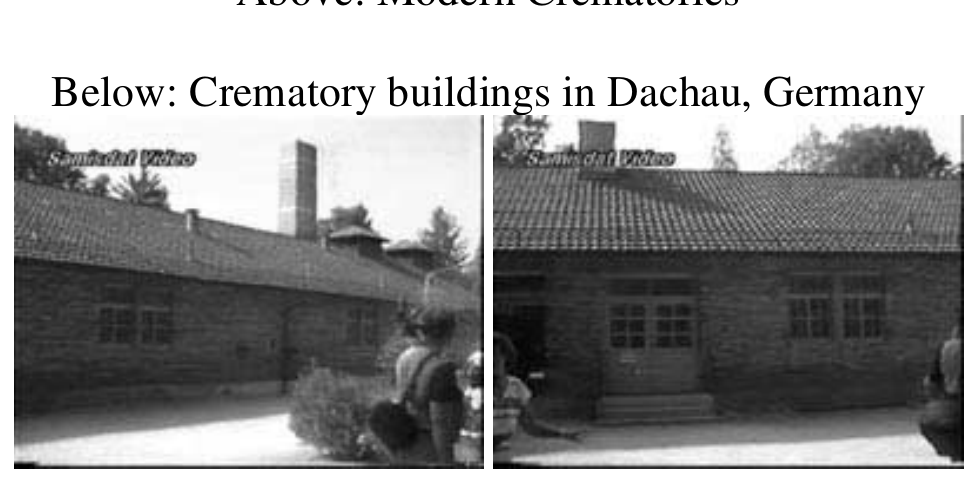

A consideration of crematories, both old and new, must be made to determine the functionability of the German Kremas at accomplishing their attributed tasks.

Cremation of the dead is not a new concept. It has been practiced by many cultures for many centuries. Although practiced several thousand years ago, it was frowned upon by the Catholic Church and not practiced recently until the Church relaxed its opposition in the later part of the 18th century.

Cremation was forbidden by Orthodox Judaism. By the early 1800's Europe was again practicing cremation on a limited basis. It becomes advantageous to control disease, free up much needed land in crowded areas and eliminate the need for storing corpses in winter when the ground is frozen. Europe's early crematories were coal or coke fired furnaces.
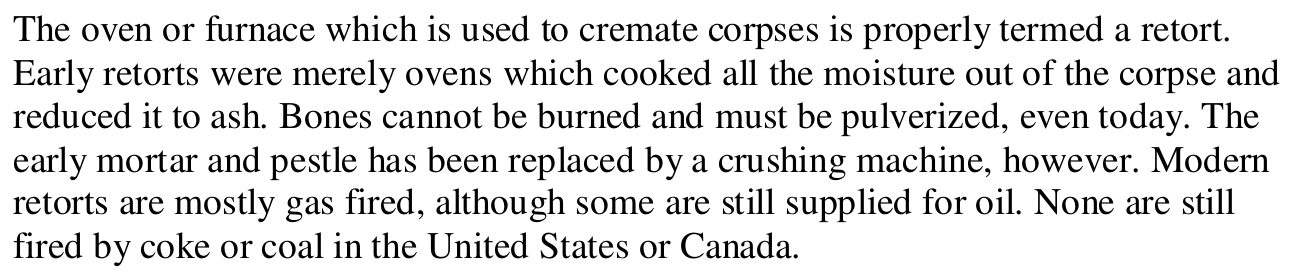
The oven or furnace which is used to cremate corpses is properly termed a retort. Early retorts were merely ovens which cooked all the moisture out of the corpse and reduced it to ash. Bones cannot be burned and must be pulverized, even today. The early mortar and pestle has been replaced by a crushing machine, however. Modern retorts are mostly gas fired, although some are still supplied for oil. None are still fired by coke or coal in the United States or Canada.
Cremation thermally alters and fragments bone
“Bones cannot be burned” confuses combustion of the body with the complete disappearance of mineral bone. Shipman, Foster, and Schoeninger's controlled heating study measured changes in bone color, microstructure, crystal structure, and shrinkage at temperatures up to 940°C. Innocenti and colleagues examined 100 human cadavers cremated at 600–1,200°C and documented color and morphological changes, including fire-related fractures.
Bone is thermally altered and fragmented rather than simply vanishing. That finding does not supply a cycle time or throughput figure for the camp furnaces.
| Study | Material and range | Observed or measured |
|---|---|---|
| Shipman, Foster, Schoeninger, 1984 | Sheep and goat bone and teeth, 20–940°C | Color, SEM morphology, crystal structure, shrinkage; five temperature-linked stages |
| Innocenti et al., 2024 | 100 human cadavers, 600–1,200°C | Cremation time, color, morphology, fractures, and surface change |
These studies test thermal alteration of bone. They leave mineral fragments and do not supply a Topf furnace cycle time or throughput.
Sources: Shipman et al., burned-bone experiment · Innocenti et al., human cremation study
Report context 2 passages
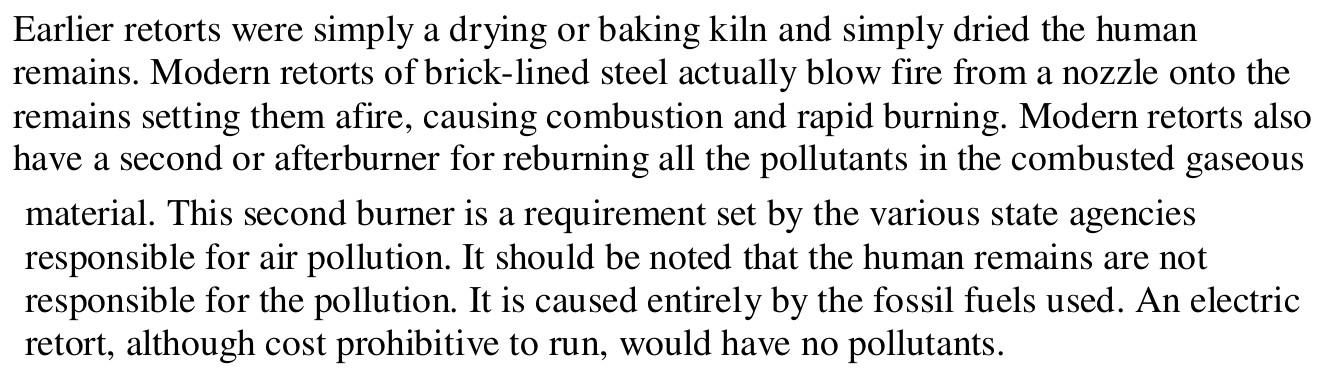
Earlier retorts were simply a drying or baking kiln and simply dried the human remains. Modern retorts of brick-lined steel actually blow fire from a nozzle onto the remains setting them afire, causing combustion and rapid burning. Modern retorts also have a second or afterburner for reburning all the pollutants in the combusted gaseous material. This second burner is a requirement set by the various state agencies responsible for air pollution. It should be noted that the human remains are not responsible for the pollution. It is caused entirely by the fossil fuels used. An electric retort, although cost prohibitive to run, would have no pollutants.
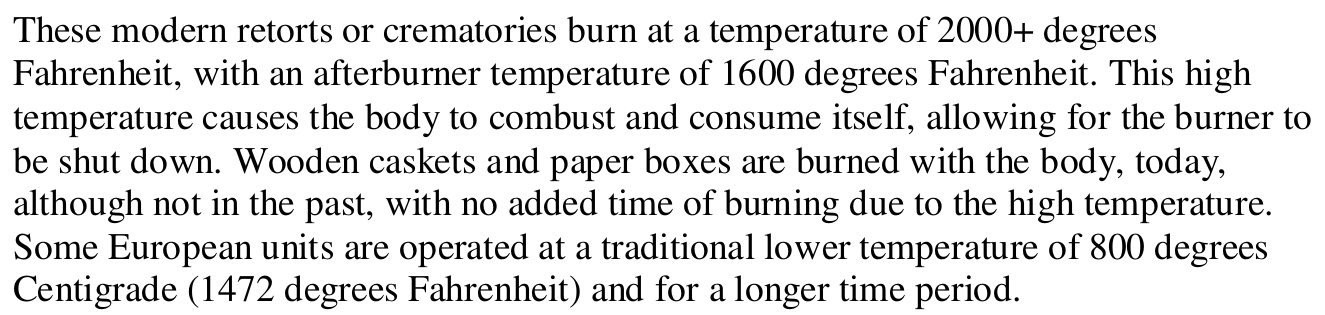
These modern retorts or crematories burn at a temperature of 2000+ degrees Fahrenheit, with an afterburner temperature of 1600 degrees Fahrenheit. This high temperature causes the body to combust and consume itself, allowing for the burner to be shut down. Wooden caskets and paper boxes are burned with the body, today, although not in the past, with no added time of burning due to the high temperature. Some European units are operated at a traditional lower temperature of 800 degrees Centigrade (1472 degrees Fahrenheit) and for a longer time period.
At 2000 degrees Fahrenheit or more with a 2500 cfm blowered air supply from the outside, modern retorts will cremate one corpse in 1.25 hours. Theoretically, this is 19.2 in a 24 hour time period. Factory recommendation for normal operation and sustained use allows for three (3) or less cremations per day. Older, oil, coal and coke furnaces with forced air (but no direct flame application) normally took 3.5 to 4 hours for each corpse.
Leuchter gives no basis for the claimed three-and-a-half-to-four-hour cycle
The arithmetic 24 ÷ 1.25 = 19.2 is correct, but it only extends a selected modern one-body cycle across 24 continuous hours. The report supplies no manufacturer source for its three-per-day recommendation or for the claimed three-and-a-half-to-four-hour older-furnace cycle. It gives no test showing that either figure is a physical maximum for the Topf multi-muffle installations.
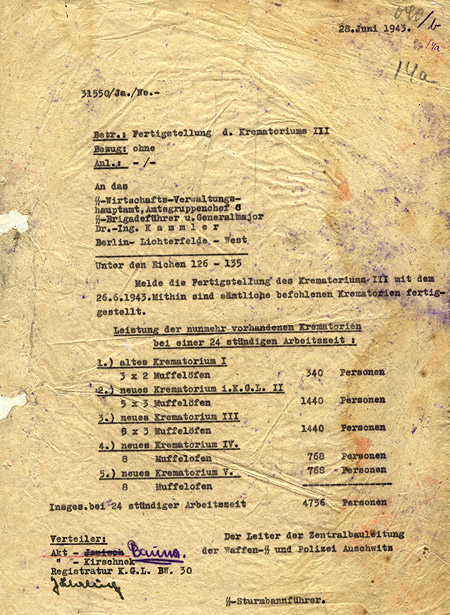
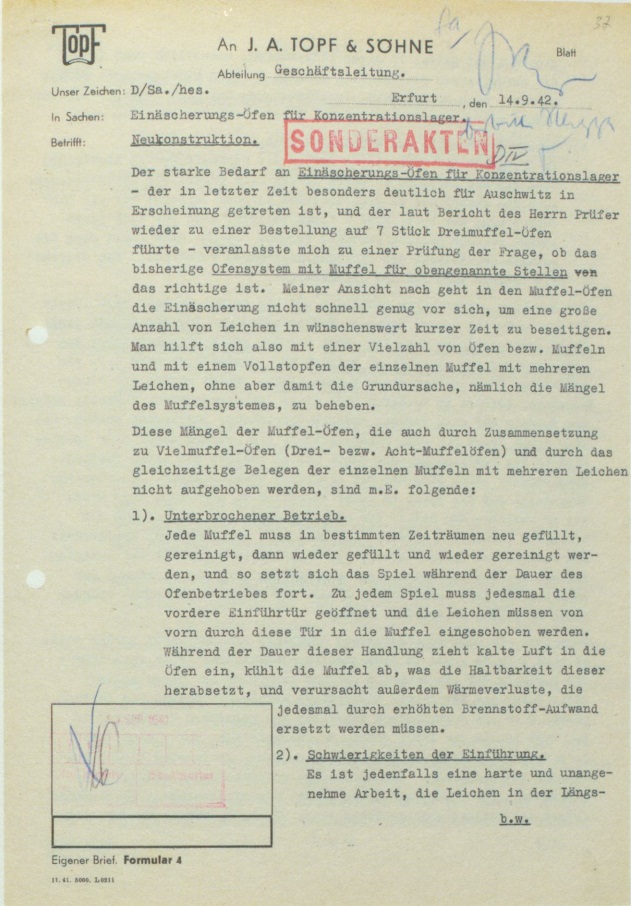
A September 1942 Topf memorandum describes individual muffles being loaded with several corpses. The June 28, 1943 construction-office letter gives nominal capacities far above Leuchter's figures. Their operative content and limits appear in the contemporary-record table. Neither record proves sustained output. Both are contemporary contrary evidence the report does not address.
Sources: June 28 capacity letter · Sander/Topf memorandum, Sept. 14, 1942
Theoretically, this could allow for 6.8 corpses in a 24 hour period at a maximum. Normal operation permits a maximum of three (3) cremations in a 24 hour time period. These computations are based on 1 corpse per retort per cremation. These modern retorts are of all steel construction and lined with high quality refractory brick. The fuel is pumped directly to the retort and all controls are electric and automatic. The coal and coke fired furnaces did not burn at an even temperature (approximately 1600 degrees Fahrenheit max.) and had to be constantly fed fuel by hand and dampered up and down. Since there was no direct application of flame to the corpse, the blower only fanned the flames and increased the temperature of the kiln. This crude mode of operation probably produced an average temperature of about 1400 degrees Fahrenheit.
The Sander memorandum reports multiple loading
The Sander memorandum contradicts Leuchter's one-body limit. Sander called the existing muffle system too slow and contemporaneously reported individual muffles being filled with several corpses. The memorandum is evidence of that practice, not a controlled throughput test.
A June 28, 1943 construction-office letter gives a nominal 4,416 corpses per 24 hours for Birkenau's four crematoria, or 4,756 including old Crematorium I at Auschwitz. Those ratings are not proof of sustained output. They confirm that the operating model was not Leuchter's civilian one-body cycle. The report supplies no furnace test or heat balance for its supposed ceiling.
| Record | Operative content | Limit |
|---|---|---|
| Sander memorandum, 14 September 1942 | “einzelnen Muffeln mit mehreren Leichen”: individual muffles with several corpses | No measured cycle time |
| Bischoff letter, 28 June 1943 | 4,416 per 24 h for Birkenau; 4,756 including Auschwitz I | Nominal ratings, not demonstrated sustained output |
The first record directly defeats one corpse per muffle as a physical ceiling. The second shows the construction office's nominal operating model. Neither record proves continuous achievement of the printed capacity.
Sources: June 28 capacity letter · Sander/Topf memorandum, Sept. 14, 1942
Report context 1 passage
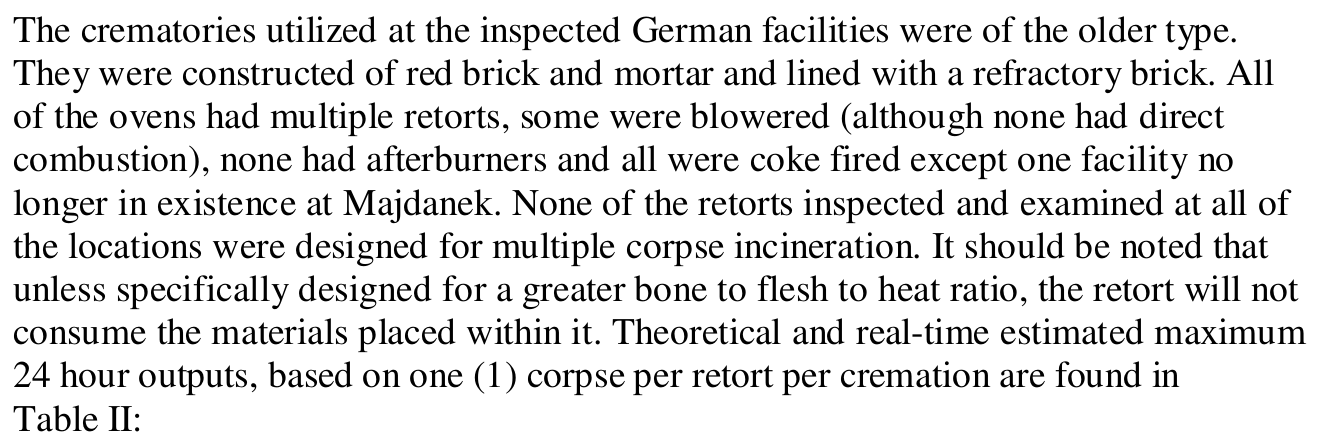
The crematories utilized at the inspected German facilities were of the older type. They were constructed of red brick and mortar and lined with a refractory brick. All of the ovens had multiple retorts, some were blowered (although none had direct combustion), none had afterburners and all were coke fired except one facility no longer in existence at Majdanek. None of the retorts inspected and examined at all of the locations were designed for multiple corpse incineration. It should be noted that unless specifically designed for a greater bone to flesh to heat ratio, the retort will not consume the materials placed within it. Theoretical and real-time estimated maximum 24 hour outputs, based on one (1) corpse per retort per cremation are found in Table II:
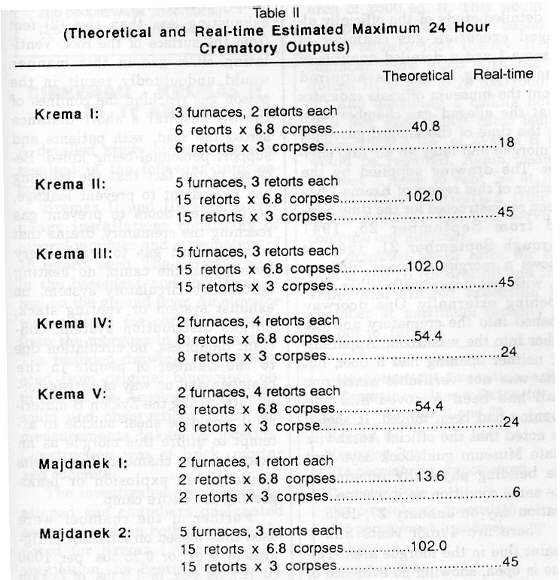
Table II conflicts with the five-muffle Majdanek identification
Table II prints fifteen retorts by multiplying five furnaces by three. Pressac identifies one Kori block with five muffles, and the linked July 1944 photograph shows five loading fronts. On that identification, the table triples both outputs printed for Majdanek 2 before the cycle-time assumptions are considered.
The visible sources establish a direct conflict between fifteen printed retorts and the five-muffle identification. A primary Kori inventory, plan, or manufacturer record would make the count independent of Pressac's synthesis.
The table is arithmetic rather than a furnace test. Its “theoretical” column applies a single-body cycle to every retort, and its “real-time” column imports a civilian three-per-day operating recommendation.
| Input | Count |
|---|---|
| Leuchter: five furnaces × three retorts | 15 retorts |
| Pressac's installation description | One block with five muffles |
| July 1944 photograph | Five loading fronts |
| Multiplier if the five-muffle identification is correct | 15 ÷ 5 = 3 |
The source table remains visible beside this check. The displayed record establishes the conflict. A primary Kori inventory, plan, or manufacturer record is still needed to make the five-muffle count independent of Pressac.
Sources: Pressac: Kori furnaces · Majdanek Museum: ovens
3.14 Forensic Considerations of HCN, Cyano-Compounds and Crematories
Report context 2 report items

As stated earlier, forensic samples of brick, mortar, concrete and sediment were selectively taken from sites in Poland. Cyanide and cyanide compounds may remain in a given location for long periods of time and if they do not react with other chemicals, may migrate around in brick and mortar.
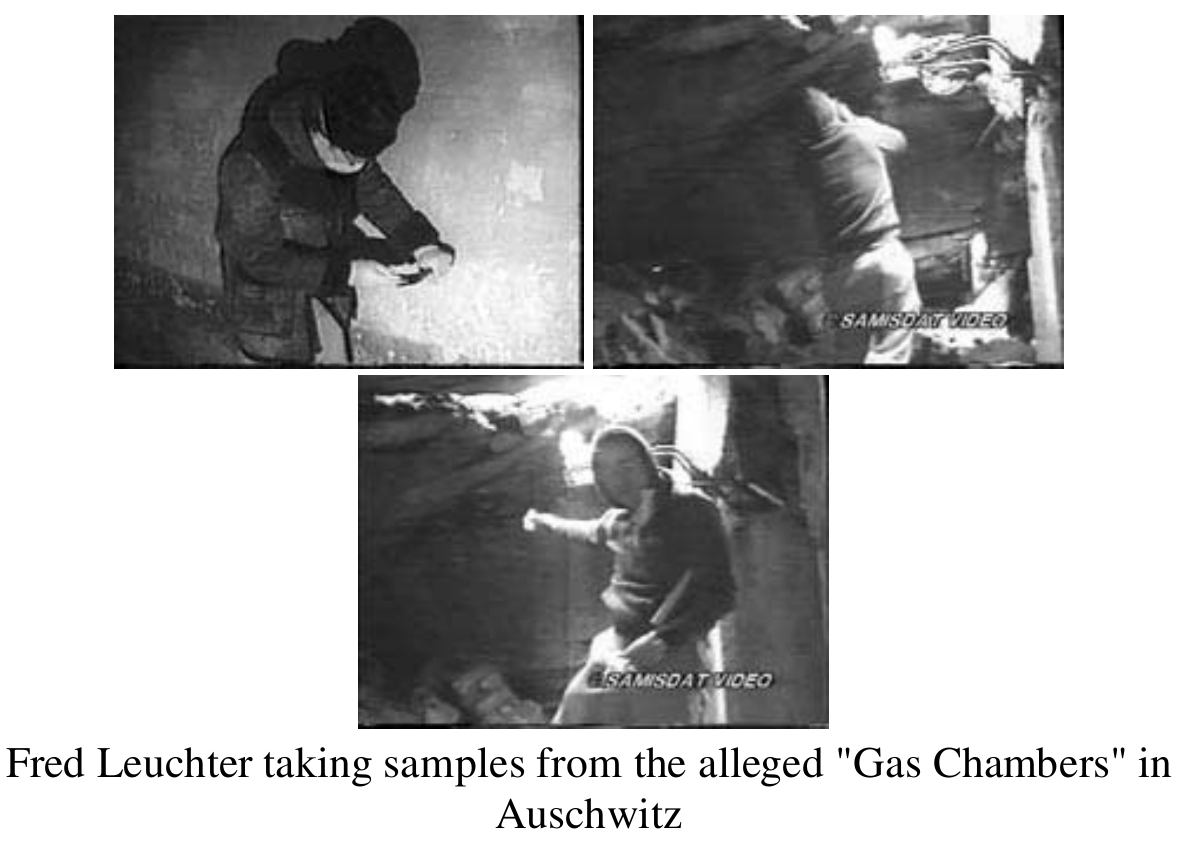
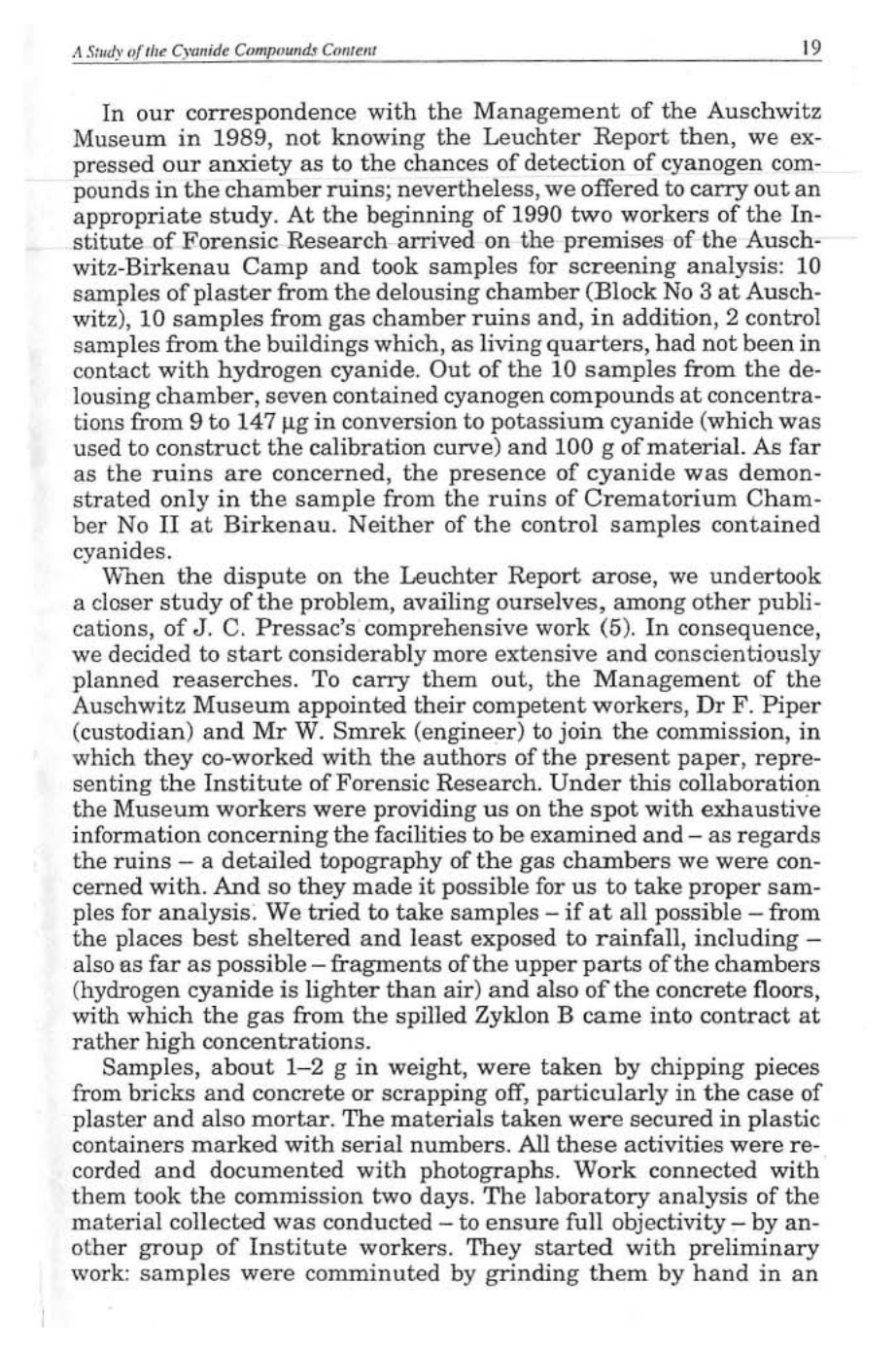
Thirty-one samples were selectively removed from the alleged gas chambers at Kremas I, II, III, IV and V. A control sample was taken from delousing facility #1 at Birkenau. The control sample was removed from a delousing chamber in a location where cyanide was known to have been used and was apparently present as blue staining. Chemical testing of the control sample #32 showed a cyanide content of 1050 mg/kg, a very heavy concentration. The conditions at areas from which these samples were taken are identical with those of the control sample, cold, dark and wet. Only Kremas IV and V differed, in the respect that these locations had sunlight (the buildings have been torn down) and sunlight may hasten the destruction of uncomplexed cyanide. The cyanide combines with the iron in the mortar and brick and becomes ferric-ferro-cyanide or prussian blue pigment, a very stable iron-cyanide complex.
Sample 32 was an unmatched positive comparator
Leuchter says sample 32 came from an indoor delousing room and was chosen where blue staining was visible. The questioned samples came largely from weathered outdoor ruins. Their substrates, exposure, sunlight, water, and preservation were not matched. It was neither a negative nor a site-matched control.
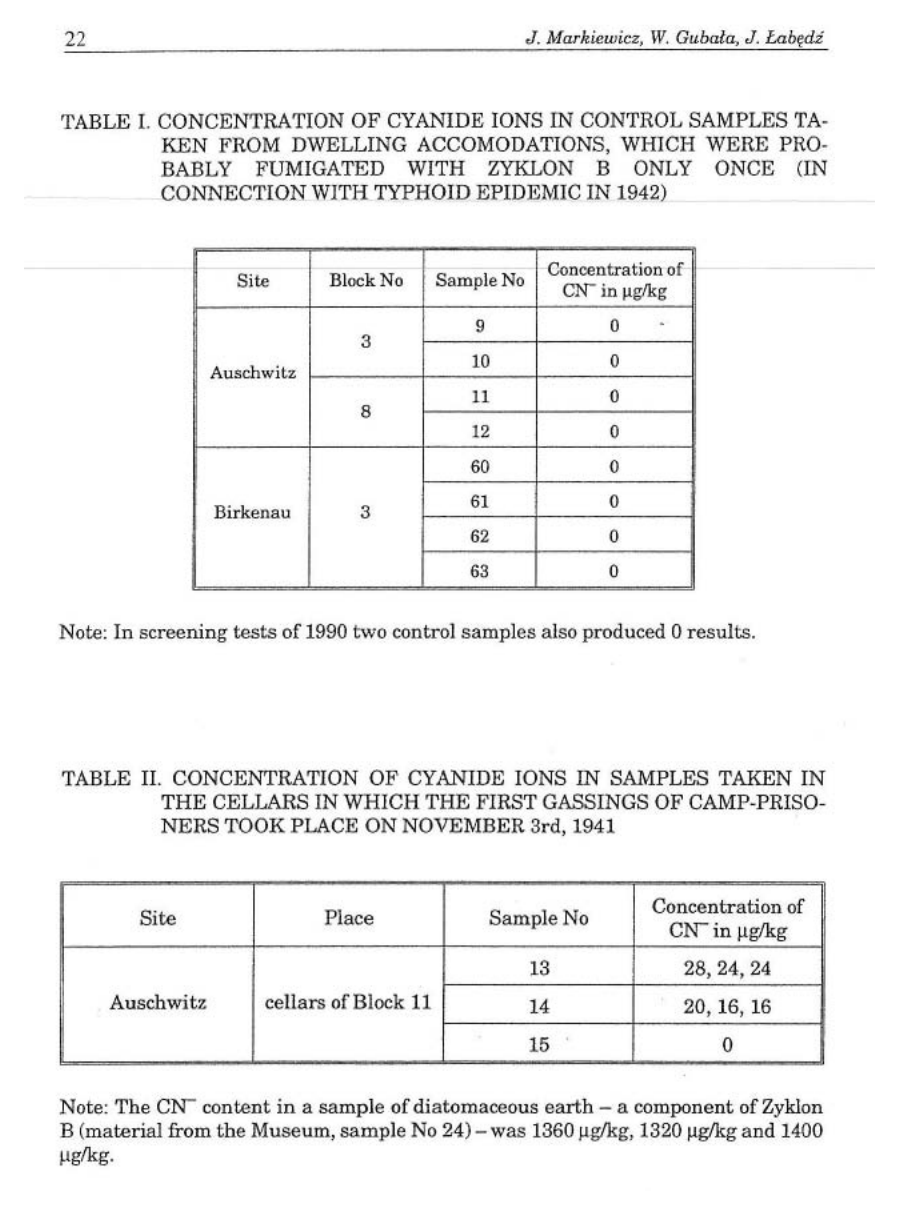
Calling those conditions “identical” is false. The report also records no consistent surface area, depth, or mass geometry, so pulverizing chunks of undocumented depth introduced unknown dilution. The 1994 Kraków study used documented sites, negative dwelling controls, small samples, replicate determinations, and a method chosen not to decompose the stable iron-blue complex. The side-by-side protocol and results table makes the differences inspectable.
Sources: Markiewicz et al., 1994 · Pressac: deficiencies in the Leuchter Report · James Roth: later account of the laboratory procedure
Report context 3 report items
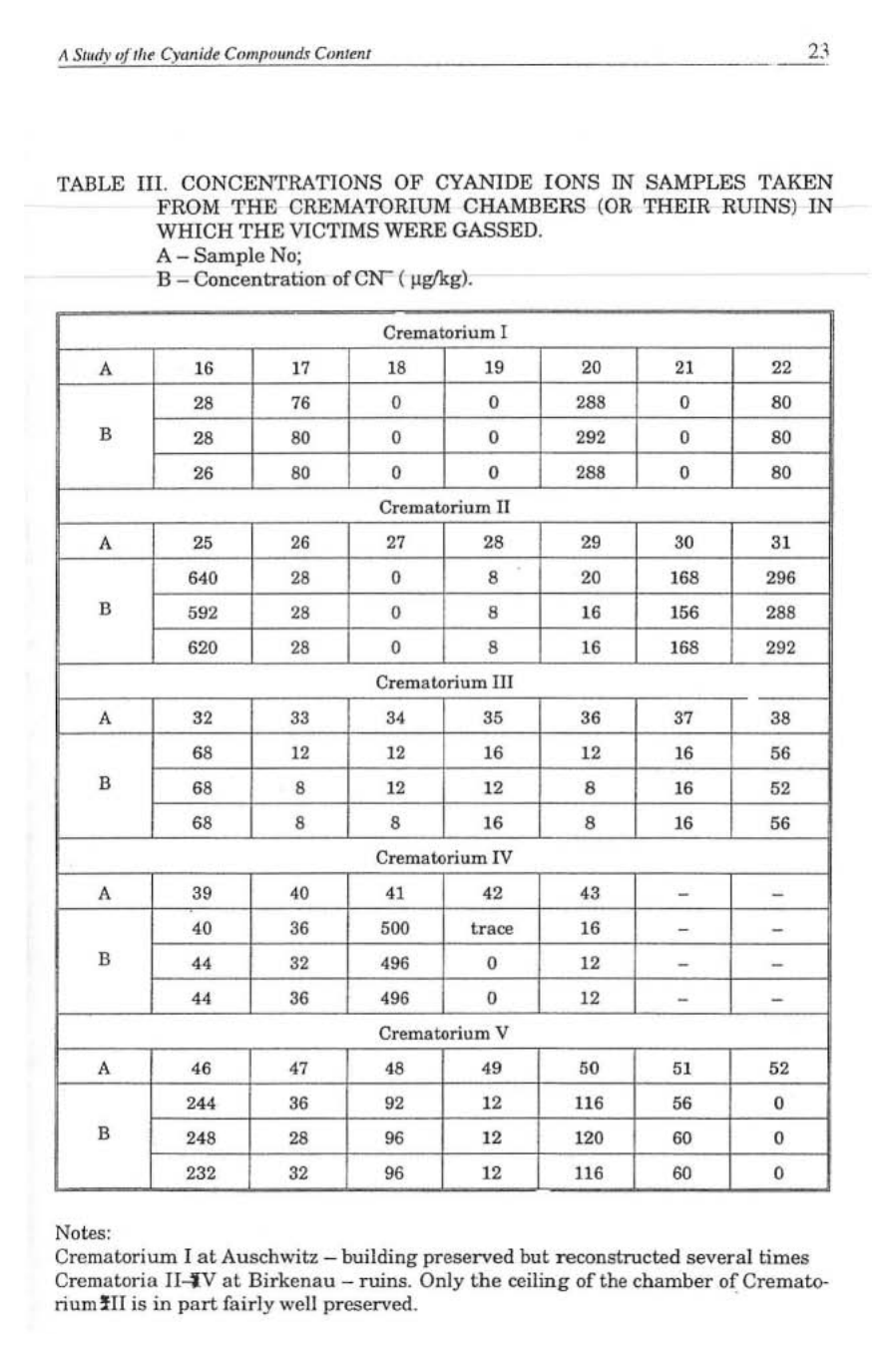
The locations from which the analyzed samples were removed are set out in Table III.
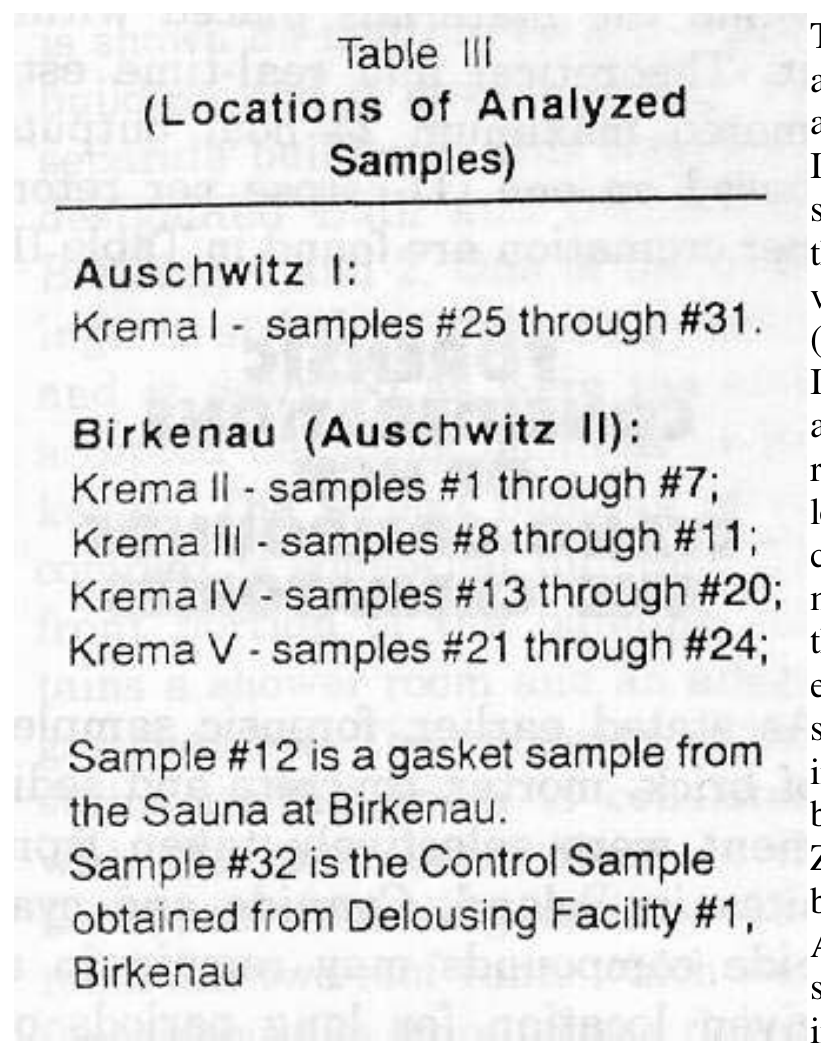
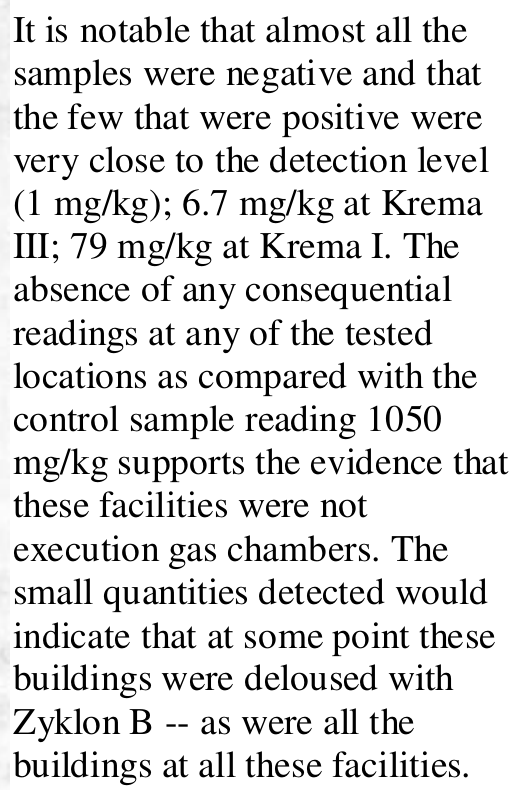
It is notable that almost all the samples were negative and that the few that were positive were very close to the detection level (1 mg/kg); 6.7 mg/kg at Krema III; 79 mg/kg at Krema I. The absence of any consequential readings at any of the tested locations as compared with the control sample reading 1050 mg/kg supports the evidence that these facilities were not execution gas chambers. The small quantities detected would indicate that at some point these buildings were deloused with Zyklon B as were all the buildings at all these facilities.

Additionally, the areas of blue staining show a high iron content, indicating ferric-ferro-cyanide, no longer hydrogen cyanide.
Iron blue can outlast free HCN because it is a reaction product
Free hydrogen cyanide is volatile. Decades-later masonry tests concern bound cyanide compounds, not free HCN. The report is right to distinguish those species.
It is not right to identify Iron Blue from total iron and visible color alone. Markiewicz and his colleagues found iron among the main elements in the masonry, but used a cyanide-specific method chosen not to break down the stable iron-cyanide complex. Their material and flushing experiments also found that retention varied sharply by material and moisture: the 48-hour material results ranged from zero to 2,700 µg/kg, and flushing removed 82.5% and 90.7% in two plaster tests. Those experiments do not date a stain. They show why visible blue, or its absence, cannot serve as a quantitative exposure test.
Sources: Markiewicz et al., 1994 · NIOSH: hydrogen cyanide

One would have expected higher cyanide detection in the samples taken from the alleged gas chambers (because of the greater amount of gas allegedly utilized there) than that found in the control sample. Since the contrary is true, one must conclude that these facilities were not execution gas chambers, when coupled with all the other evidence gained on inspection.
The laboratory values cannot support Leuchter's exposure comparison
Alpha Analytical reported laboratory measurements. The defect lies in Leuchter's historical comparison. The report records no chunk depth or surface-to-mass ratio, pulverizes pieces of undocumented geometry, uses one unmatched positive comparator, includes no unexposed negative controls, and compares different substrates and weather histories.
Those omissions prevent the reported concentrations from establishing what one wall should contain relative to another. The Markiewicz study answers a more controlled question with documented locations, dwelling negatives, triplicates, a stated determination limit, material tests, and water-flushing tests. Its field values still cannot reconstruct dose, frequency, or purpose.
| Design element | Leuchter and Alpha | Markiewicz et al., 1994 |
|---|---|---|
| Specimen geometry | Thumb- to fist-sized chunks; exposed face and depth unrecorded | 1–2 g pieces chipped or scraped from documented locations |
| Comparator design | One visibly blue positive comparator; no unexposed negative | Eight dwelling controls; all eight reported 0 |
| Replication and calibration | No replicate scheme or determination limit stated in the report | Standards in every series; triplicates; positives repeated; 3–4 µg/kg limit |
| Field results | Reported laboratory values, including 1,050 mg/kg for sample 32 | Both positive and zero triplicates appear in the field table |
| Material variability | No substrate or moisture experiment | 0–2,700 µg/kg after the same 48 h exposure across eight material states |
| Water exposure | Weather histories unmatched | Two plaster tests lost 82.5% and 90.7% after flushing |
Alpha's numbers remain laboratory measurements. The missing geometry and controls prevent Leuchter's historical comparison. The later study shows why preservation, substrate, and moisture matter; its own field concentrations do not reconstruct dose, frequency, or purpose.
Sources: Markiewicz et al., 1994 · James Roth: later account of the laboratory procedure
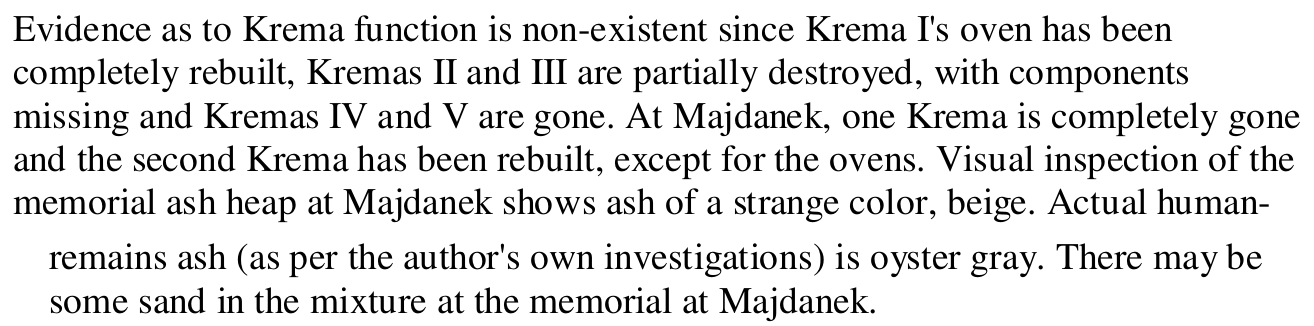
Evidence as to Krema function is non-existent since Krema I's oven has been completely rebuilt, Kremas II and III are partially destroyed, with components missing and Kremas IV and V are gone. At Majdanek, one Krema is completely gone and the second Krema has been rebuilt, except for the ovens. Visual inspection of the memorial ash heap at Majdanek shows ash of a strange color, beige. Actual human- remains ash (as per the author's own investigations) is oyster gray. There may be some sand in the mixture at the memorial at Majdanek.
Documents test the site claims; ash color has no forensic value
The displayed claim-to-record matrix contains the operative construction evidence: ventilation correspondence, a blower inventory, a gas-tight-door order, listed wire devices and covers, and gas-tester procurement whose target gas is unspecified in that item. Those records have narrow meanings, but “non-existent” excludes them altogether.
The Majdanek Museum states that material gathered in the mausoleum includes victims' ashes mixed with dirt and waste. That institutional provenance account is not a compositional test. Nor is Leuchter's visual beige-versus-gray comparison. Color alone cannot identify or exclude human remains.
Within the report: The report admits that components were missing or destroyed. Their absence in 1988 cannot show that they never existed.
Sources: Jan. 29, 1943 letter · Crematorium II blower inventory · Gas-tight door order · Wire-mesh device inventory · Gas-tester telegram · Majdanek Museum history
Report context 2 report items

Additionally, the author will discuss the alleged burning (cremation) pits in this section.
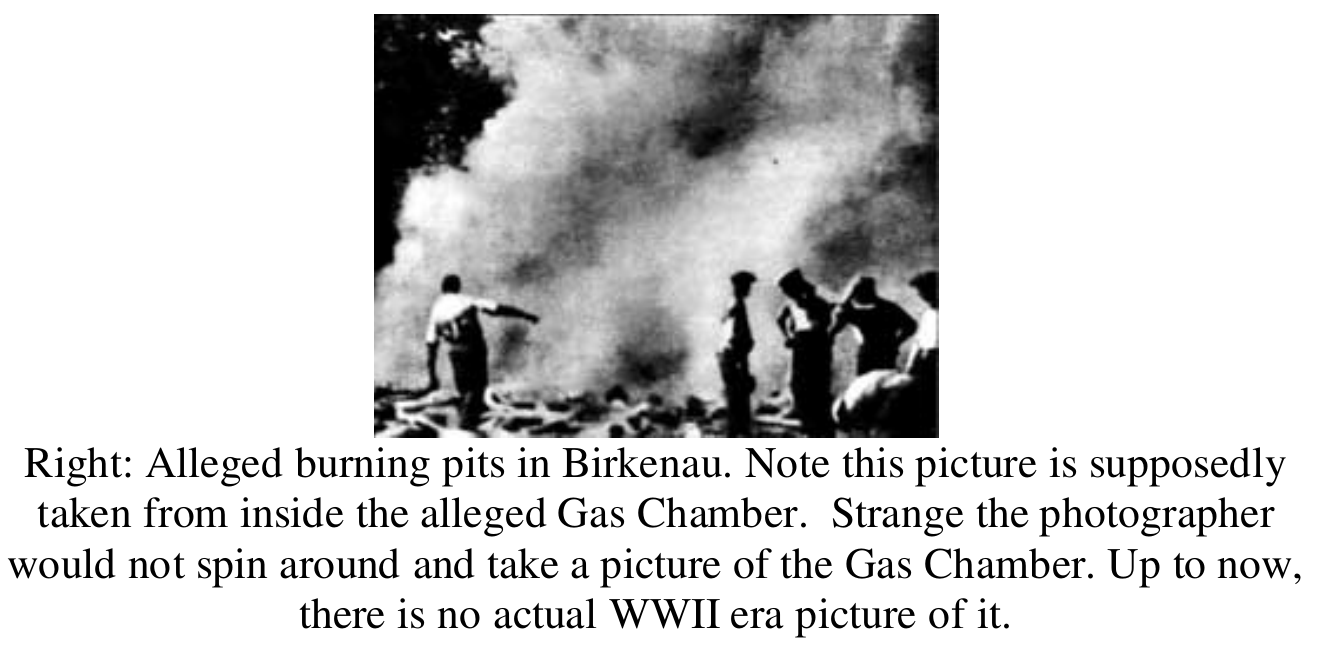
The author personally inspected and photographed the burning pits at Birkenau. Most remarkable about those pits is a high water table perhaps as high as 1.5 feet from the surface. The historical description of these pits is that they were 6 meters (19.55 feet) deep. It is not possible to burn corpses under water, even with the use of an artificial accelerant (gasoline). All pit locations officially designated on museum maps were inspected and as anticipated, since Birkenau was constructed on a swamp, all locations had water within 2 feet of the surface. It is the opinion of this author that no burning pits existed at Birkenau.
Wartime photographs document open-air burning near Crematorium V
The Auschwitz Museum identifies a smoke column and cremation-pit area beside Crematorium V in an August 1944 Allied aerial photograph. A clandestine Sonderkommando photograph independently shows open-air burning behind the same crematorium.
The Museum also reproduces a March 1943 drainage plan extending to the burning area. The photographs are primary images; the precise feature labels are the Museum's documented interpretation. They establish open-air burning and evidence for the identified area, while supplying no exact pit depth. A water level observed in 1988 cannot support the categorical claim that no pits existed in 1944.
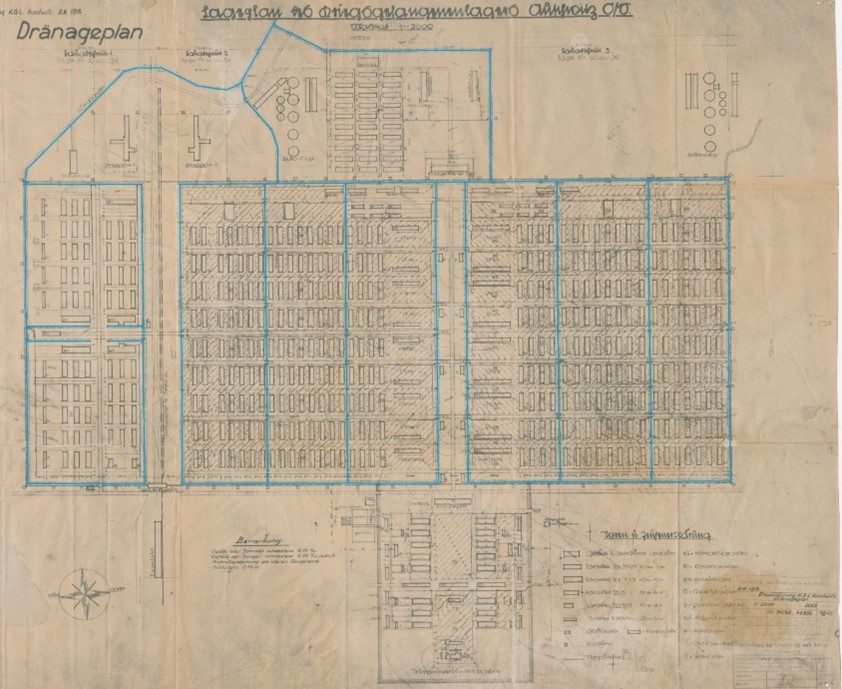
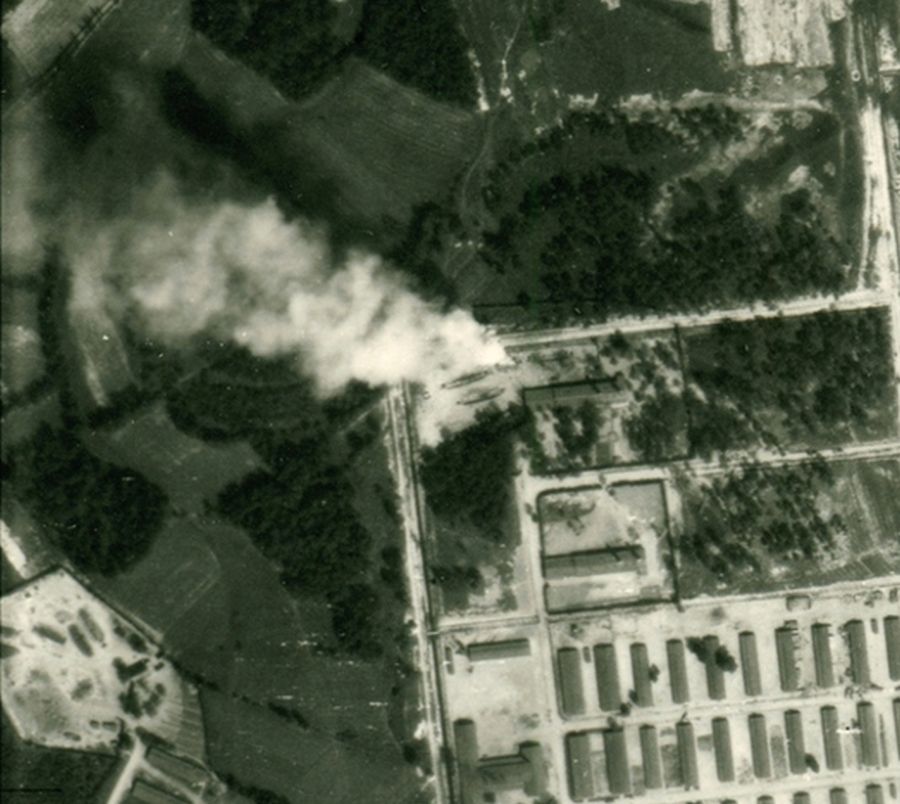
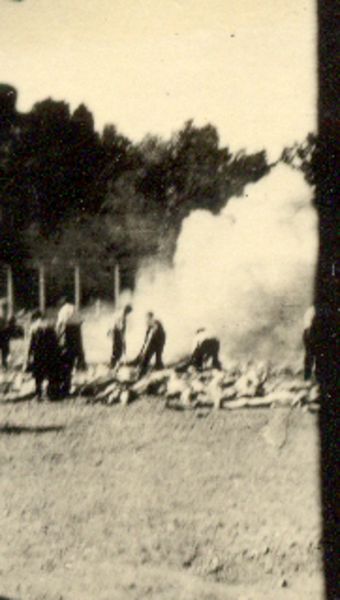
Sources: Auschwitz Museum: groundwater · Auschwitz Museum: gas chambers
Auschwitz, Birkenau, and Majdanek
3.15 Auschwitz, Krema I
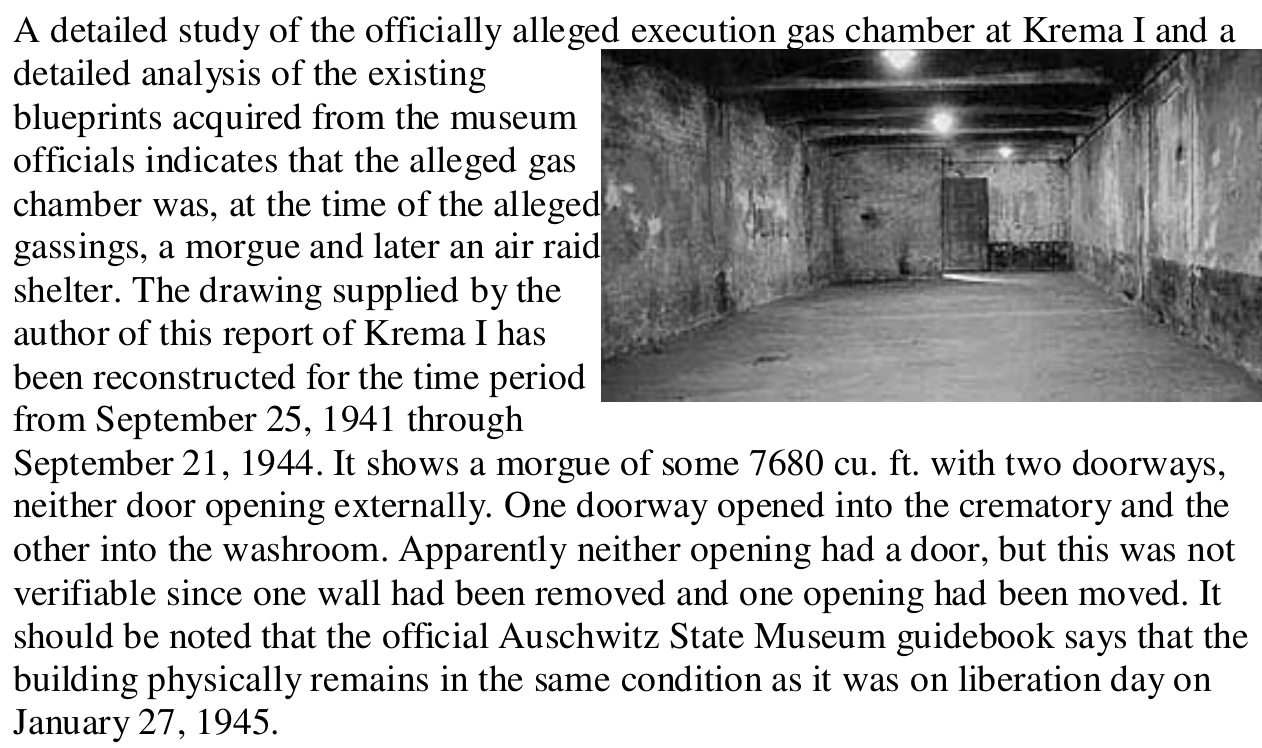
A detailed study of the officially alleged execution gas chamber at Krema I and a detailed analysis of the existing blueprints acquired from the museum officials indicates that the alleged gas chamber was, at the time of the alleged gassings, a morgue and later an air raid shelter. The drawing supplied by the author of this report of Krema I has been reconstructed for the time period from September 25, 1941 through September 21, 1944. It shows a morgue of some 7680 cu. ft. with two doorways, neither door opening externally. One doorway opened into the crematory and the other into the washroom. Apparently neither opening had a door, but this was not verifiable since one wall had been removed and one opening had been moved. It should be noted that the official Auschwitz State Museum guidebook says that the building physically remains in the same condition as it was on liberation day on January 27, 1945.
Crematorium I survives as a composite of several physical phases
The Auschwitz Museum and Pressac reconstruct several phases of Crematorium I: mortuary, provisional gas chamber, and 1944 air-raid shelter. They also document postwar removal of shelter partitions, reconstruction of the furnaces and chimney, reopening of roof holes, and inclusion of the former corpse-washing room in the displayed chamber. Pressac's plan gives about 94 m² for the present room and 78.2 m² for the original mortuary.
Those are historical reconstructions from plans, photographs, surviving fabric, and records; they are not facts read directly from the 1988 room. They show why the exhibit's present dimensions cannot be projected backward and why the old guidebook's unchanged-room implication was wrong.
| Date or phase | Physical record |
|---|---|
| 1941 | Plan shows the furnaces, underfloor fire channel, and chimney |
| 1944 air-raid-shelter conversion | Furnaces and chimney dismantled; room divided into new chambers |
| Second half of 1947 | Furnaces reassembled from surviving parts; chimney rebuilt from foundations |
| Pressac room-plan comparison | Original mortuary 78.2 m²; displayed room about 94 m² |
The plans and reconstruction record make the 1988 room a composite historical exhibit. Present dimensions and fittings cannot be carried back to every wartime phase without a phase-specific argument.
Sources: Auschwitz Museum: Krema I · Auschwitz Museum: gas chambers · Auschwitz Museum: Crematorium I phase plans · Pressac: Crematorium I plans · Pressac: deficiencies in the Leuchter Report
Report context 2 report items
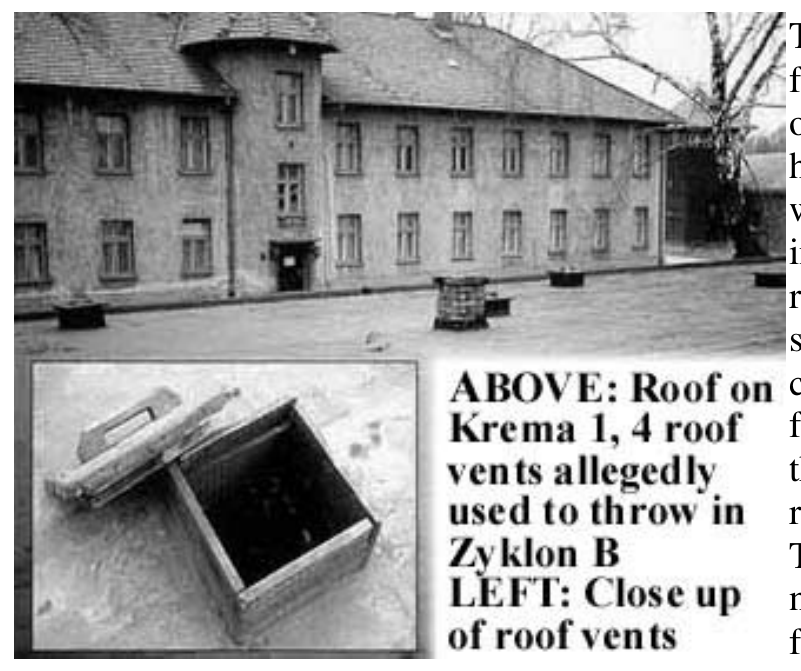
There are 4 roof vents and 1 heater flue in the morgue area. The flue is open, showing no evidence of ever having been closed. The roof vents were not gasketed and new wood indicated they had recently been rebuilt. The walls and ceiling are stucco and the floor is poured concrete. The floor area is 844 sq. ft. The ceiling is beamed and on the floor one can see where the air raid shelter walls were removed. The lighting was not, and is not now, explosion-proof. There are floor drains in the floor of the chamber which connect into the main camp drain and sewer system. Assuming a 9 sq. ft. area per person to allow for gas circulation, which is nevertheless very tight, a maximum of 94 people could fit into this room at one time. It has been reported that this room could hold up to 600 persons.
The stated 94-person maximum comes from an admitted assumption
Leuchter calls the observed stack a heater flue. Pressac's 1989 plan labels it more cautiously as presumed ventilation from the 1944 air-raid-shelter conversion. The Museum's 1944 phase plan documents that shelter conversion. The stack therefore cannot be assigned to the earlier provisional gas-chamber phase without phase-specific evidence.
Leuchter labels nine square feet per person an assumption and then reports 94 people as the room's maximum. He gives no packing test or gas-circulation calculation showing that nine square feet was required. The 94-person ceiling is his input, not a measured limit.
Sources: Auschwitz Museum: Krema I · Auschwitz Museum: Crematorium I phase plans · Pressac: Crematorium I plans

The alleged execution gas chamber is, as stated earlier, not designed to be used in such a manner. There is no evidence of an exhaust system or fan of any type in this structure. The venting system for the alleged gas chamber consisted simply of four (4) square roof vents exhausting less than two (2) feet from the surface of the roof.
No air-change calculation supports the impossibility claim
No Topf forced-air plant is documented for the provisional Crematorium I chamber. Leuchter therefore had to show that natural airing through the doors and roof apertures could not clear the room. He supplies no air-change measurement or calculation for that impossibility claim.
Sources: Auschwitz Museum: Krema I · Auschwitz Museum: gas chambers · NI-9912 fumigation rules
Ventilating HCN gas in this manner would undoubtedly result in the poison gas reaching the confines of the SS hospital a short distance across the road, with patients and support personnel being killed. Because of the fact that the building has no sealant to prevent leakage, no gasketed doors to prevent gas reaching the crematory, drains that would permit gas to reach every building in the camp, no heating system, no circulatory system, no exhaust system or venting stack, no gas distribution system, constant dampness, no circulation due to the number of people in the chamber, and no way of satisfactorily introducing the Zyklon B material, it would be sheer suicide to attempt to utilize this morgue as an execution gas chamber. The results would be an explosion, or leaks gassing the entire camp.
No calculation supports the hospital or camp-wide poisoning claim
A nearby hospital made leakage a real hazard. Leuchter nevertheless gives no source quantity, leak rate, path, wind, or dilution calculation for the claim that the hospital or “entire camp” would be poisoned. Drains alone do not establish a continuous camp-wide gas path.
The report also contradicts its explosion claim. Appendix III gives 75 g/m³ as the explosion threshold and says the normal 8–10 g/m³ application was not explosive. The paragraph supplies no local release, mixing, or ignition calculation that would place a flammable pocket at the crematory.
Sources: Auschwitz Museum: Krema I · NI-9912 fumigation rules
Further, if the chamber were used thus, (based on DEGESCH figures of 4 oz. or 0.25 lbs. per 100 cu. ft.), 30.4 oz. or 1.9 lbs. of Zyklon B gas (gross weight of Zyklon B is three times that of Zyklon B gas; all figures are for Zyklon b gas only) would be used each time for 16 hours at 41 degrees Fahrenheit (based on German government fumigation figures). Ventilation must take at least 20 hours and tests must be made to determine if the chamber is safe. It is doubtful whether the gas would clear in a week without an exhaust system. This clearly is contradictory of the chamber's alleged usage of several gassings per day.
The printed dose is wrong by a factor of ten
At 0.25 pounds per 100 cubic feet, a 7,680-cubic-foot room requires 19.2 pounds, not 1.9. The 1.9-pound result uses 0.25 pounds per 1,000 cubic feet, the rate printed later for Crematoria II and III.
The sixteen-hour exposure and long airing schedule also come from cold-weather building fumigation for insects. They are not minimum times for killing humans. The report provides no air-change calculation for the claim that an empty room would remain unsafe for a week.
| Printed input | Arithmetic |
|---|---|
| Room volume | 7,680 ft³ |
| Rate printed in this paragraph | 0.25 lb per 100 ft³ |
| Number of 100 ft³ units | 7,680 ÷ 100 = 76.8 |
| Required mass at the printed rate | 76.8 × 0.25 = 19.2 lb |
| Report's result | 1.9 lb |
The reported 1.9-pound result follows only if the denominator is changed to 1,000 cubic feet. This checks the report's arithmetic; it does not reconstruct an actual dose or exposure.
Within the report: The printed rate produces 19.2 pounds. The report prints 1.9 pounds, the result for the different rate used later.
Sources: NI-9912 fumigation rules · NIOSH: hydrogen cyanide · Auschwitz Museum: Krema I
Report context 2 report items

Computed theoretical and real-time usage rates of Krema I and alleged execution gas chamber at maximum capacity are set out in Table IV.
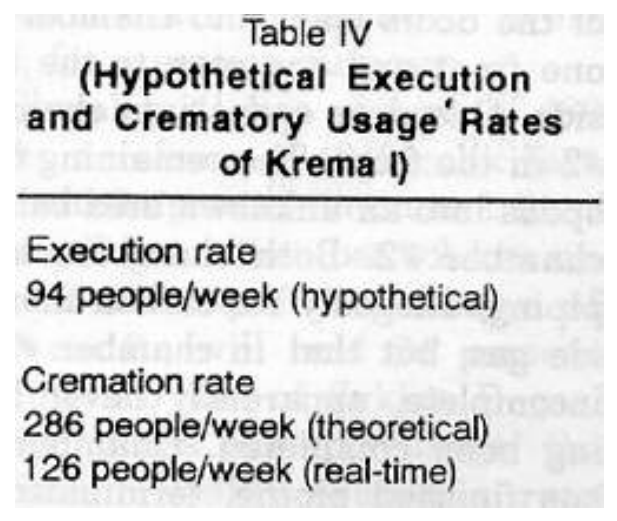
3.16 Birkenau: Kremas II, III, IV and V
Report context 4 report items
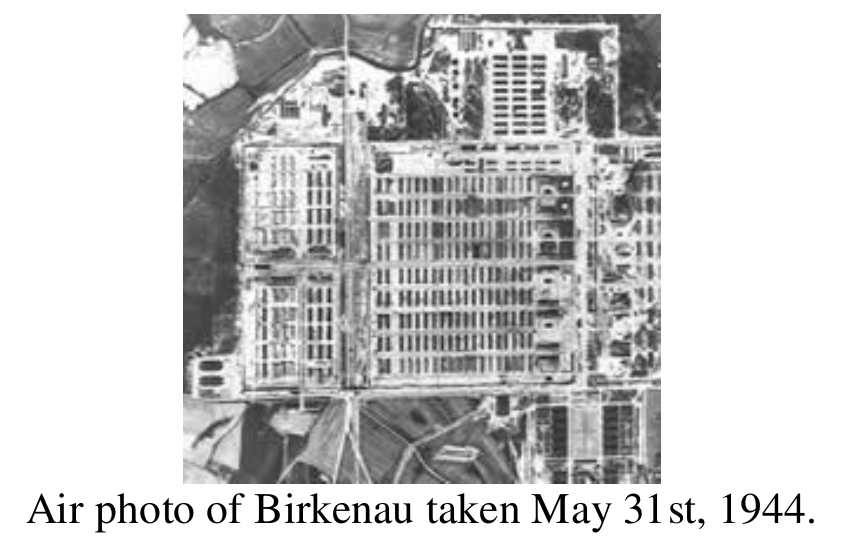

A detailed study of these Kremas resulted in the following information.
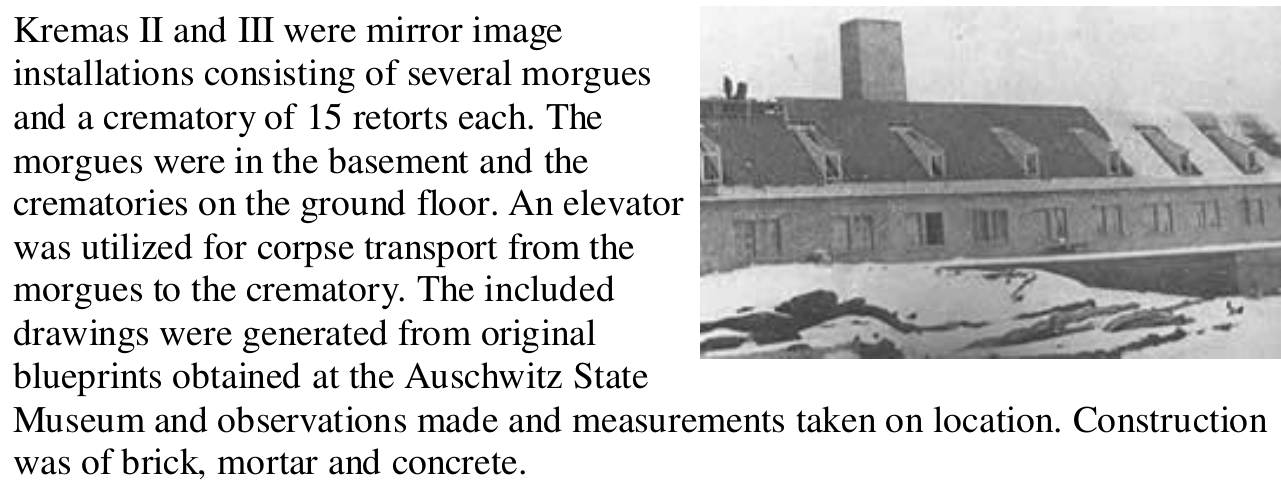
Kremas II and III were mirror image installations consisting of several morgues and a crematory of 15 retorts each. The morgues were in the basement and the crematories on the ground floor. An elevator was utilized for corpse transport from the morgues to the crematory. The included drawings were generated from original blueprints obtained at the Auschwitz State Museum and observations made and measurements taken on location. Construction was of brick, mortar and concrete.
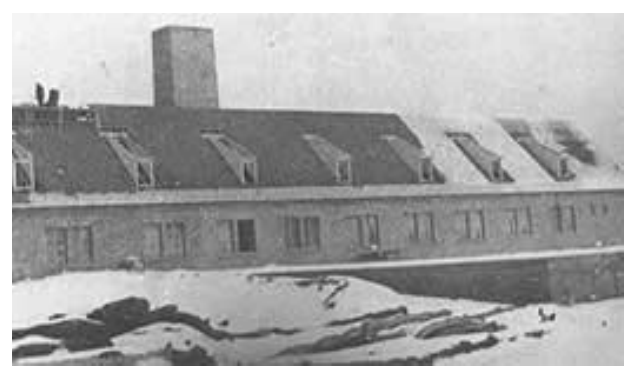
The investigated areas were the alleged gas chambers designated as morgue #1 on both drawings. As noted for Krema I, there was no ventilation, no heating system, no circulation system, no sealant inside or out and further, no doors on the morgues in Krema II. The area has been examined by the author and no evidence of doors or door frames has been found. This investigator could not make this determination for Krema III since portions of the structure are missing. Both structures had roofs of reinforced concrete without any apparent openings. Further, reports of hollow gas- carrying columns are not true. All the columns are solid, reinforced concrete exactly as indicated in the captured German plans. The roof vents are not gasketed. These facilities would be very dangerous if used as gas chambers and this use would probably result in the death of the users and an explosion when the gas reached the crematory. Each facility had a corpse elevator of 2.1 meters x 1.35 meters. Clearly, this elevator was large enough for only one (1) body and an attendant.
Ventilation, insertion devices, and a gas-tight-door order are documented
The displayed records answer several categorical negatives, each within a narrow limit. A January 1943 letter uses Vergasungskeller and says the supply and exhaust plant awaited installation. A building inventory lists electric-motor blowers. A March door order specifies one gas-tight door for Leichenkeller 1 in Crematorium III. A handover attachment lists four wire-mesh insertion devices and four wooden covers. A telegram orders ten gas testers while leaving the target gas unspecified.
These items do not by themselves establish a final room connection, air-change rate, the use of each wire device, or the full operating history. They do show that the construction file contains relevant mechanical equipment, a gas-tight-door order, and specialized listed items that the report's blanket negatives do not address.
Pressac reproduces a February 15, 1943 provisional goods-lift order specifying a minimum 300-kg payload for Crematoria II and III. That order establishes a payload specification, while supplying no trip contents or operating count. Missing fittings in a damaged ruin cannot date their absence. The explosion claim supplies no local concentration, mixing, or ignition calculation; the relevant flammability arithmetic appears earlier.
| Record | Operative content | Narrow conclusion |
|---|---|---|
| 29 January 1943 letter | Uses “Vergasungskeller”; says supply and exhaust plant awaited installation | Terminology and planned installation; no final air-change rate |
| Crematorium II equipment inventory | Lists blowers with 1.5, 3.5, and 4.5 hp electric motors | Building-level mechanical equipment; room connection not shown here |
| 31 March 1943 door order | One gas-tight door, 100 × 192 cm, for Leichenkeller 1 in Crematorium III | A specific order; later installation details require other records |
| Crematorium II handover attachment | Four wire-mesh insertion devices and four wooden covers | Items listed; precise use requires the surrounding record |
| 26 February 1943 telegram | Immediate dispatch of ten gas testers | Procurement shown; target gas unspecified in this item |
| 15 February 1943 provisional goods-lift order | Minimum payload of 300 kg for Crematoria II and III | Record reproduced by Pressac; no trip contents or operating count |
The records defeat categorical claims that the file contained none of the relevant equipment or terminology. They do not independently prove a room's complete installation, air-change rate, or operating history.
Within the report: The paragraph says the roof had no apparent openings, then refers to ungasketed roof vents.
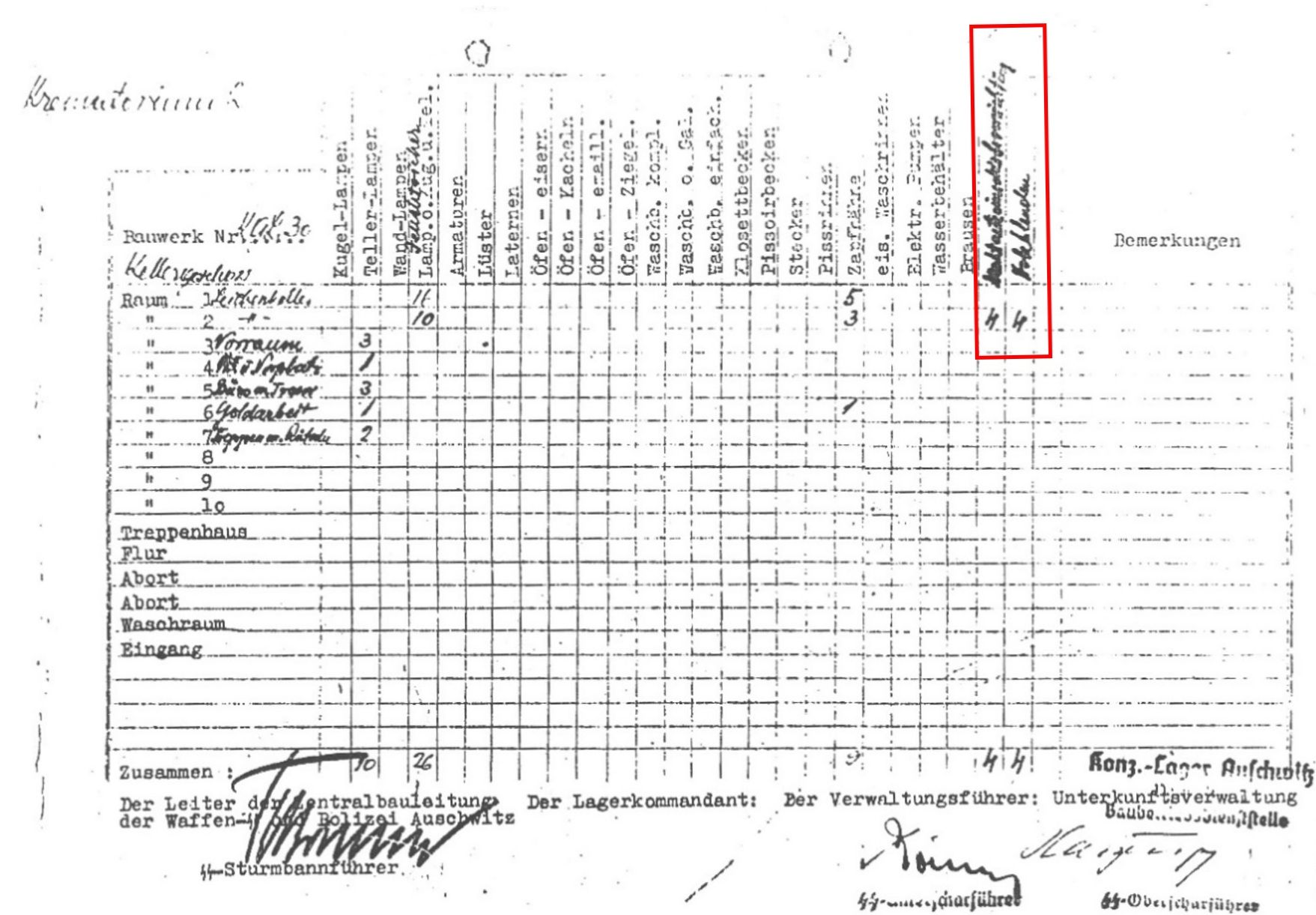
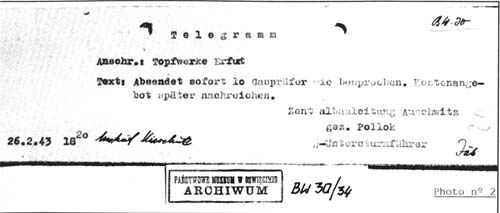
Sources: Crematorium II blower inventory · Gas-tight door order · Gas-tester telegram · Jan. 29, 1943 letter · Wire-mesh device inventory · Auschwitz Museum: openings · NIOSH: hydrogen cyanide · Crematorium II lift order, Feb. 1943
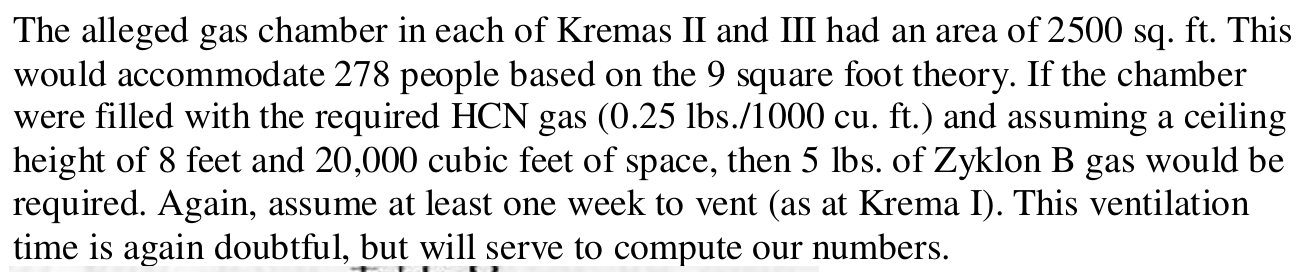
The alleged gas chamber in each of Kremas II and III had an area of 2500 sq. ft. This would accommodate 278 people based on the 9 square foot theory. If the chamber were filled with the required HCN gas (0.25 lbs./1000 cu. ft.) and assuming a ceiling height of 8 feet and 20,000 cubic feet of space, then 5 lbs. of Zyklon B gas would be required. Again, assume at least one week to vent (as at Krema I). This ventilation time is again doubtful, but will serve to compute our numbers.
The 278-person ceiling and one-week turnaround are unsupported inputs
Even accepting the report's 2,500-square-foot input, its 278-person ceiling is simply 2,500 ÷ 9 = 277.8. The divisor is the report's unsupported nine-square-foot allowance, equivalent to about 0.84 m² per person. No diffusion, circulation, or occupancy calculation makes that a physical minimum. The derivation is exposed in the input table.
The one-week turnaround carries an insect-fumigation schedule into a different enclosure while the construction records document mechanical equipment. Those records supply no room-specific air-change rate. A precise clearance time and weekly maximum therefore remain uncalculated.
| Printed or documented input | Calculation or record | Limit |
|---|---|---|
| 2,500 ft² and nine ft² per person | 2,500 ÷ 9 = 277.8 people | Nine ft² is assumed; no gas-circulation model is supplied |
| Nine ft² per person | 9 × 0.092903 = 0.836 m² per person | A unit conversion does not validate the allowance |
| One cycle per week | No room-specific air-change calculation | An insect-fumigation schedule cannot supply the missing rate |
| Construction records | Ventilation plant discussed; electric-motor blowers listed | Mechanical equipment shown; final room connection and rate remain unstated |
This table accepts the report's 2,500-square-foot figure for the purpose of tracing its own result. The arithmetic produces 278 only after the unsupported occupancy allowance is adopted.
Sources: Auschwitz Museum: Leuchter · Crematorium II blower inventory · NI-9912 fumigation rules
Report context 2 report items
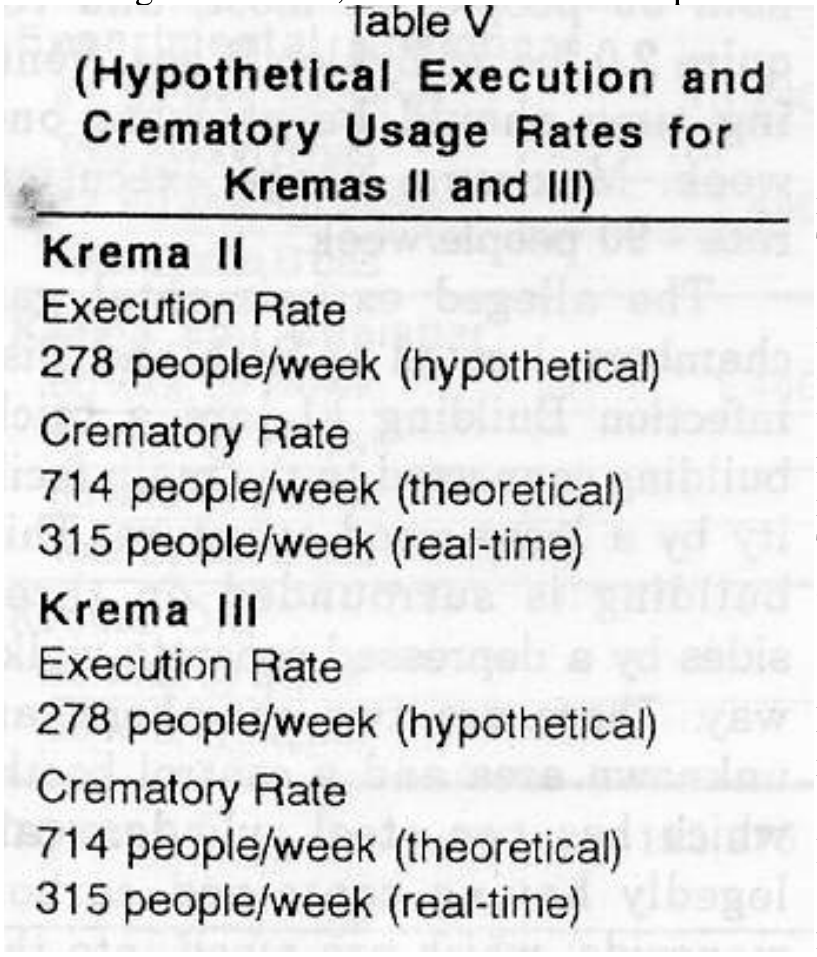
Computed usage rates for Kremas II and III (theoretical and real-time) and alleged execution gas chamber at maximum capacity are set out in Table V.
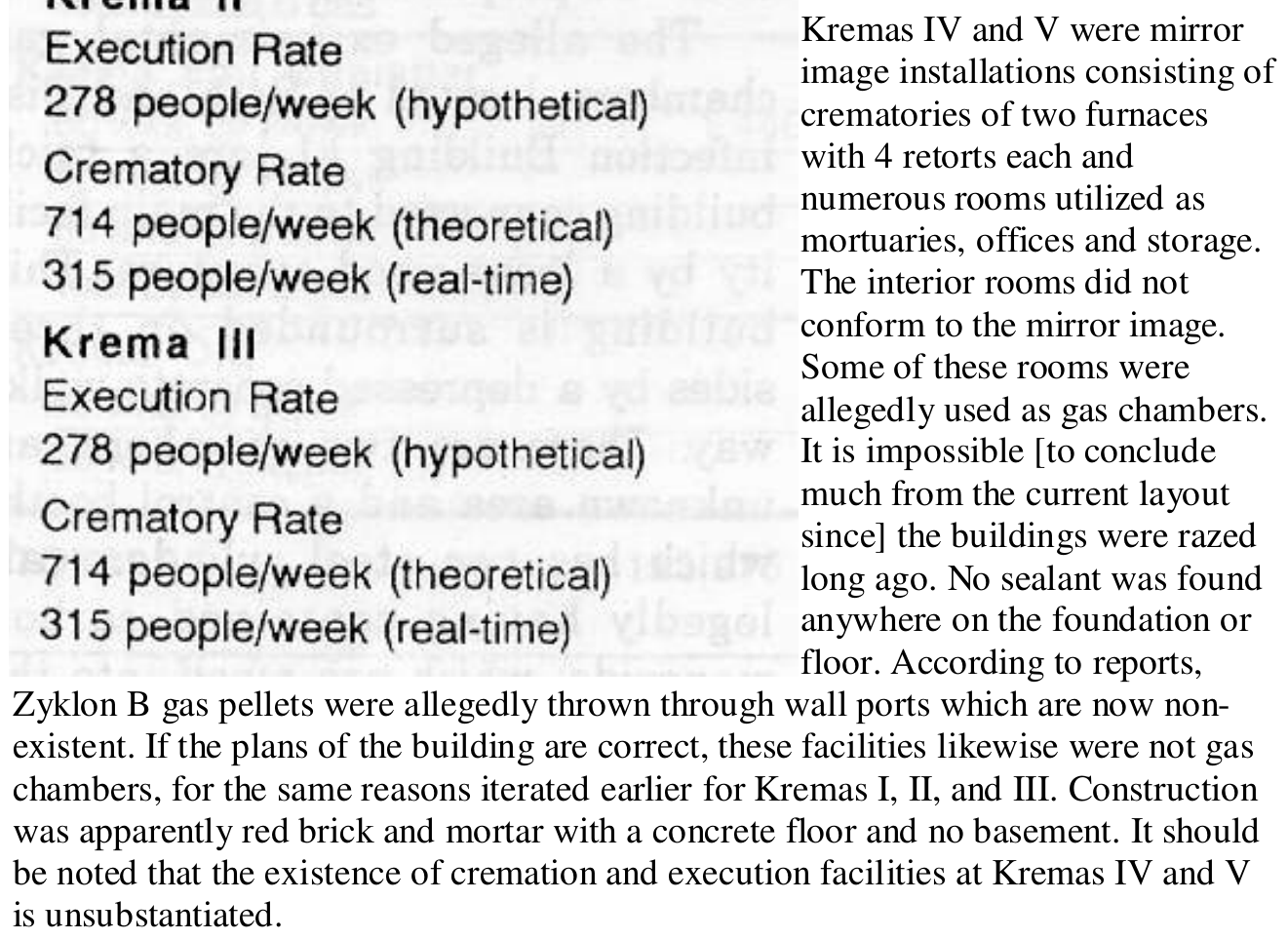
Kremas IV and V were mirror image installations consisting of crematories of two furnaces with 4 retorts each and numerous rooms utilized as mortuaries, offices and storage. The interior rooms did not conform to the mirror image. Some of these rooms were allegedly used as gas chambers. It is impossible [to conclude much from the current layout since] the buildings were razed long ago. No sealant was found anywhere on the foundation or floor. According to reports, Zyklon B gas pellets were allegedly thrown through wall ports which are now non- existent. If the plans of the building are correct, these facilities likewise were not gas chambers, for the same reasons iterated earlier for Kremas I, II, and III. Construction was apparently red brick and mortar with a concrete floor and no basement. It should be noted that the existence of cremation and execution facilities at Kremas IV and V is unsubstantiated.
Foundations cannot show what stood in demolished walls
Crematoria IV and V were destroyed above foundation level. Foundations inspected in 1988 cannot show whether ports or doors once stood in demolished walls. That question requires wartime plans, photographs, and testimony, none of which the report analyzes here.
The epoxy-or-tar claim merely repeats the false American-design checklist.
Sources: Auschwitz Museum: gas chambers · NI-9912 fumigation rules · Auschwitz Museum: delousing · Pressac: deficiencies in the Leuchter Report
Report context 6 report items

Based upon statistics, obtained from the Auschwitz State Museum and measurements made at the site, for Kremas IV and V relative to the alleged gas areas, and assuming a ceiling height of 8 feet, the computed statistics are as follows:

1875 sq. ft.; will hold 209 people. 15,000 cu. ft. will use 3.75 lbs. of Zyklon B gas at 0.25 lbs./1000 cu. ft.

5125 sq. ft.; will hold 570 people. 41,000 cu. ft. will use 10.25 lbs. of Zyklon B gas at 0.25 lbs./1000 cu. ft.

Computed alleged usage rates for Kremas IV and V (theoretical and real-time) and gas chamber at maximum capacity and 1 week ventilation time are set out in Table VI
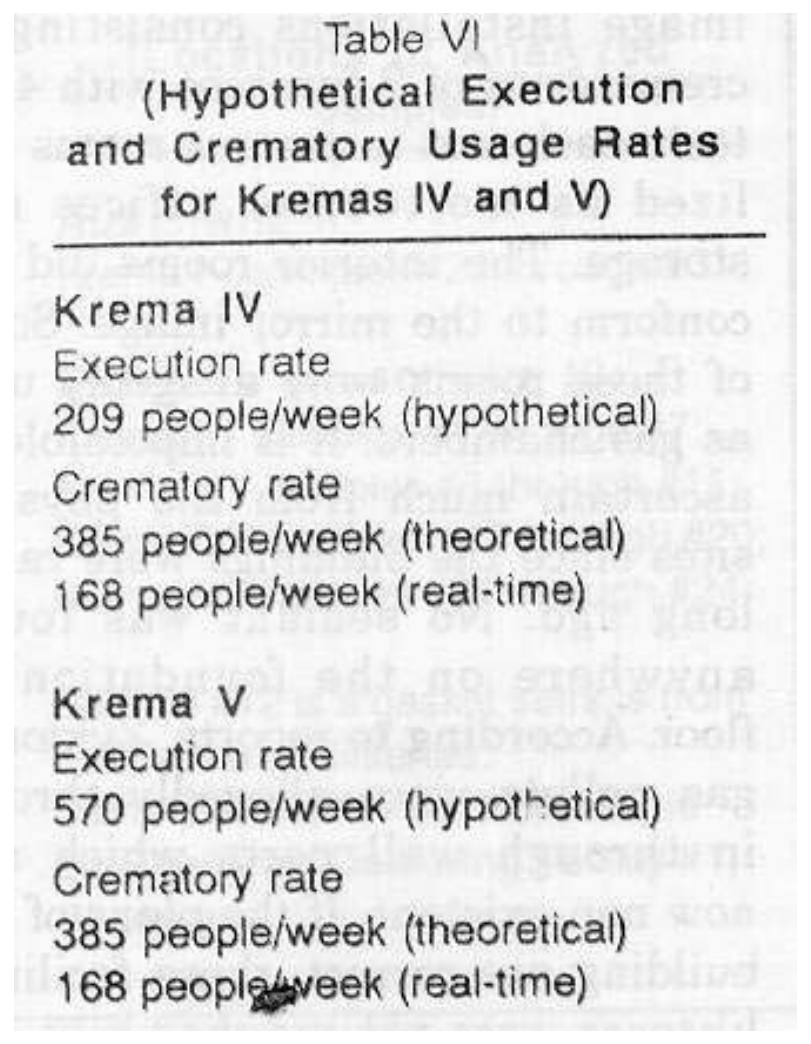

The Red and White houses, otherwise designated as Bunker I and II, were alleged to be gas chambers only, and there are no estimates available or statistics on the buildings.
3.17 Majdanek
Report context 5 report items
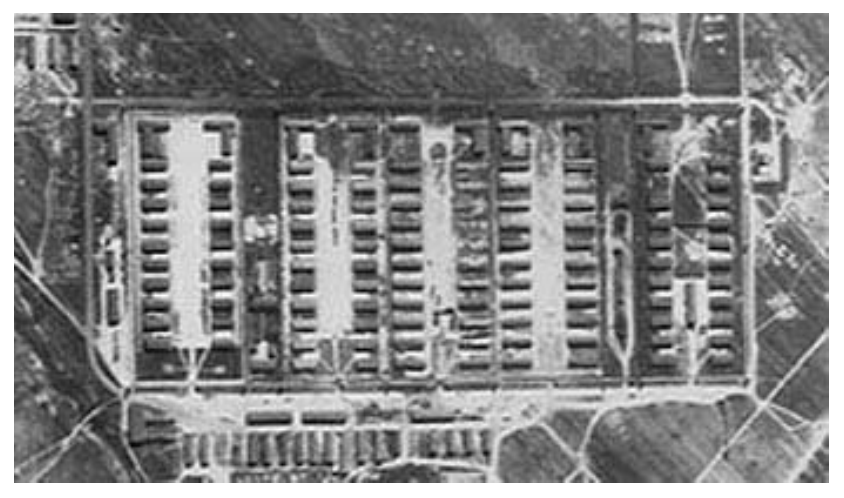

At Majdanek, there are several facilities of interest: the original crematory, now removed; the crematory with the alleged execution gas chamber, now rebuilt; the Bath and Disinfection Building #2, which was apparently a delousing facility; and Bath and Disinfection Building #1, which contained a shower, delousing and storage room and the alleged experimental CO and HCN gas chambers.
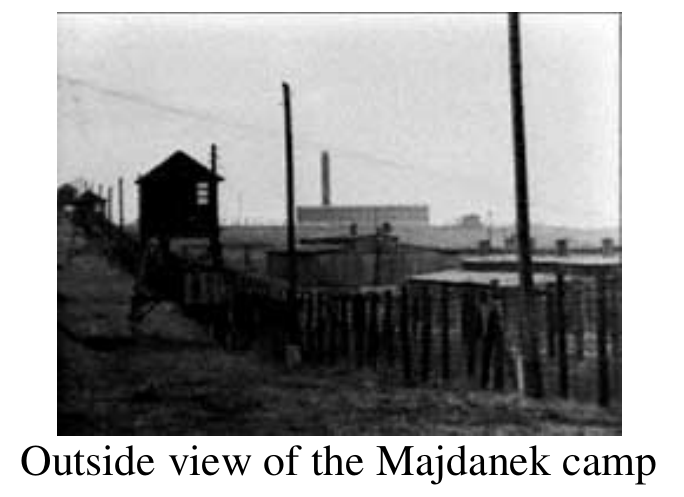
The first free standing crematory, which has been removed, has been discussed earlier. For Bath and Disinfection #2, although closed, an inspection through the windows confirms its function was only a delousing facility, similar to those at Birkenau. The rebuilt crematory and alleged gas chamber, although discussed earlier, will be considered briefly, again. The furnaces are the only portion of the original facility which has not been rebuilt. The basic structure appears to be of wood, as are the other facilities at Majdanek (except for the experimental chambers). However, closer inspection reveals that much of the building is of reinforced concrete, totally inconsistent with the remaining portions of the camp. The alleged execution gas chamber is adjacent to the crematory with apparently no means of containing the HCN gas.
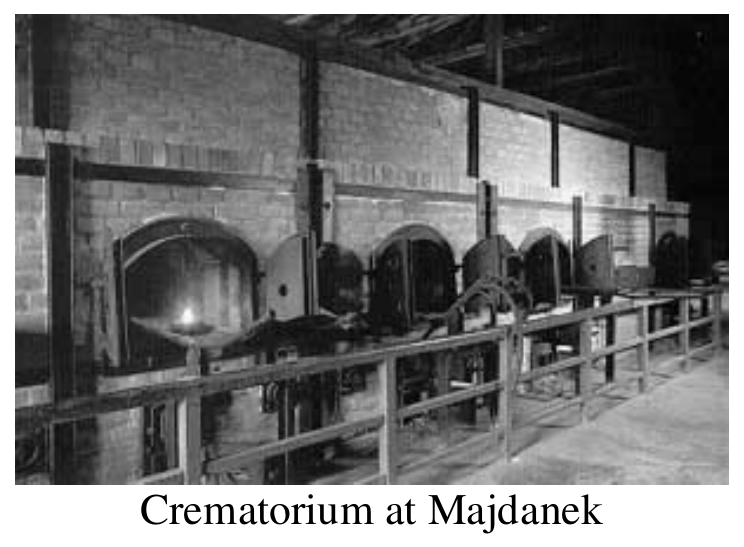

The building is not sealed and would be inoperable for its alleged purpose. Allegedly rebuilt from an original plan, which does not exist, it physically appears to be nothing more than a crematory with several morgues. It is by far the smallest and most insignificant alleged gas chamber of all.
The crematorium analysis cannot decide Majdanek's separate gas-chamber bunker
This paragraph analyzes the reconstructed crematorium and morgue, not the separate gas-chamber bunker described in Section 3.17. The Majdanek Museum's institutional identification places the structures separately; the locations and phases are set out in the topology table. Findings about the crematorium room cannot decide the other building.
No leakage test or phase-specific reconstruction appears here.
Sources: Majdanek Museum topography · Pressac: deficiencies in the Leuchter Report
The delousing/storage area at Bath and Disinfection #1 is an L-shaped room with an internal wooden partition and door. It comprises some 7657 cu. ft. of volume and has an area of 806 sq. ft. It has stuccoed walls, beam construction and two ungasketed roof vents. It contains an air circulatory system which is improperly designed whereby the inlet and outlet are in close proximity to each other. Blue staining, apparently caused by ferric-ferro-cyanide pigment, visibly coats the surface of the walls. It would appear from design that this was a delousing room or storage room for deloused materials. The roof vents are only capable of providing long term airing of stored materials. The doors are not gasketed and are not designed to be tight. The room is not sealed inside or out with sealant. There were several areas in this building that were permanently sealed and not available for the author's inspection. This room, clearly, was not an execution chamber and meets none of the described criteria. See drawing.
The accepted delousing room did not require the claimed universal features
The blue staining, circulation equipment, and bathhouse setting are consistent with HCN delousing. That identification does not prove homicidal use.
It does contradict Leuchter's universal checklist. He accepts HCN use in a room with ungasketed doors, no epoxy coating, roof vents, and no forty-foot stack. Those missing features did not make the accepted HCN use impossible.
Sources: NI-9912 fumigation rules · Pressac: deficiencies in the Leuchter Report
Report context 5 report items
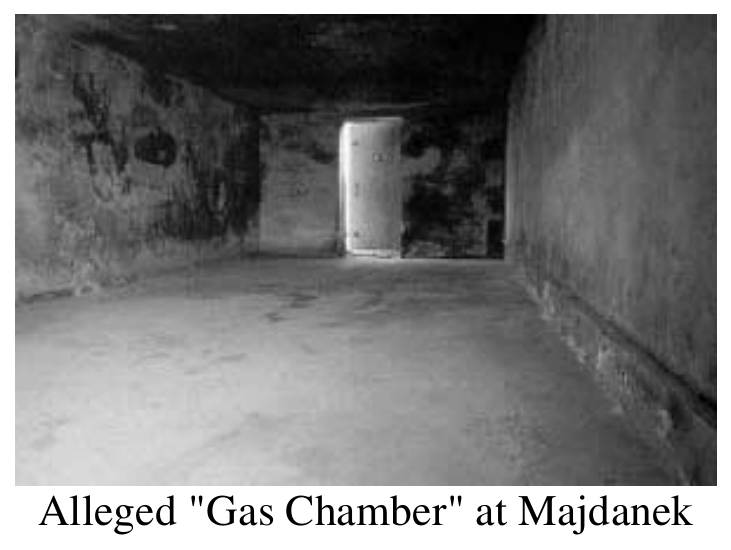

If this were utilized as a presumed execution chamber, it would hold 90 people, at most, and require 2.0 lbs. of Zyklon B gas. Venting time should be at least one week. Maximum usage execution rate 90 people/week.
The alleged experimental gas chambers, located at Bath and Disinfection Building #1, are a brick building connected to the main facility by a loose wood structure. This building is surrounded on three sides by a depressed concrete walkway. There are two chambers, an unknown area and a control booth, which has two steel cylinders, allegedly having contained carbon monoxide, which are piped into the two chambers. There are four steel doors with a rabbet, presumably for a gasket. The doors open out and are fastened shut with two mechanical latches and a locking bar (hasp).
All four doors have glass peep holes and the two inner doors have chemical test cylinders, to test the air in the chamber. The control booth has an open window of some 6 inches by 10 inches, never having provision for glass or gasketing, barred horizontally and vertically with reinforcing rods and opening into chamber #2. See drawing. Two of the doors open into chamber #1, one front and one rear, to the outside. One door opens into chamber #2 in the front. The remaining door opens into an unknown area behind chamber #2. Both chambers have piping, allegedly for carbon monoxide gas, but that in chamber #2 is incomplete, apparently never having been completed. Chamber #1 has finished piping, terminated in gas ports at two corners of the room. Chamber #2 has provision for a roof vent, but it appears never to have been cut through the roof. Chamber #1 has a heater/circulatory system for the air, which is not properly designed (the inlet and outlet are too close) and has no provision for venting.
The walls are of stucco, the roof and floor are of poured concrete, none of which has been sealed, inside or out. There are two heater circulators built as sheds on the side of the building, one for chamber 31 and the other for something in the Bath and Disinfection facility, forward, (see drawing) neither of which are properly designed and have no provision for vent/exhaust. The walls in chamber #1 have the characteristic blue ferric-ferro-cyanide staining. The building is unheated and damp.
Although at first glance these facilities appear properly designed, they fail to meet all the required criteria for an execution gas chamber or a delousing facility. First, there is no sealant on any of the inside or outside surfaces. Second, the depressed walkway is a potential gas trap for HCN, making the building extremely dangerous. Chamber #2 is incomplete and probably was never used. The piping is incomplete and the vent has never been opened in the roof. Although chamber #1 is operational for carbon monoxide, it is poorly vented and not operational for HCN. The heater/circulator is improperly installed. There is no vent or stack.
Chamber 1 is described as operational for carbon monoxide
The report admits that chamber 1 was “operational for carbon monoxide.” Carbon monoxide kills at ordinary atmospheric pressure. That admission directly contradicts the next paragraph's claim that the chamber “could never” function as an execution gas chamber. It does not by itself prove that executions occurred.
The remaining objections do not rescue the conclusion. NI-9912 documents HCN use in ordinary buildings sealed temporarily rather than in permanent pressure chambers. The trench claim has no leak rate or dispersion model. An unfinished second chamber says nothing about the first.
Sources: NIOSH: carbon monoxide · NRC acute CO review · NI-9912 fumigation rules · Pressac: deficiencies in the Leuchter Report

Therefore, it is the author's best engineering opinion that chambers #1 and #2 were never, and could not ever, be used as execution gas chambers. None of the facilities at Majdanek are suitable, or were used, for execution purposes.
“Could never” contradicts the report's own carbon-monoxide admission
The preceding admission that chamber 1 was operational for carbon monoxide contradicts “could never.” It does not establish actual use. Questions about one unfinished room, one circulator, and the site's 1988 condition cannot support a categorical claim of impossibility.
Within the report: The preceding paragraph calls chamber 1 operational for carbon monoxide. This paragraph says it “could not ever” function as an execution gas chamber.
Sources: NIOSH: carbon monoxide · NRC acute CO review · Pressac: deficiencies in the Leuchter Report
Report context 2 report items

Chamber #1 has an area of 480 sq. ft., a volume of 4240 cubic feet, will hold 54 persons and use one pound of Zyklon B gas. Chamber #2 has an area of 209 sq. ft., a volume of 1850 cubic feet, will hold 24 persons and use 0.5 pounds of Zyklon B gas. Assuming gas chamber usage, the maximum weekly execution rate would have been the figures set out in Table VII.
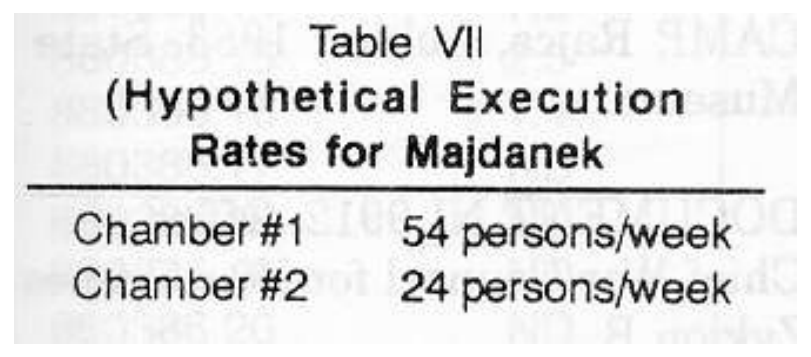
Calculations and conclusions
3.18 Statistics
Report context 2 passages

The statistics set out in Table VIII were generated for this report. Assuming the gas chambers existed (and they did not), these figures represent the maximum 24-hour, 7- day a week outputs of each facility and the amount of Zyklon B gas required.

Relative to the additional alleged execution facilities of Chelmno (gas vans), Belzec, Sobibor, Treblinka and any others, it should be noted that carbon monoxide gas was allegedly used.

As discussed above, carbon monoxide gas is not an execution gas and the author believes that before the gas could take effect, all would have suffocated. Therefore, it is the author's best engineering opinion that no one died of CO execution.
Carbon monoxide kills at ordinary pressure
NIOSH's 1,200-ppm IDLH is an emergency escape and respirator benchmark, rather than a direct lethality threshold. The NRC review supplies the relevant concentration-time evidence, including a 600-ppm 30-minute AEGL-3 and a qualified ISO estimate of 2,500–4,000 ppm for 30 minutes. Those limits and the ordinary-pressure arithmetic are shown in the carbon-monoxide table.
The report supplies no site inspection, engine test, exhaust measurement, enclosure model, or exposure reconstruction for the Operation Reinhard camps. A generic claim about diesel exhaust cannot establish that “no one” died from CO. The report's alternative of suffocation before carbon-monoxide poisoning also does not support that conclusion.
Sources: NIOSH: carbon monoxide · NRC acute CO review
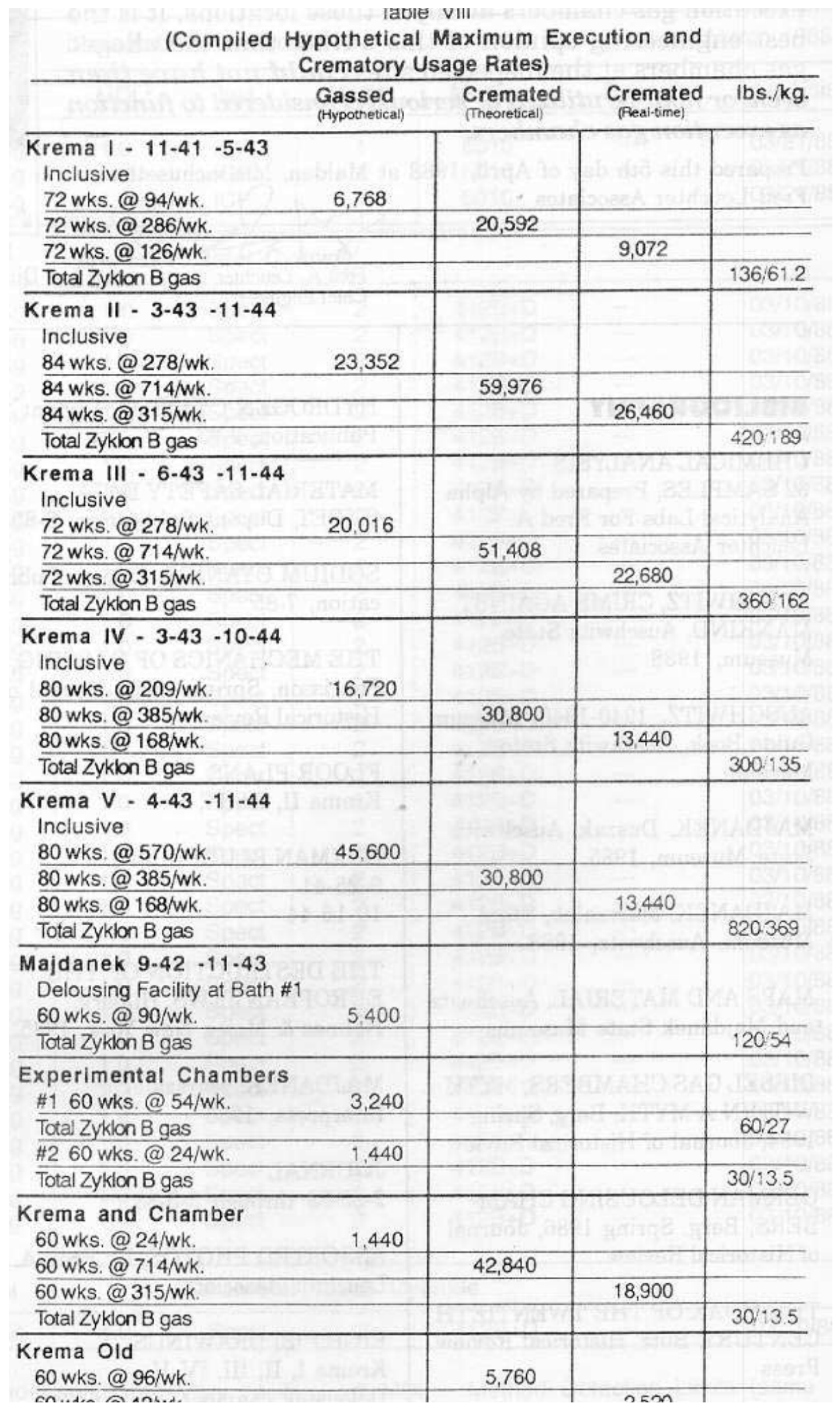
Table VIII compounds earlier assumptions
The products in the main rate columns are arithmetically consistent with the printed weekly rates. The problem is the inputs. The “gassed” totals carry forward the nine-square-feet-per-person ceiling and one cycle per week. The cremation totals carry forward a one-body three-and-a-half-hour cycle and a civilian three-per-day recommendation. The Zyklon totals multiply Leuchter's selected dose by the chosen number of weeks. The input ledger traces each assumption to the earlier calculation or record and states the source limit. The table supplies no independent validation.
| Input carried into Table VIII | Status before multiplication |
|---|---|
| Nine square feet per person | Assumed packing allowance; no circulation model |
| One gas cycle per week | Imported fumigation and airing schedule; no chamber air-change calculation |
| One corpse per muffle | Contradicted by Sander's multiple-loading description |
| Three-and-a-half-hour old-furnace cycle | No cited Topf test or manufacturer basis |
| Three cremations per day | Civilian operating recommendation used as a physical ceiling |
| Majdanek retort count | Table II conflict: fifteen printed, five muffles identified by Pressac and the photograph |
Multiplication can be correct while every output remains conditional on its inputs. The table supplies no independent test of those inputs.
Sources: Crematorium II blower inventory · June 28 capacity letter · Sander/Topf memorandum, Sept. 14, 1942
3.19 Conclusion
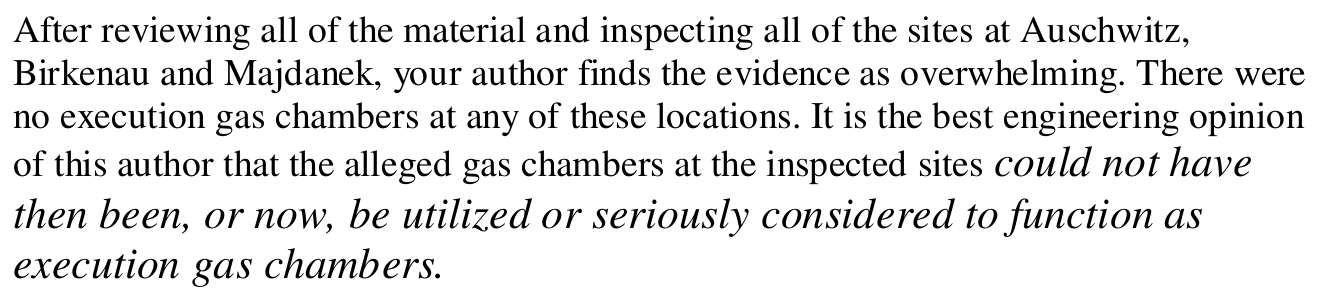
After reviewing all of the material and inspecting all of the sites at Auschwitz, Birkenau and Majdanek, your author finds the evidence as overwhelming. There were no execution gas chambers at any of these locations. It is the best engineering opinion of this author that the alleged gas chambers at the inspected sites could not have then been, or now, be utilized or seriously considered to function as execution gas chambers.
The final verdict repeats calculations and premises already contradicted
This final paragraph adds no new test. Its categorical verdict depends on the earlier temperature, flammability, carbon-monoxide, sampling, cremation, construction, preservation, and building-identity premises. The ledger below points to the displayed calculation, experiment, or record for each one.
Several source limits remain important. The construction records support only the narrow findings stated beside them. Nominal furnace ratings do not prove sustained output. Museum topography is an institutional reconstruction. Those limits still leave the report's load-bearing calculations and universal requirements unsupported or contradicted. The word “overwhelming” supplies no missing measurement.
| Premise tested earlier | Displayed result |
|---|---|
| HCN release and boiling point | Measured release below freezing; substantial vapor pressure below boiling |
| Explosion threshold | 3,200 ppm is 17.5 times below the NIOSH lower explosive limit |
| Carbon-monoxide pressure | 4,000 ppm is a 0.4% mixture at ordinary total pressure |
| Suffocation timing | Floor area supplies no time; a disclosed sensitivity check fails to show death well before CO |
| Masonry chemistry | Alpha measured values; Leuchter's design cannot support the exposure comparison |
| One-body cremation ceiling | Contemporary memorandum describes several corpses in an individual muffle |
| Missing construction features | Displayed records support several narrow contrary findings |
| Majdanek building identity | The criticized crematorium and gas-chamber building occupy separate phases and locations |
This ledger introduces no new proof. It shows which earlier findings the final categorical verdict would have to overcome.
Sources: Crematorium II blower inventory · Gas-tight door order · Gas-tester telegram · Wire-mesh device inventory · NI-9912 fumigation rules · NIOSH: hydrogen cyanide · NIOSH: carbon monoxide · Markiewicz et al., 1994 · June 28 capacity letter
Report context 2 passages

Prepared this 5th day of April, 1988 at Malden, Massachusetts.
Fred Leuchter Associates Fred A. Leuchter, Jr. Chief Engineer
3.20 Bibliography
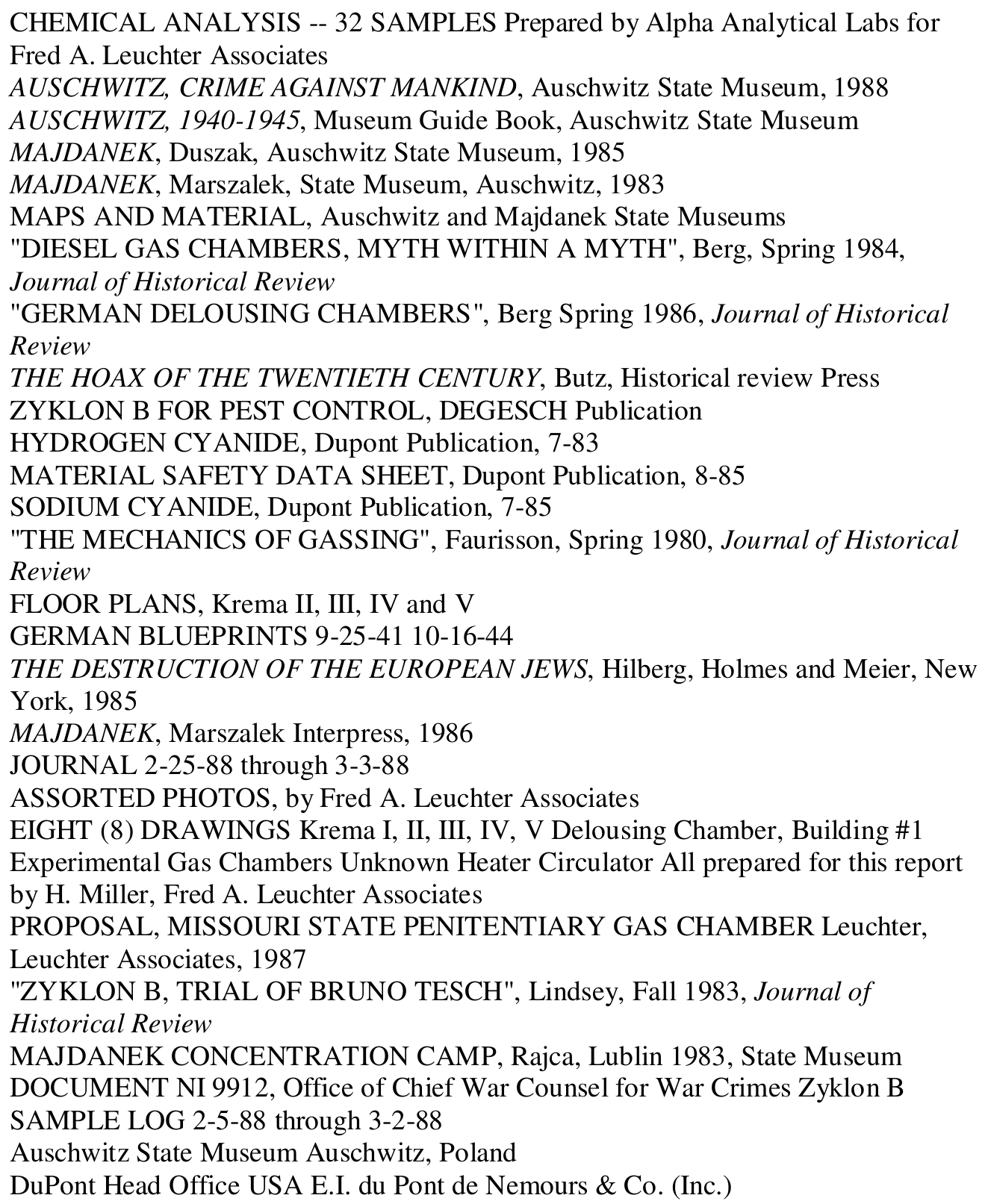
CHEMICAL ANALYSIS 32 SAMPLES Prepared by Alpha Analytical Labs for Fred A. Leuchter Associates AUSCHWITZ, CRIME AGAINST MANKIND, Auschwitz State Museum, 1988 AUSCHWITZ, 1940-1945, Museum Guide Book, Auschwitz State Museum MAJDANEK, Duszak, Auschwitz State Museum, 1985 MAJDANEK, Marszalek, State Museum, Auschwitz, 1983 MAPS AND MATERIAL, Auschwitz and Majdanek State Museums "DIESEL GAS CHAMBERS, MYTH WITHIN A MYTH", Berg, Spring 1984, Journal of Historical Review "GERMAN DELOUSING CHAMBERS", Berg Spring 1986, Journal of Historical Review THE HOAX OF THE TWENTIETH CENTURY, Butz, Historical review Press ZYKLON B FOR PEST CONTROL, DEGESCH Publication HYDROGEN CYANIDE, Dupont Publication, 7-83 MATERIAL SAFETY DATA SHEET, Dupont Publication, 8-85 SODIUM CYANIDE, Dupont Publication, 7-85 "THE MECHANICS OF GASSING", Faurisson, Spring 1980, Journal of Historical Review FLOOR PLANS, Krema II, III, IV and V GERMAN BLUEPRINTS 9-25-41 10-16-44 THE DESTRUCTION OF THE EUROPEAN JEWS, Hilberg, Holmes and Meier, New York, 1985 MAJDANEK, Marszalek Interpress, 1986 JOURNAL 2-25-88 through 3-3-88 ASSORTED PHOTOS, by Fred A. Leuchter Associates EIGHT (8) DRAWINGS Krema I, II, III, IV, V Delousing Chamber, Building #1 Experimental Gas Chambers Unknown Heater Circulator All prepared for this report by H. Miller, Fred A. Leuchter Associates PROPOSAL, MISSOURI STATE PENITENTIARY GAS CHAMBER Leuchter, Leuchter Associates, 1987 "ZYKLON B, TRIAL OF BRUNO TESCH", Lindsey, Fall 1983, Journal of Historical Review MAJDANEK CONCENTRATION CAMP, Rajca, Lublin 1983, State Museum DOCUMENT NI 9912, Office of Chief War Counsel for War Crimes Zyklon B SAMPLE LOG 2-5-88 through 3-2-88 Auschwitz State Museum Auschwitz, Poland DuPont Head Office USA E.I. du Pont de Nemours Co. (Inc.)
The bibliography omits records needed to test the report's main claims
The printed bibliography names guidebooks, general plans and blueprints, manufacturer literature, denial publications, Leuchter's notes and drawings, Hilberg, NI-9912, and Alpha's completed laboratory analysis. It does not individually identify the construction records that directly test several central negatives.
The ledger below states each absence precisely. A generic plans entry cannot prove that the ventilation letter, blower inventory, door order, gas-tester telegram, handover inventory, Irmscher test, or capacity letter was examined. Later studies are excluded because they were unavailable in 1988. The bibliography therefore cannot support the report's claim to have used all available scientific and engineering material.
| What the bibliography lists | More specific record absent from the list |
|---|---|
| “Floor plans” and “German blueprints” | 29 January ventilation letter and Crematorium II blower inventory |
| Report drawings and assorted photographs | 31 March 1943 gas-tight-door order |
| No gas-tester record | 26 February 1943 telegram ordering ten gas testers |
| No handover inventory | Four wire-mesh insertion devices and four wooden covers |
| Generic “Zyklon B for Pest Control” DEGESCH publication | Irmscher's 1942 measured low-temperature release paper |
| Alpha's completed chemical analysis | No unexposed negative-control or replicate sampling protocol |
| No furnace-capacity record | 28 June 1943 nominal-capacity letter |
A generic plans entry cannot show that these specific records were examined. Later studies are excluded from this omission check because they were unavailable when the report was written.
Sources: Crematorium II blower inventory · Gas-tight door order · Gas-tester telegram · Wire-mesh device inventory · Markiewicz et al., 1994
Appendix III: NI-9912
A.0 Distribution page
Report context 1 passage
[Report sent to:] Ernst Zündel, Institute of Historical Review, and Chancellor Helmut Kohl.
A.1 Appendix 1: laboratory table
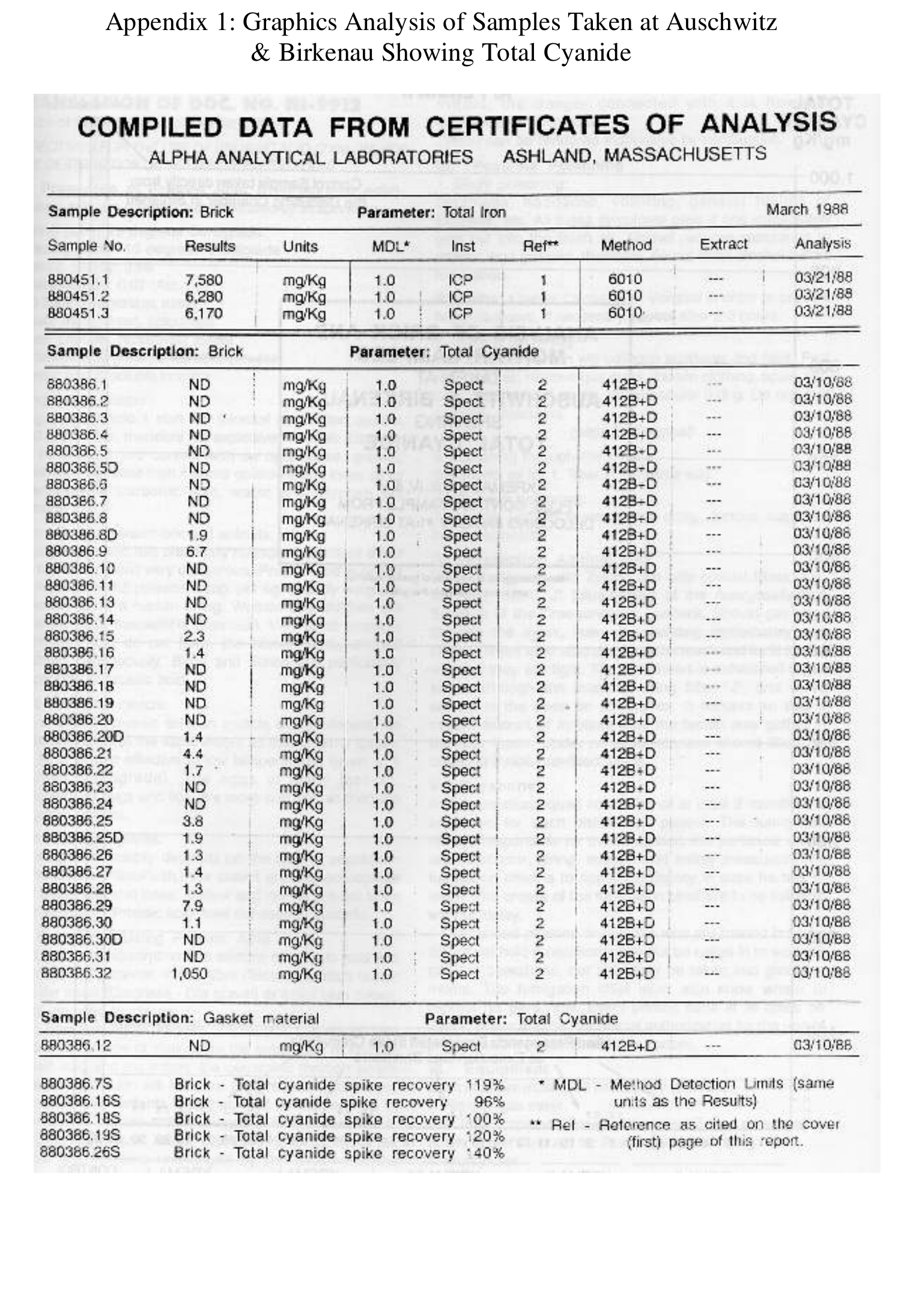
The laboratory table lacks the controls needed for comparison
The laboratory reported measurements, not all zeros. Several samples had low single-digit values; sample 32 measured 1,050 mg/kg. The values do not supply the controls or sample geometry missing from the procedure.
The table omits site identity, sampling depth, exposed surface area, substrate, weathering history, and unexposed negative controls. Leuchter describes sample 32 as a visibly blue, high-cyanide delousing-wall comparator; it is not a matched control. The later Kraków study used documented locations, dwelling-room negatives, small samples, replicate determinations, and a method chosen to preserve stable iron-blue compounds. The numerical and procedural differences are in the study comparison.
Sources: Markiewicz et al., 1994
A.2 Appendix 2: sample-analysis graph
Report context 1 report item
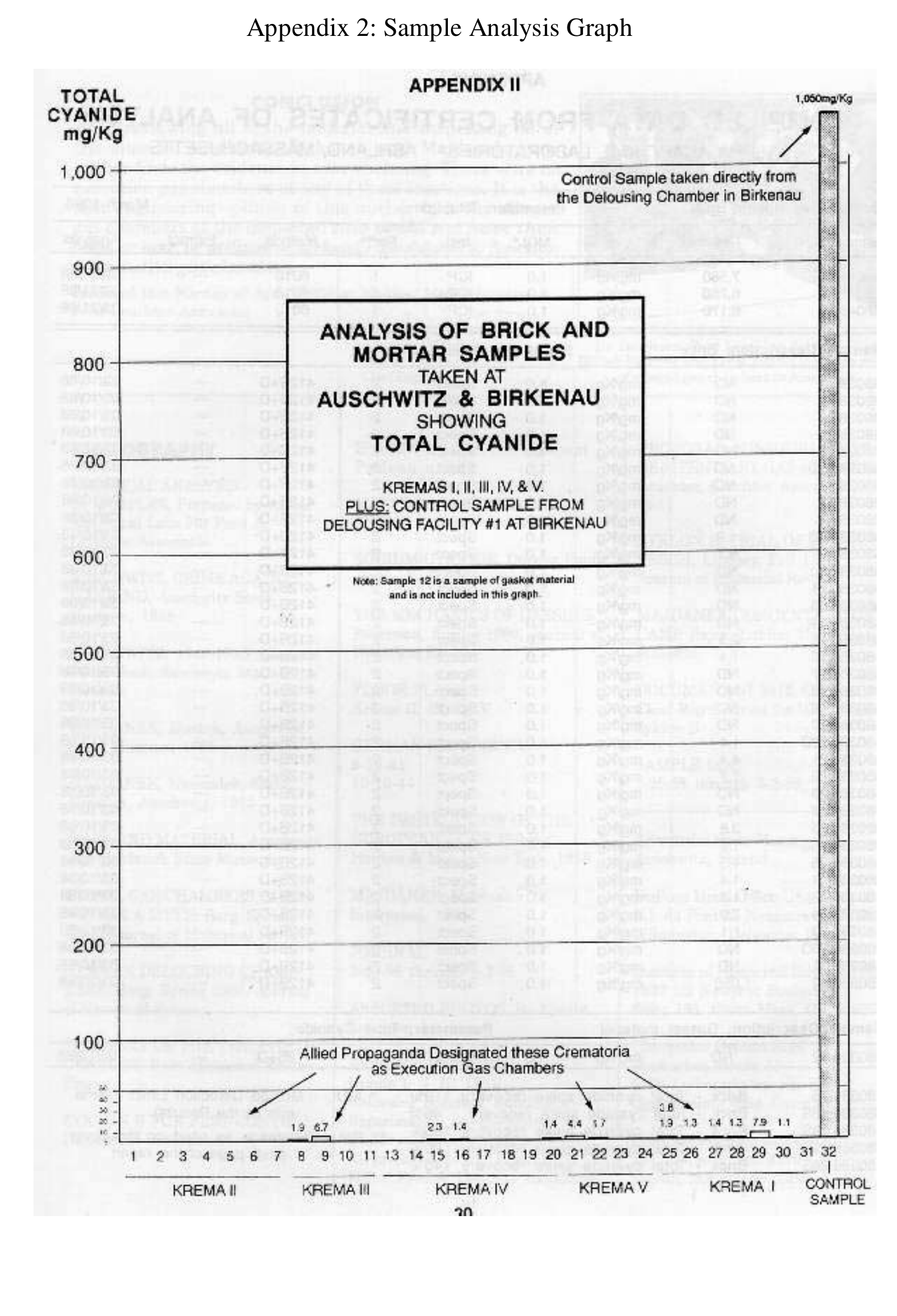
A.3 Appendix 3: NI-9912 fumigation rules
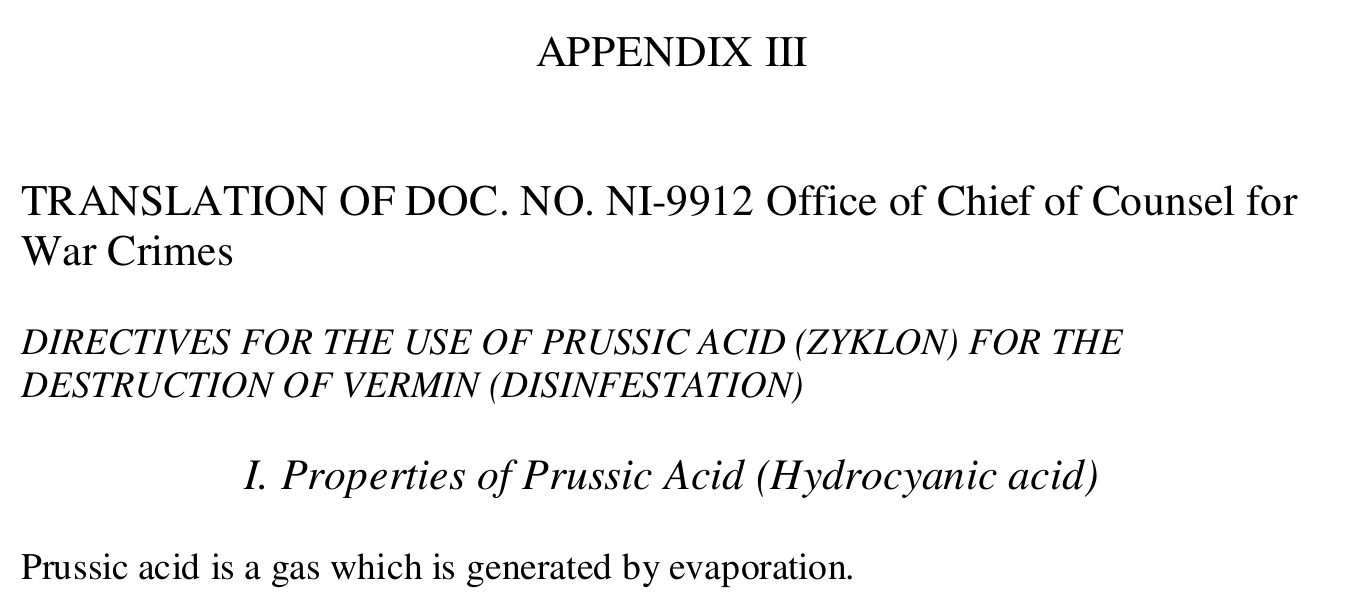
Translation of Document No. NI-9912, Office of Chief of Counsel for War Crimes. Directives for the Use of Prussic Acid (Zyklon) for the Destruction of Vermin (Disinfestation). I. Properties of Prussic Acid: Prussic acid is a gas which is generated by evaporation.
Appendix III contradicts the report's universal HCN rules
NI-9912 is an official wartime insect-fumigation directive, not a DEGESCH manual and not a reconstruction of homicidal exposure. It is part of the report's own appendix and contradicts several universal rules in the body.
The directive says HCN remains effective at 5°C, makes dose and time depend on conditions, permits six hours in warm weather, seals ordinary buildings temporarily, spreads the carrier without a hot-air generator, specifies a “J” filter for masked entry, and separates the normal 8–10 g/m³ dose from a 75 g/m³ explosion threshold. It contradicts the report's universal temperature, time, pressure-chamber, mask, hot-air, and explosion requirements.
| Appendix page | Instruction | Scope |
|---|---|---|
| 43 | Insecticidal action remains effective at 5°C | Fumigation |
| 43 | About 75 g/m³ ignition concentration; prescribed 8–10 g/m³ | Explosion warning |
| 45 | Special J filter specified for the gas mask | Protective equipment |
| 46 | Inspect the building and seal openings temporarily | Preparation |
| 46–47 | Spread the carrier; warm-weather minimum of six hours | Application and exposure |
| 47–49 | Condition-dependent airing and provisional release | Clearance |
NI-9912 governs insect fumigation. It cannot reconstruct a homicidal operation. Because Leuchter printed it, its conditional instructions directly test the universal engineering rules asserted in the report.
Sources: NI-9912 fumigation rules
Report context 27 passages
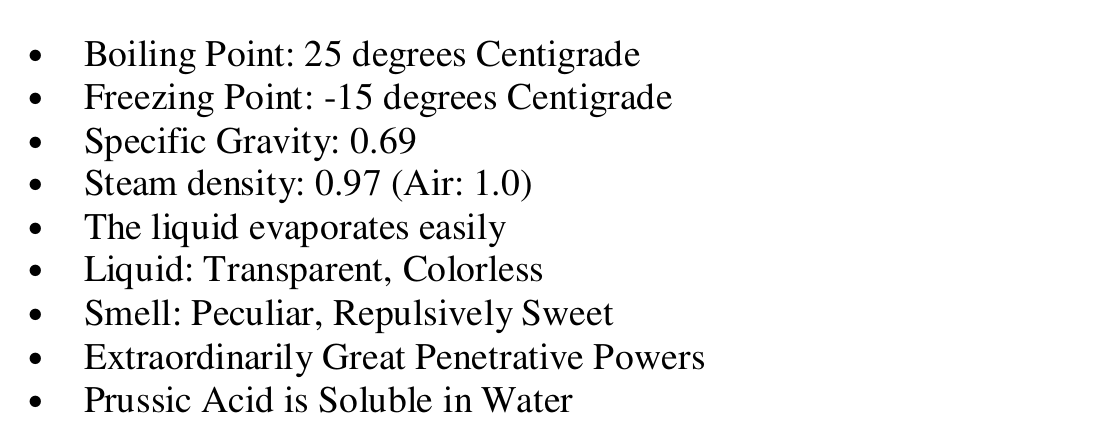
Boiling point 25°C; freezing point -15°C; specific gravity 0.69; steam density 0.97 (air 1.0); the liquid evaporates easily; liquid transparent and colorless; smell peculiar and repulsively sweet; extraordinarily great penetrative powers; soluble in water.
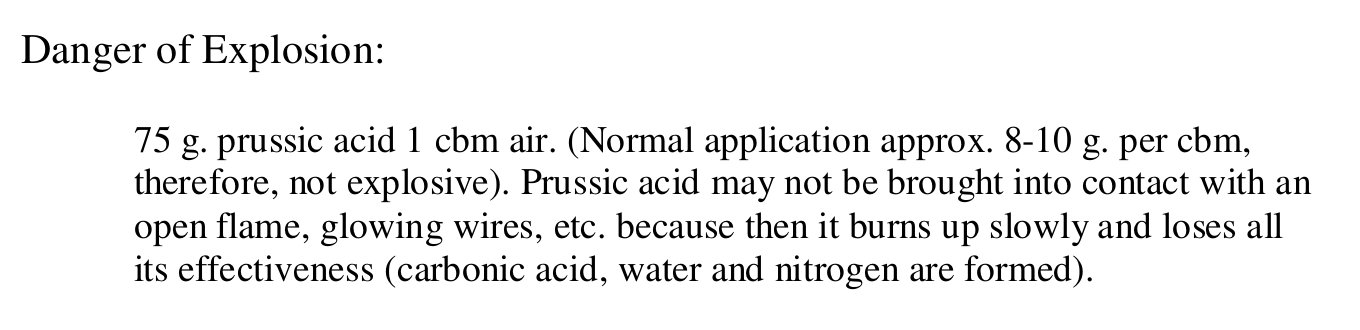
Danger of Explosion: 75 g prussic acid per cubic metre of air. Normal application approximately 8-10 g per cubic metre, therefore not explosive. Prussic acid must not contact flame or glowing wires because it then burns and loses effectiveness.
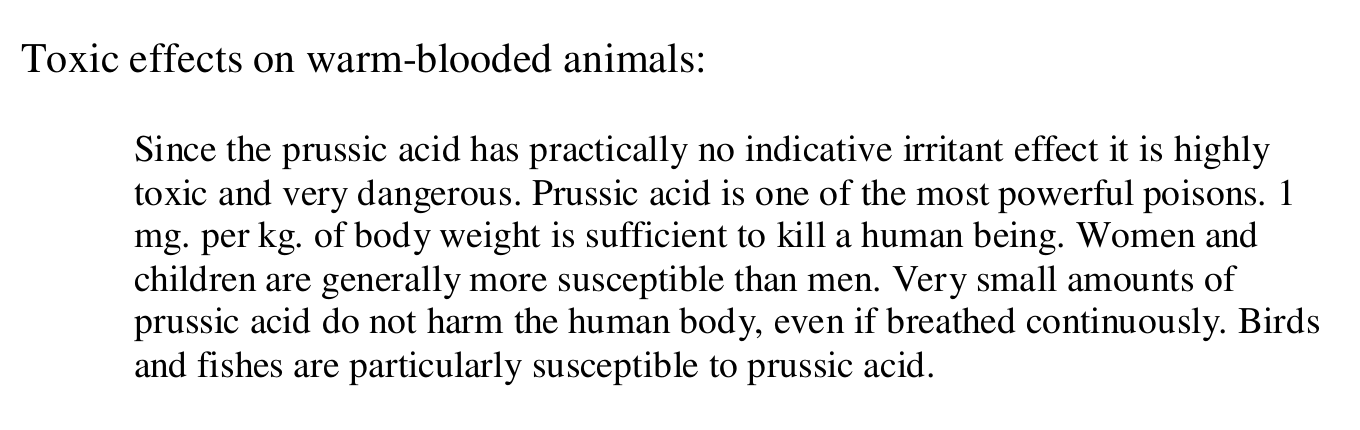
Because prussic acid has practically no irritant warning effect it is highly toxic and dangerous. One mg per kg body weight is sufficient to kill a human being; susceptibility varies, and birds and fish are particularly susceptible.
The effect on insects depends less on temperature than other gases: it is effective at low temperatures, even 5°C. Eggs of many insects, particularly bugs and lice, are more susceptible than adults.
Toxic effects on plants depend on vegetation type. Mildew and dry rot are not killed by prussic acid. Prussic acid does not destroy bacteria.
Zyklon is a mixture of prussic acid and an irritant absorbed by a carrier. Wood-fibre discs, granular material, or cubes are used. The agents are generated through simple evaporation; cans are used whole; the gaseous acid is harmless to finishes; and Zyklon can be rendered inoffensive by combustion.
Slight poisoning: dizziness, headache, vomiting, and sickness pass if the person immediately reaches fresh air. Alcohol reduces resistance, so it should not be consumed before fumigation.

Prescribe one Cardiazol or Veriazol tablet to prevent heart disorders, repeating after two to three hours if necessary.

Severe poisoning: collapse and fainting. First aid includes fresh air, removing the mask, loosening clothing, artificial respiration, and Lobelin; do not give camphor injections.

Poisoning through the skin: symptoms and treatment as for slight poisoning.

Stomach poisoning: treat with Lobelin, ferrous sulphate, and burnt magnesia.
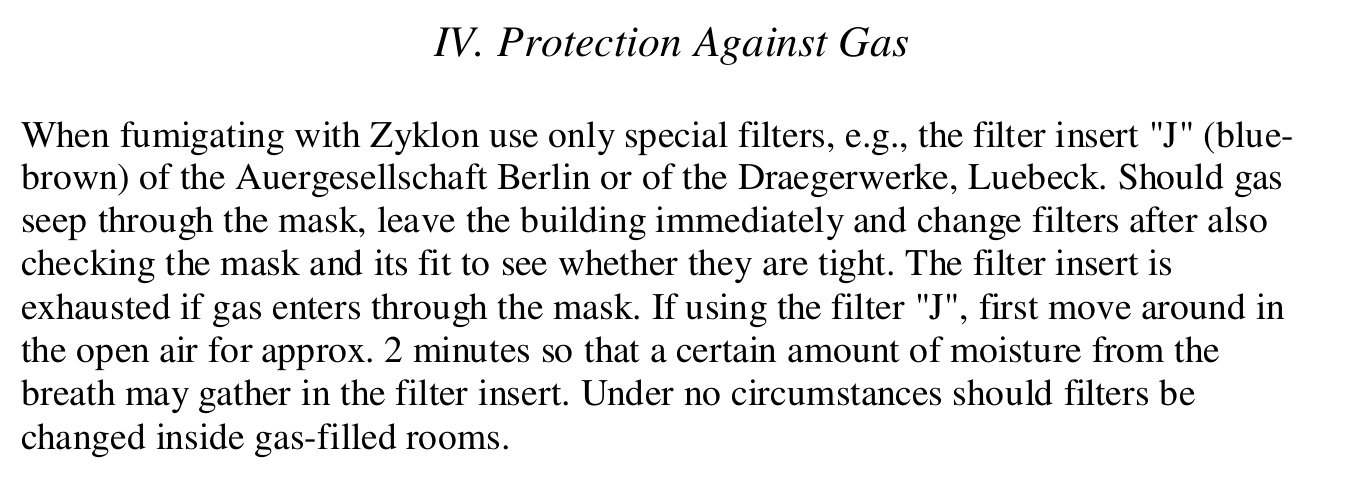
When fumigating with Zyklon use special filters, such as the “J” insert. If gas seeps through, leave and change filters after checking mask fit. Never change filters inside gas-filled rooms.
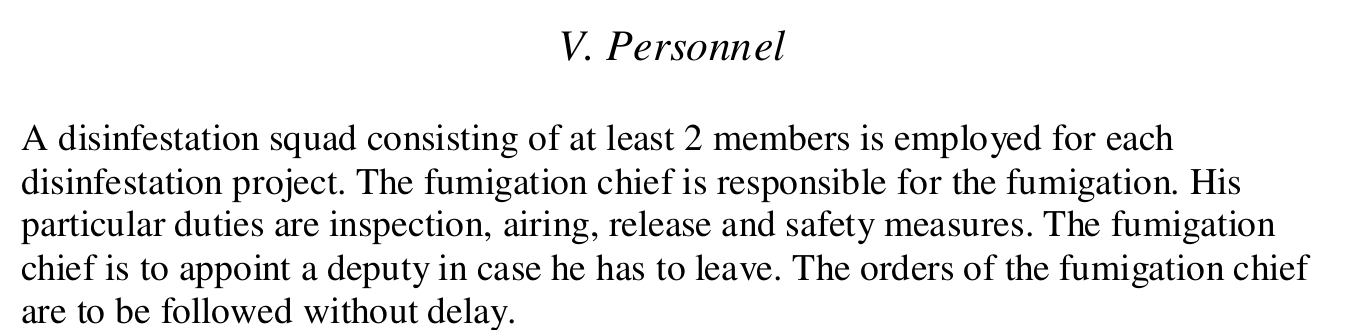
A disinfestation squad of at least two members is used. The chief is responsible for inspection, airing, release, and safety, appoints a deputy, and must be obeyed.

Untrained or uncertified personnel may not work on gassing or enter gas-filled rooms. Each person must prove official authorization to use prussic acid for extermination.
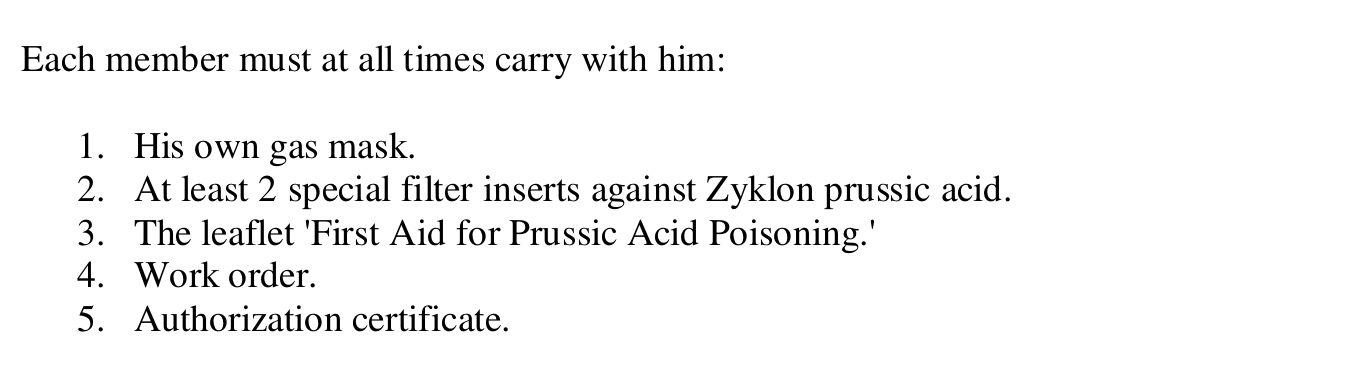
Each member carries a gas mask, at least two special filters, the first-aid leaflet, the work order, and an authorization certificate.
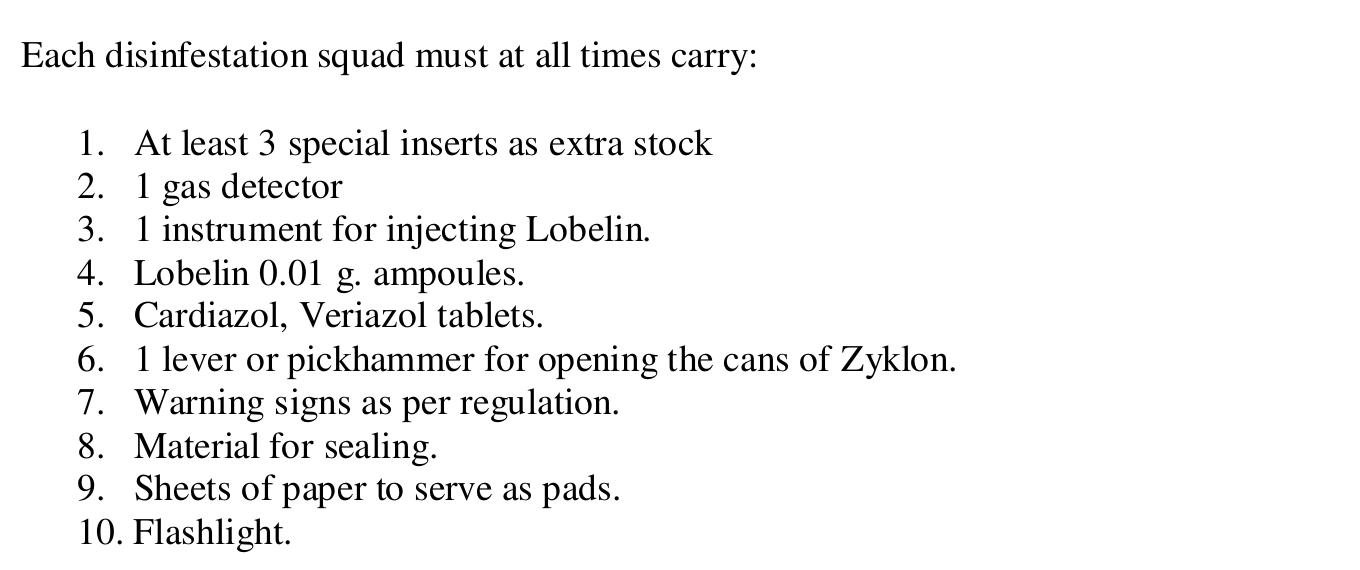
Each squad carries spare filters, a gas detector, resuscitation equipment and medicines, a can-opening tool, warning signs, sealing material, paper pads, and a flashlight.

Equipment must be kept clean and in good order, and damage repaired at once.
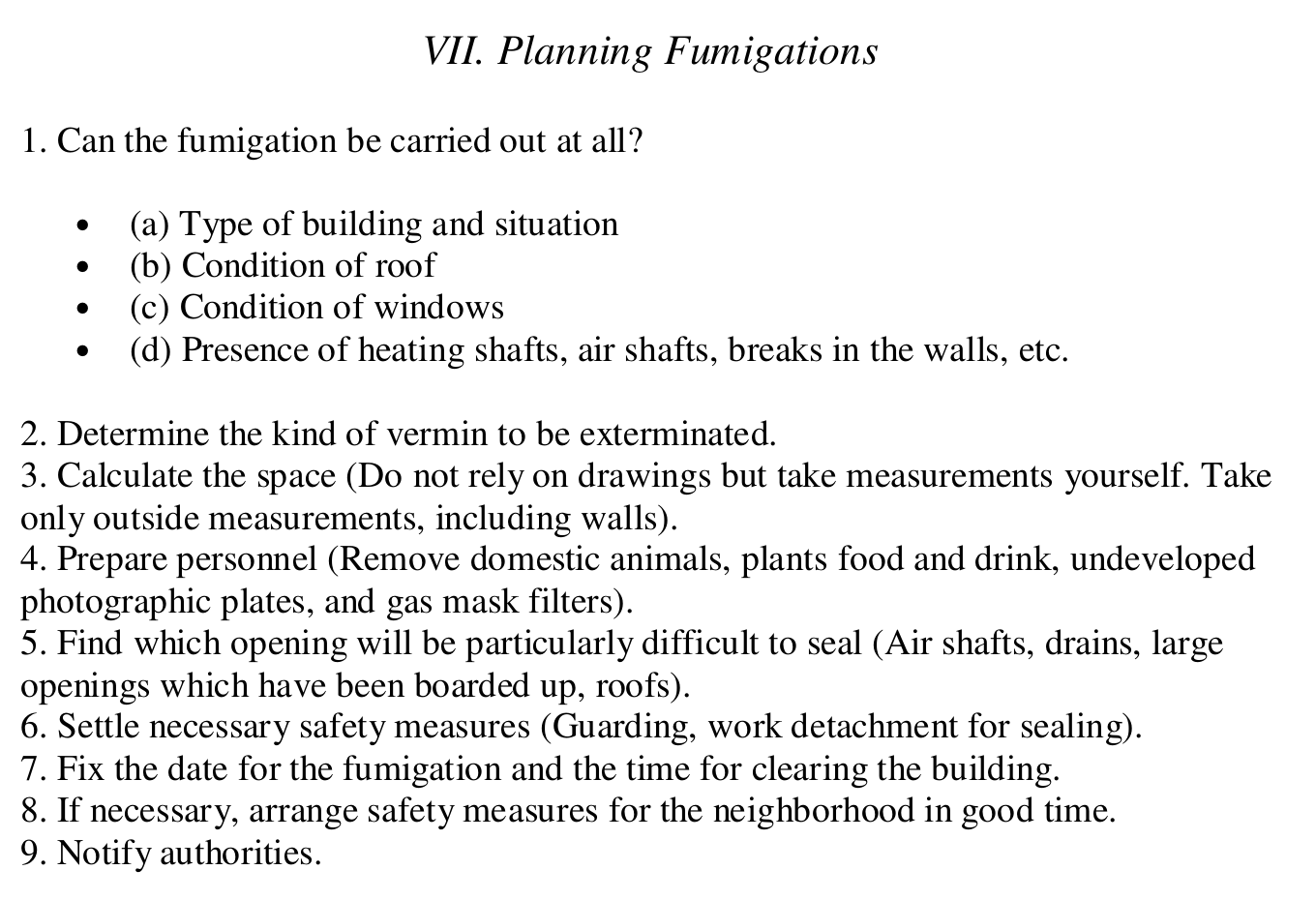
Planning asks whether the building can be fumigated, considering type, situation, roof, windows, shafts and wall breaks; identifies the vermin; measures volume; removes people, animals, plants and food; identifies difficult openings to seal; sets safety measures, date, neighborhood precautions, and official notice.
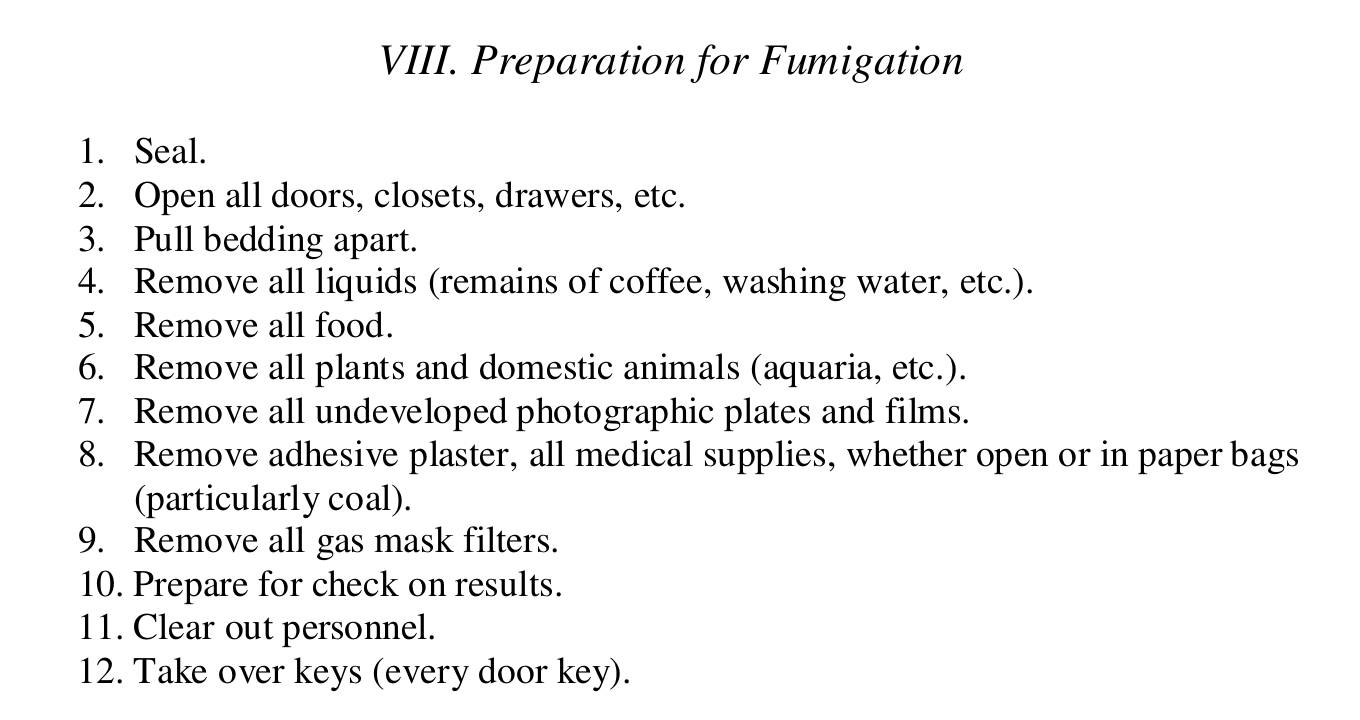
Preparation begins “Seal,” then opens enclosed spaces, separates bedding, removes liquids, food, plants, animals, film, medicines and mask filters, prepares result checks, clears personnel, and takes every door key.
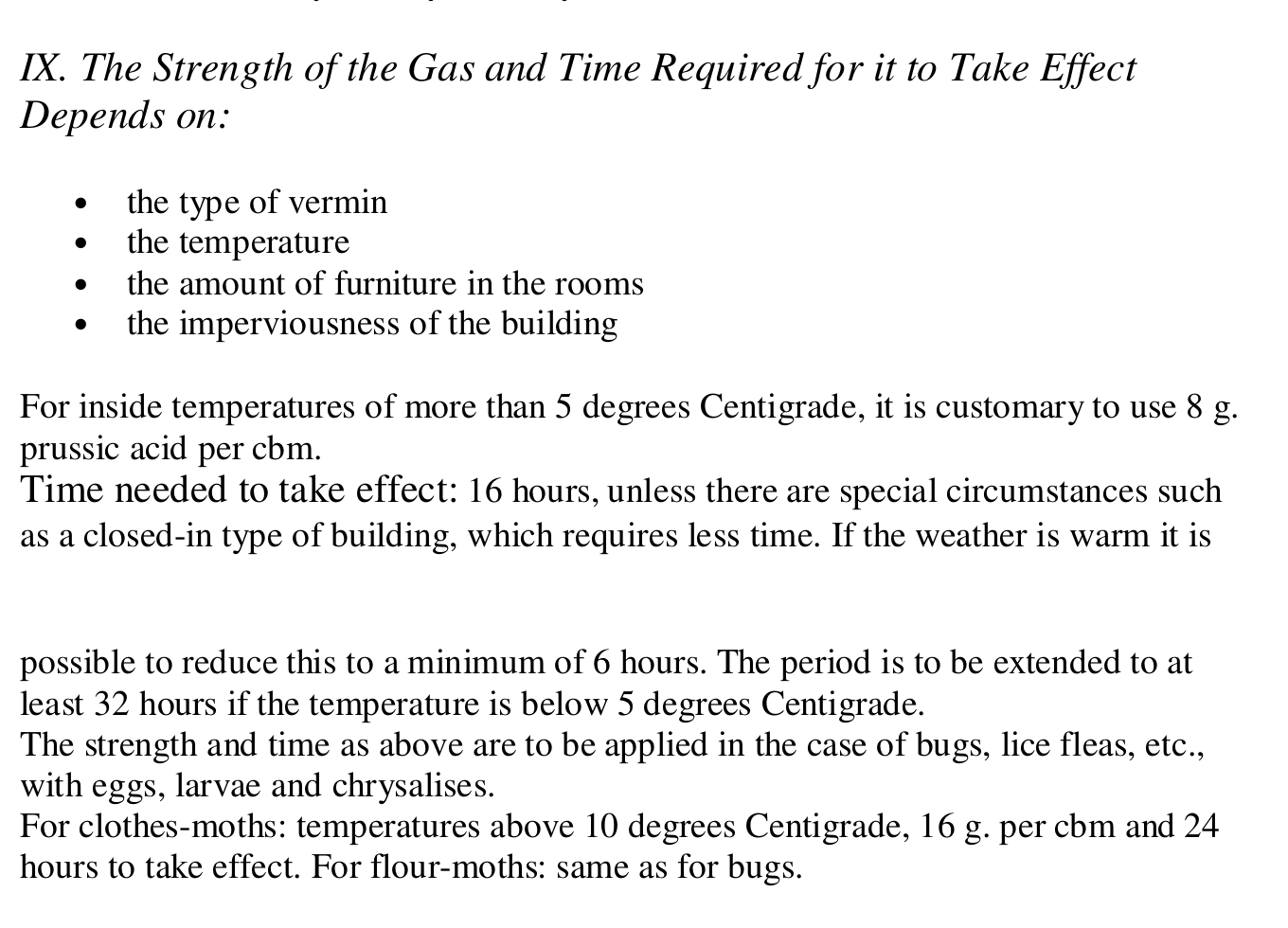
Gas strength and exposure time depend on vermin, temperature, furniture, and building imperviousness. Above 5°C the customary dose is 8 g/m³ and time 16 hours, reducible to six hours in warm weather and extended to 32 hours below 5°C. Clothes moths require different conditions.
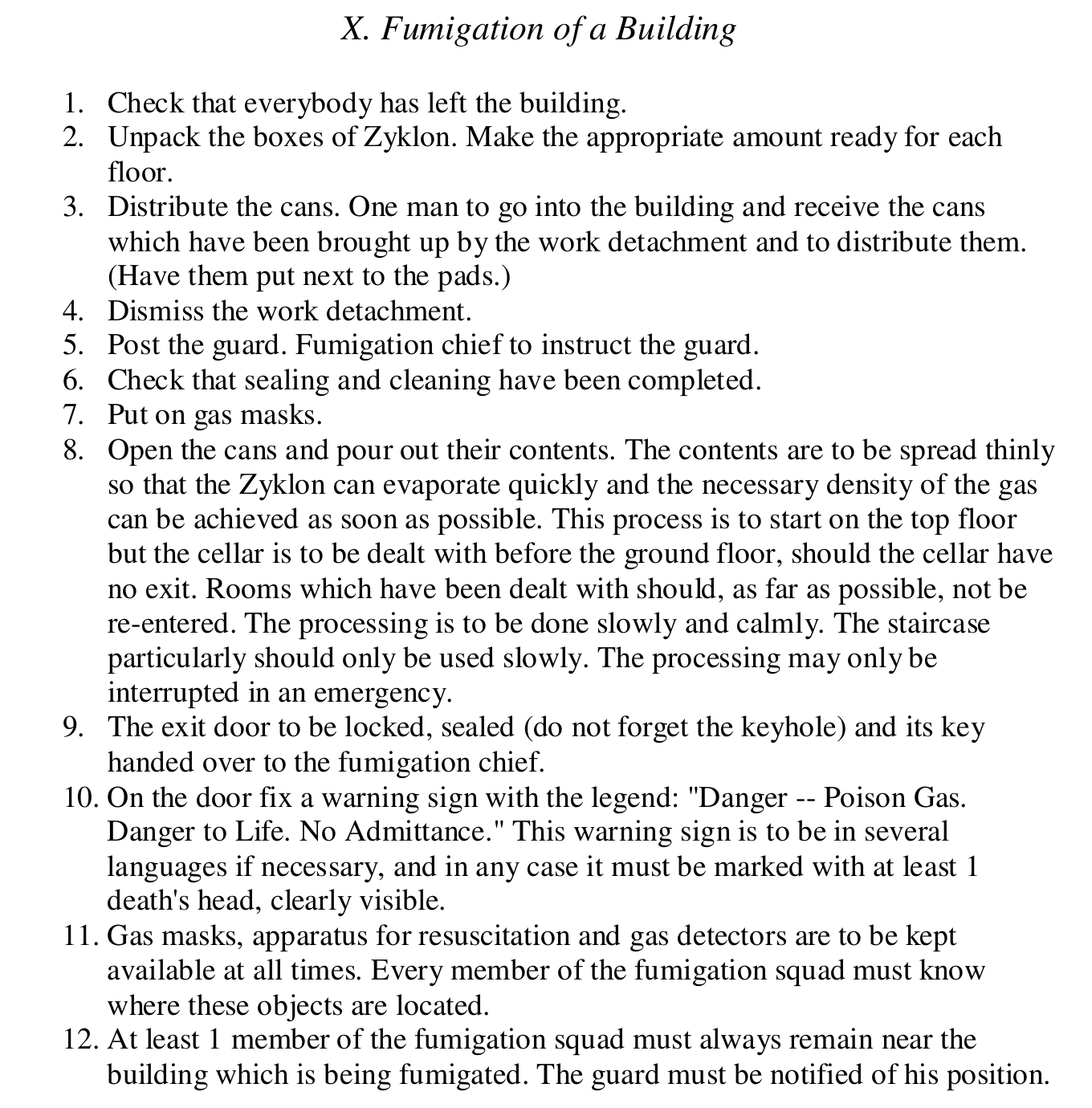
Fumigation items 1-12: clear and seal the building; prepare and distribute cans and pads by floor; dismiss the work detachment; post a guard; put on gas masks; open the cans and spread the contents thinly for rapid evaporation; lock and seal the exit; post poison-gas warnings; keep masks, resuscitation gear, and gas detectors available; and station a squad member near the building.
Airing presents the greatest danger and must be done carefully with a gas mask. The operator keeps pure air close and directs escaping gas away from others; a trained observer may watch wind direction.
Airing items 1-13: exclude strangers; post guards; wear a mask; enter and open windows and doors floor by floor; remove seals after most gas disperses; protect pipes; secure valuables and openings; remove chimney covers after provisional release; continue airing for at least 20 hours while the guard remains.
A room may be provisionally released when detector paper is lighter than the reference with doors and windows open. Only airing and cleanup work is allowed; no one may rest or sleep there and openings remain open.
Cleanup removes carrier remains and damaged cans, airs and beats mattresses and upholstered goods for at least an hour, and changes straw stuffing where possible. Chimney covers must be removed to avoid inadequate stove draft and carbon-monoxide poisoning. After release, the chief records room volume, Zyklon quantity, personnel, exposure time, and release time.
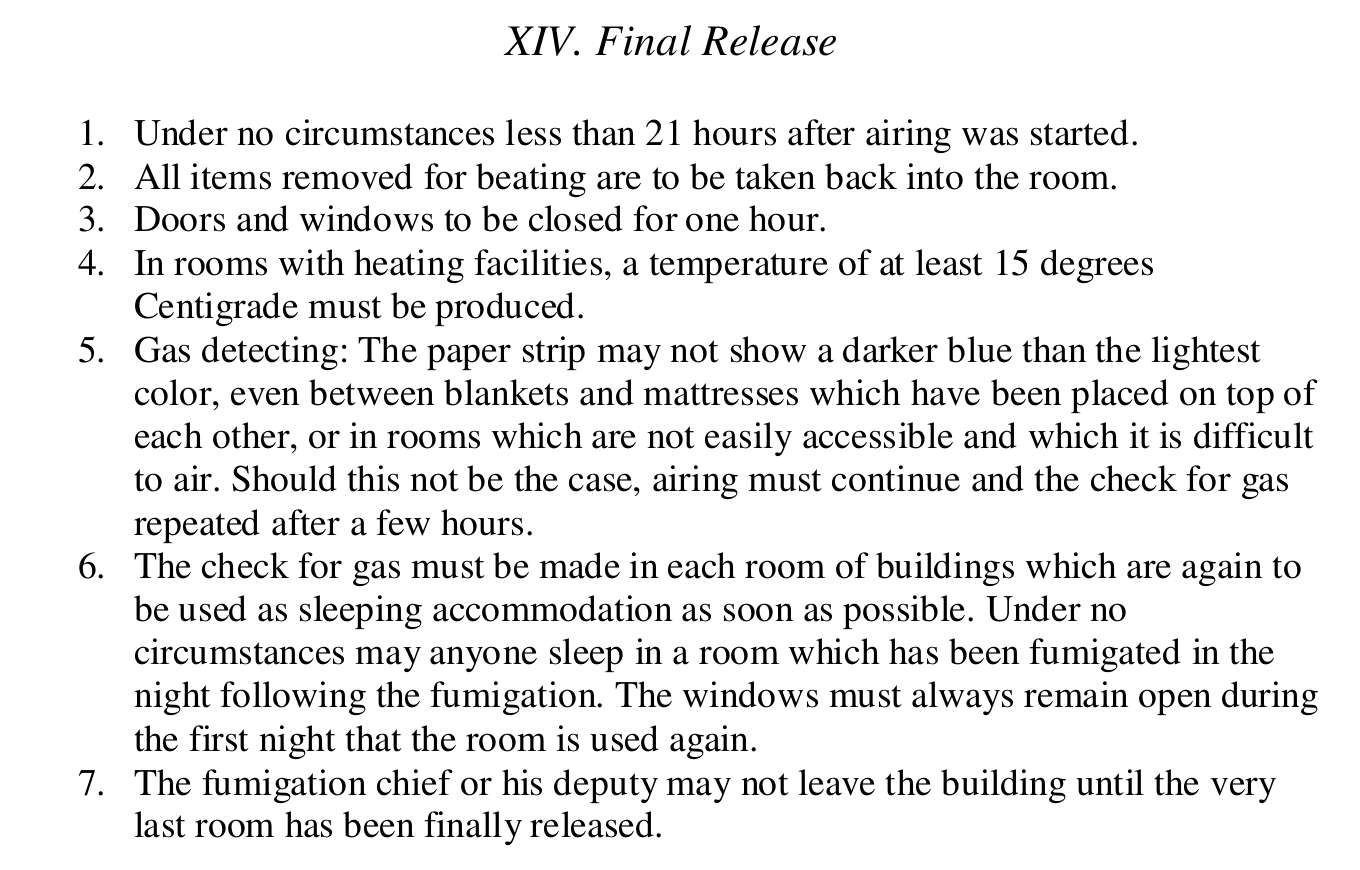
Final release occurs no sooner than 21 hours after airing starts; soft goods return, the room is closed for an hour and heated where possible, difficult locations are detector-tested, sleeping rooms receive special checks, and the chief stays until the last room is released.
Issued by the Health Institution of the Protectorate Bohemia and Moravia in Prague. Dorothea L. Galewski certifies the English as a true translation of NI-9912.
Maps, drawings, letters, and laboratory records
A.4 Appendix 4: site maps
Report context 3 report items
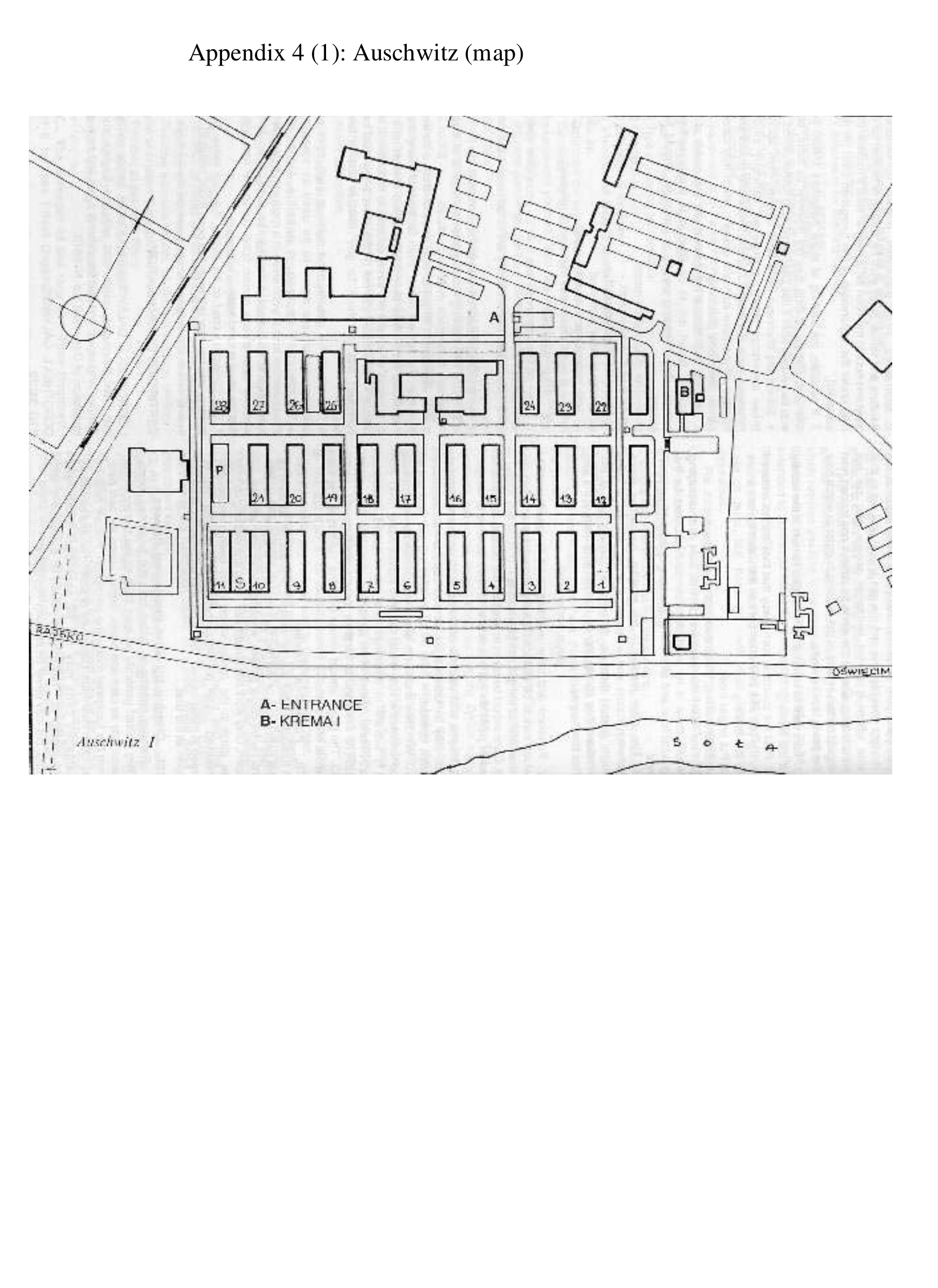
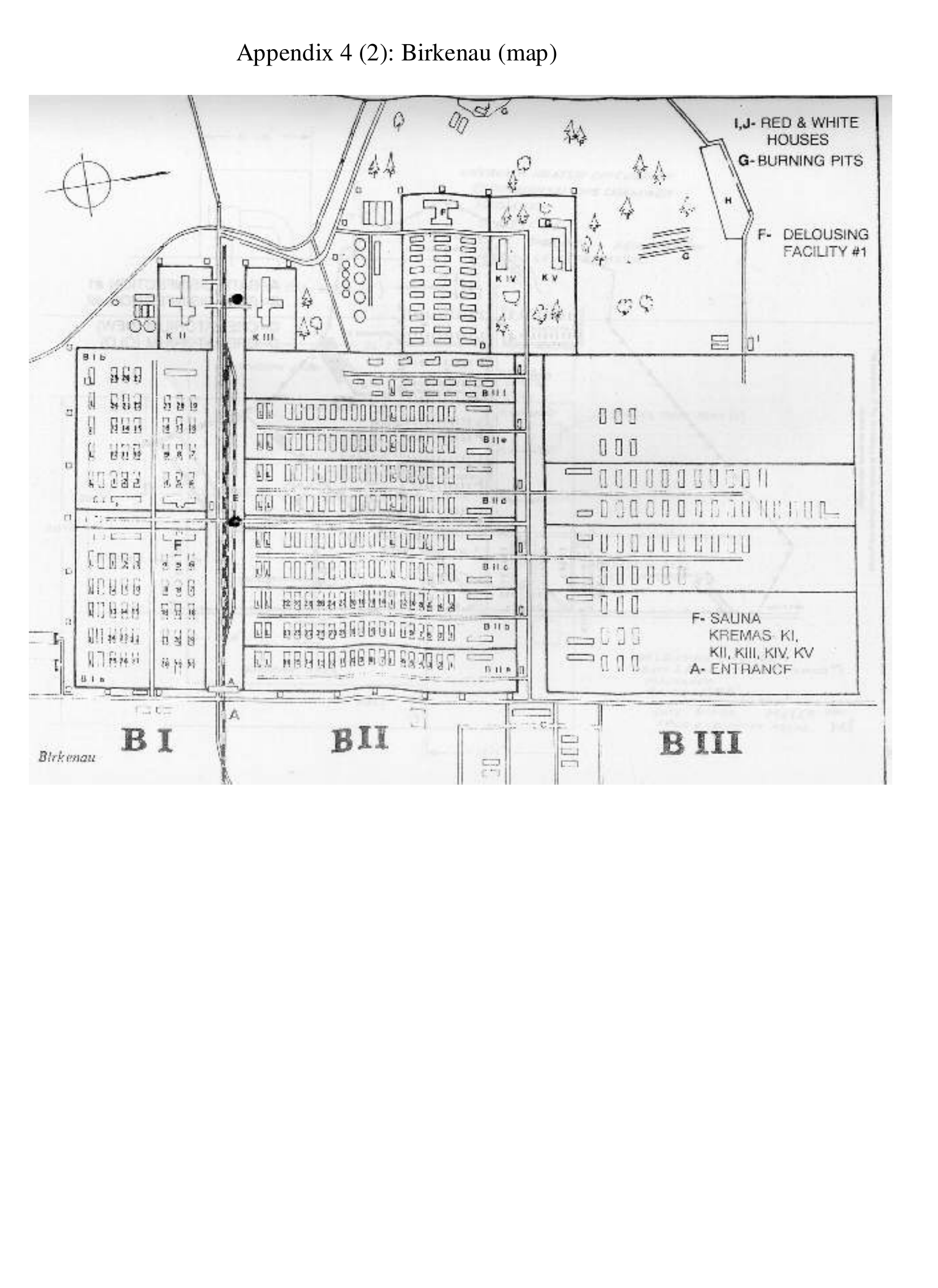
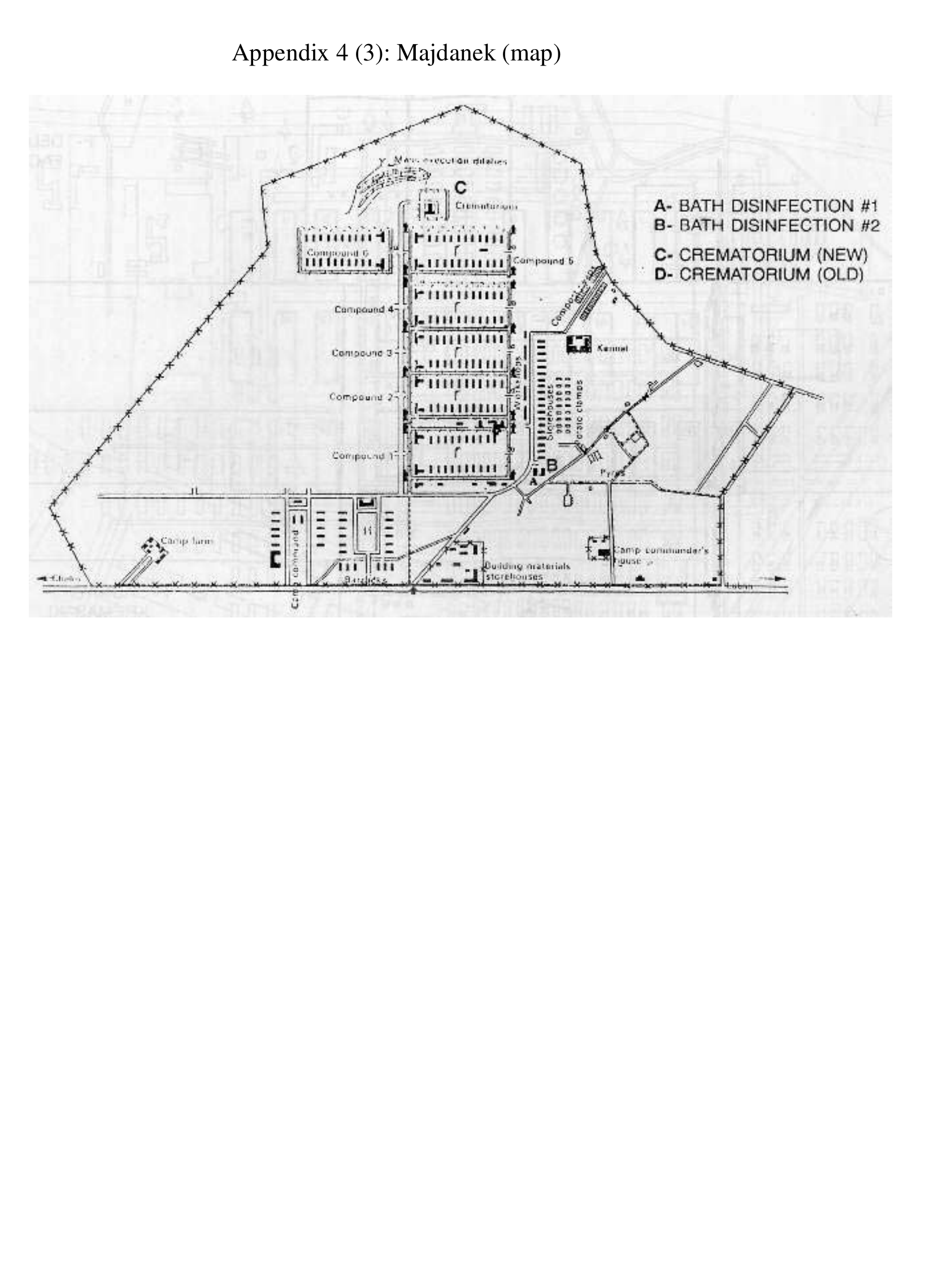
A.5 Appendix 5: Leuchter drawings
Report context 2 report items
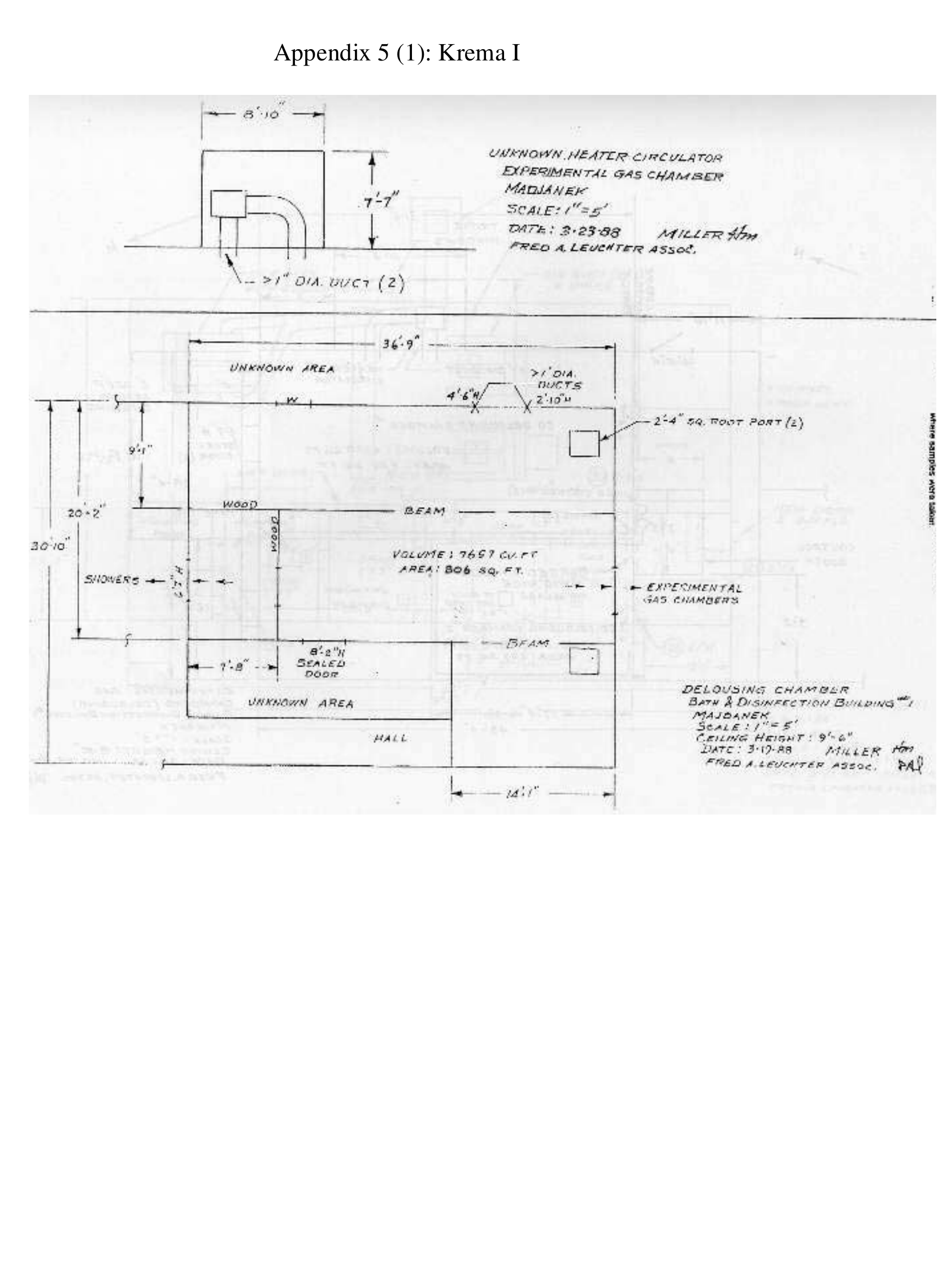
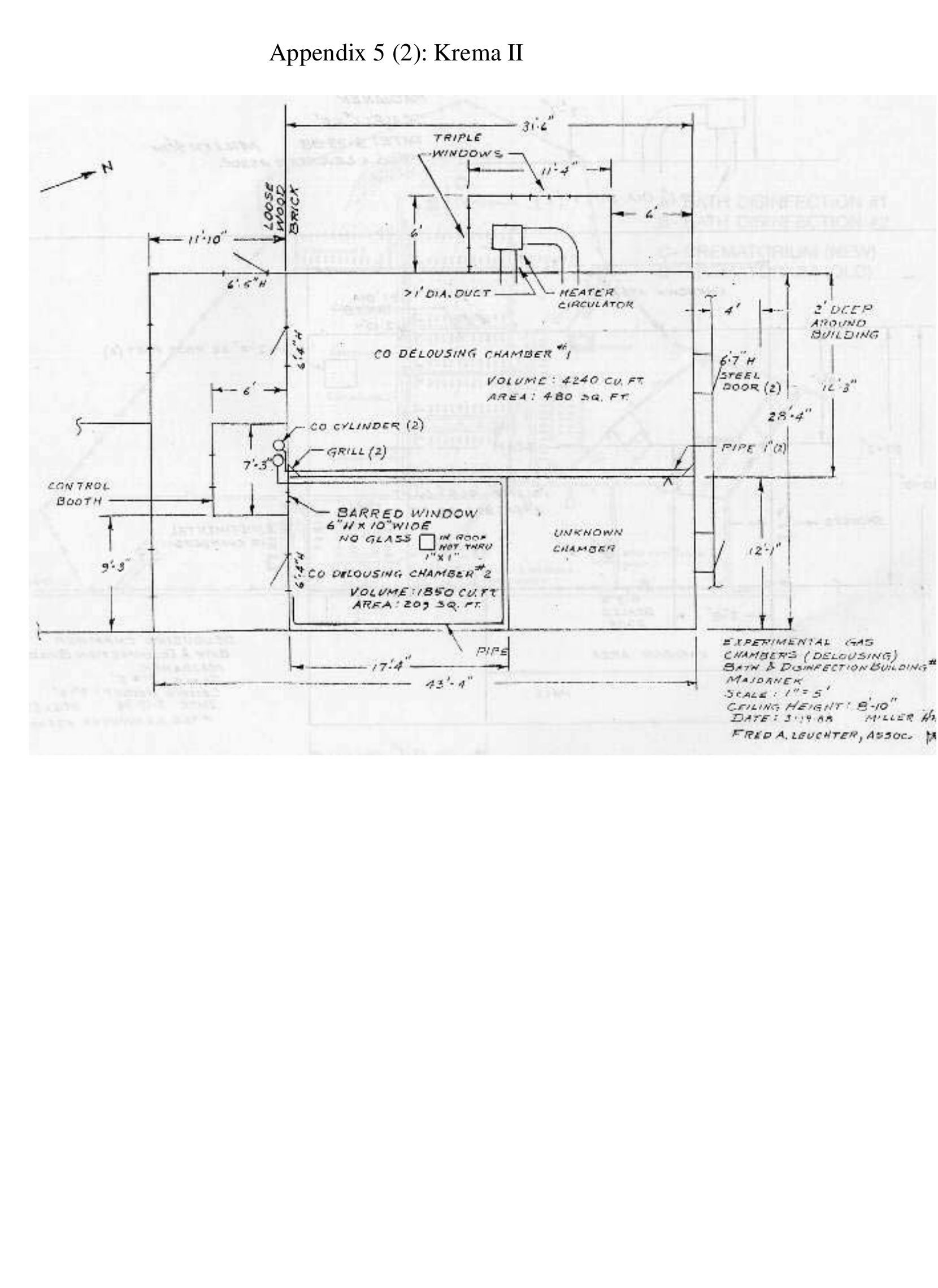
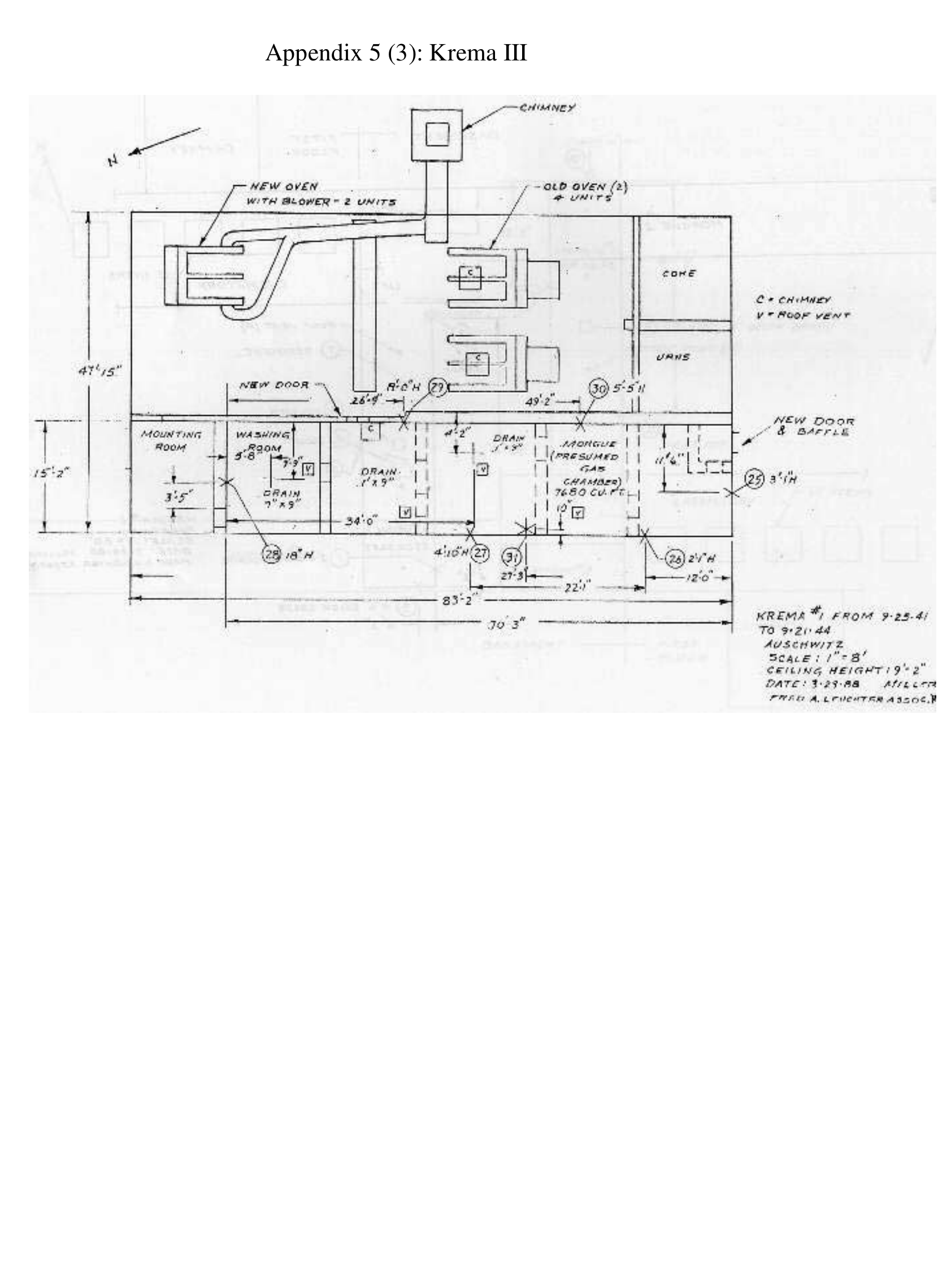
Sample 28 lies outside the claimed chamber on the report's map
The page heading says “Krema III,” while the drawing's own title block says “KREMA #1” and dates the plan from September 25, 1941 to September 21, 1944. The correction therefore relies on the drawing's internal room labels and marker positions rather than the conflicting page heading.
Marker 28 lies at the partition between “mounting room” and “washing room,” outside the mortuary area labeled “presumed gas chamber.” Appendix 1's laboratory table reports 1.3 mg/kg for sample 28. On the report's own drawing, that number cannot be counted as a sample from the marked chamber.
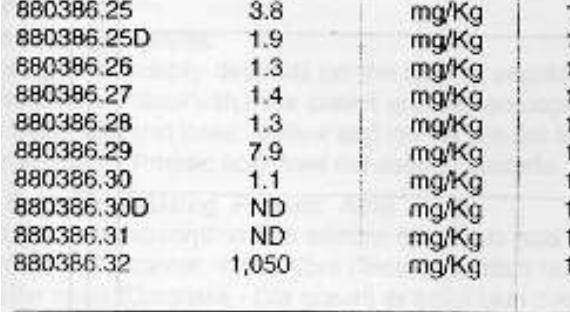
Sources: Auschwitz Museum: Krema I
Report context 3 report items
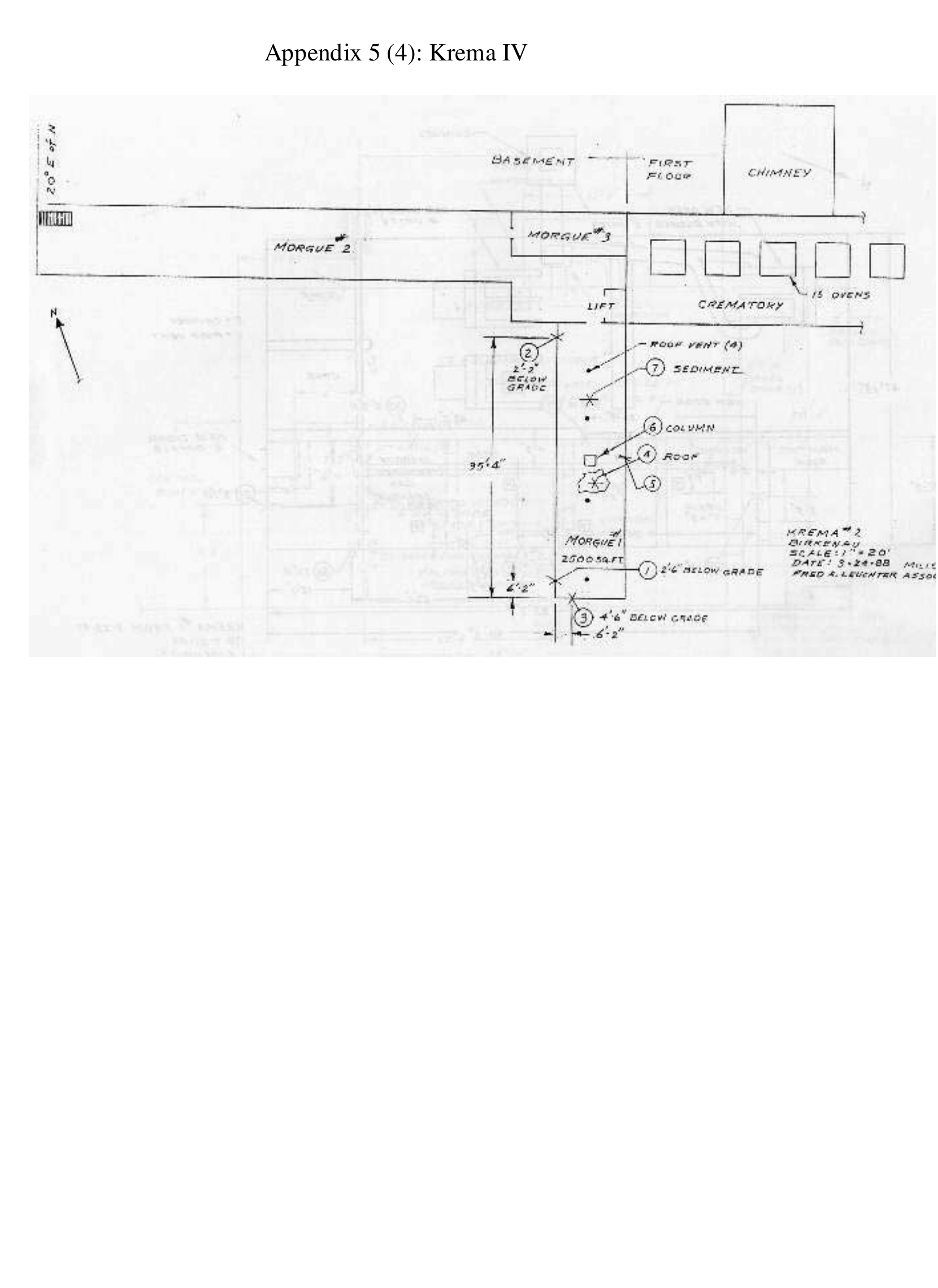
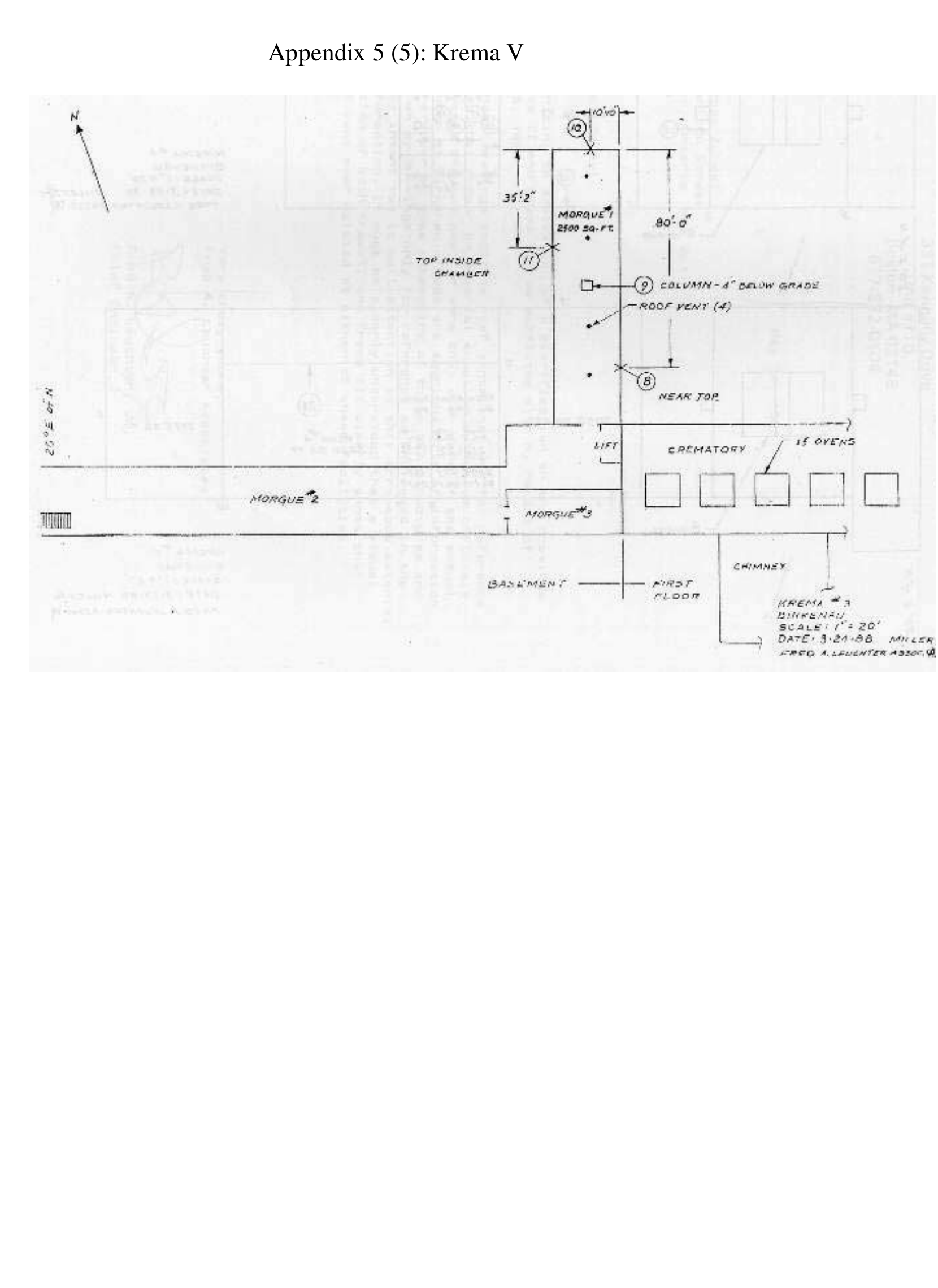
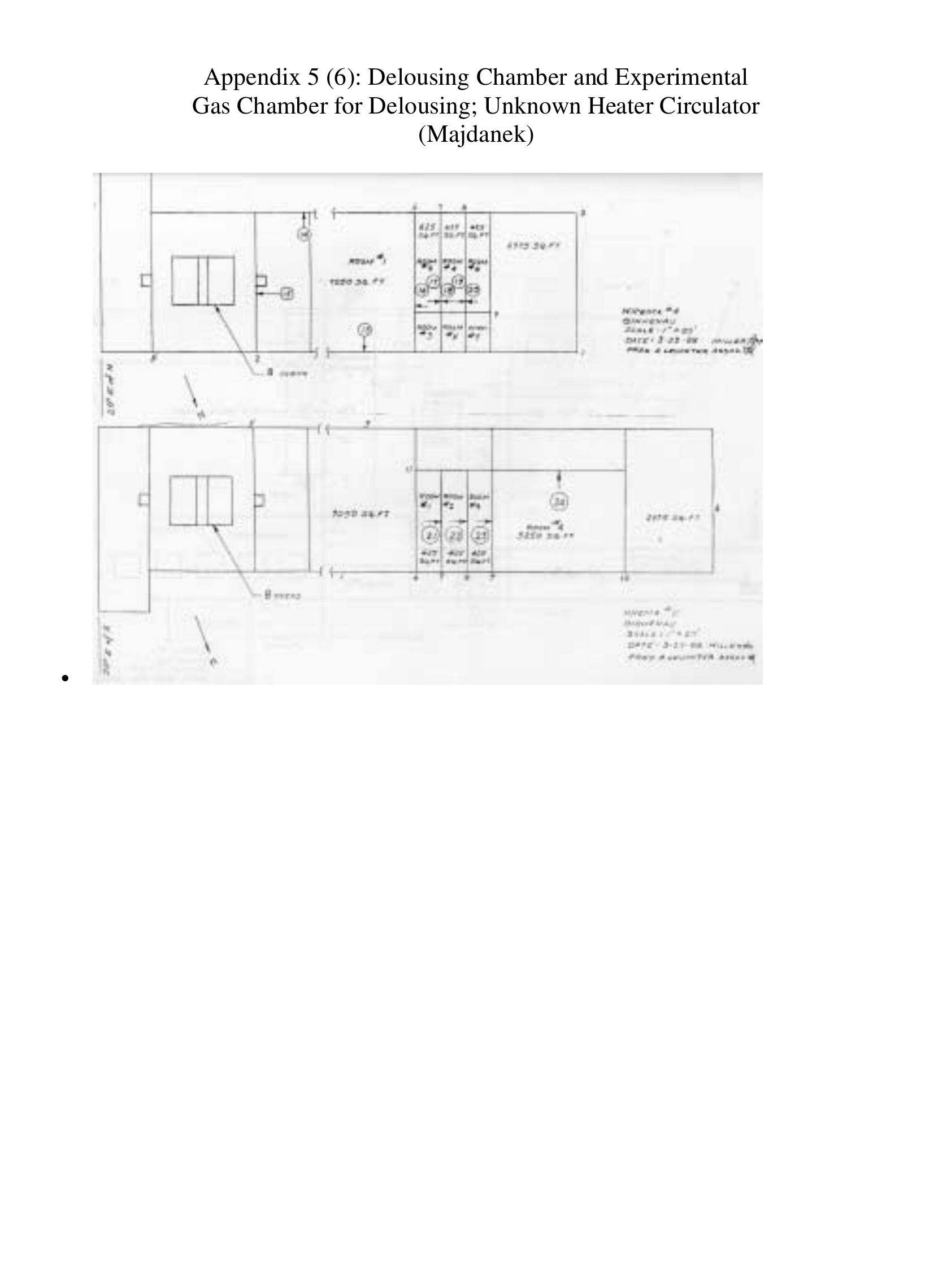
A.6 Appendix 6: roof-opening clarification
Report context 4 passages
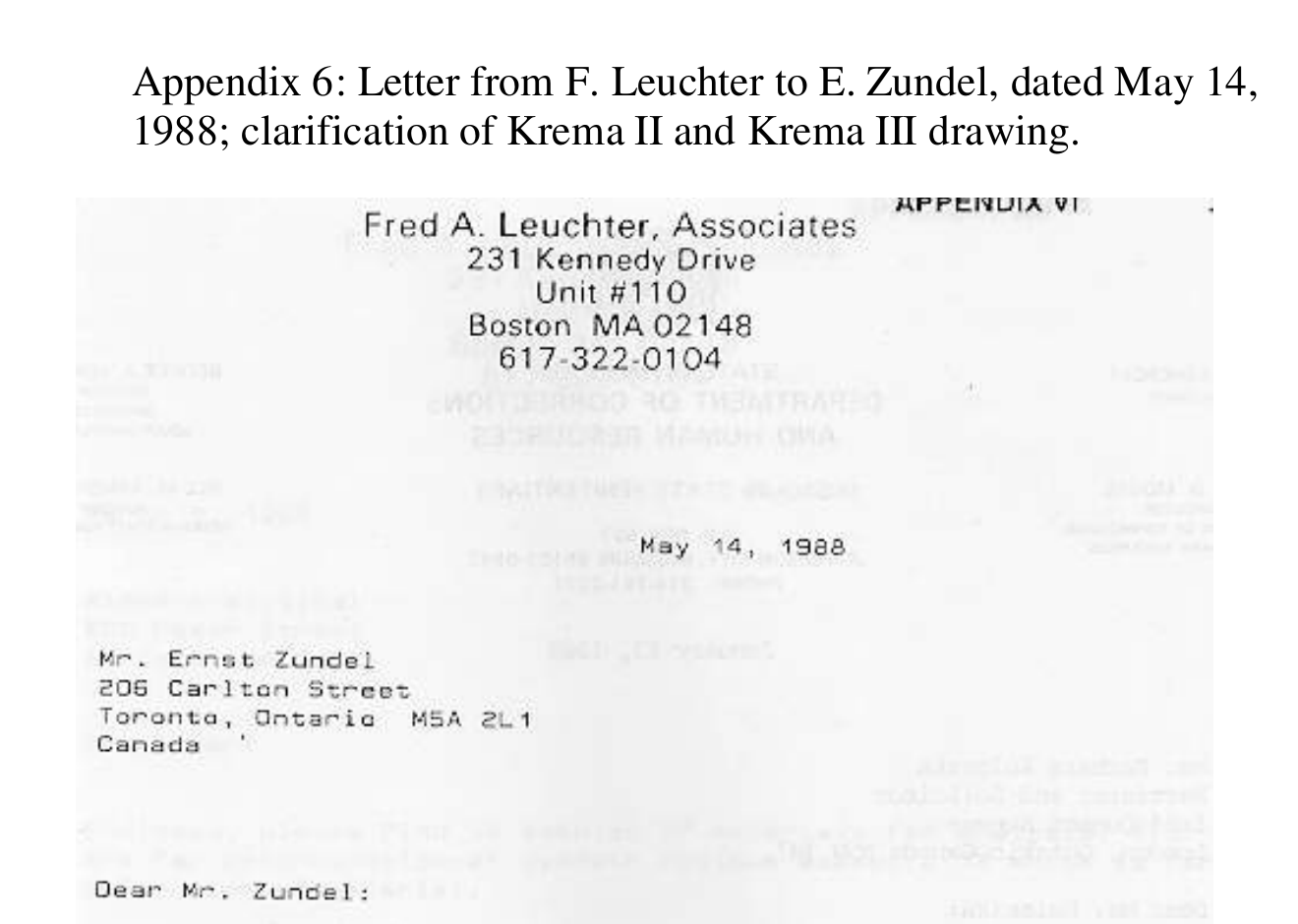
Fred A. Leuchter Associates letter to Ernst Zündel, dated May 14, 1988, described as clarification of the Krema II and Krema III drawings.

“I am writing to advise you of a clarification on the drawings of Krema II and Krema III as submitted with my report of April 5, 1968.”
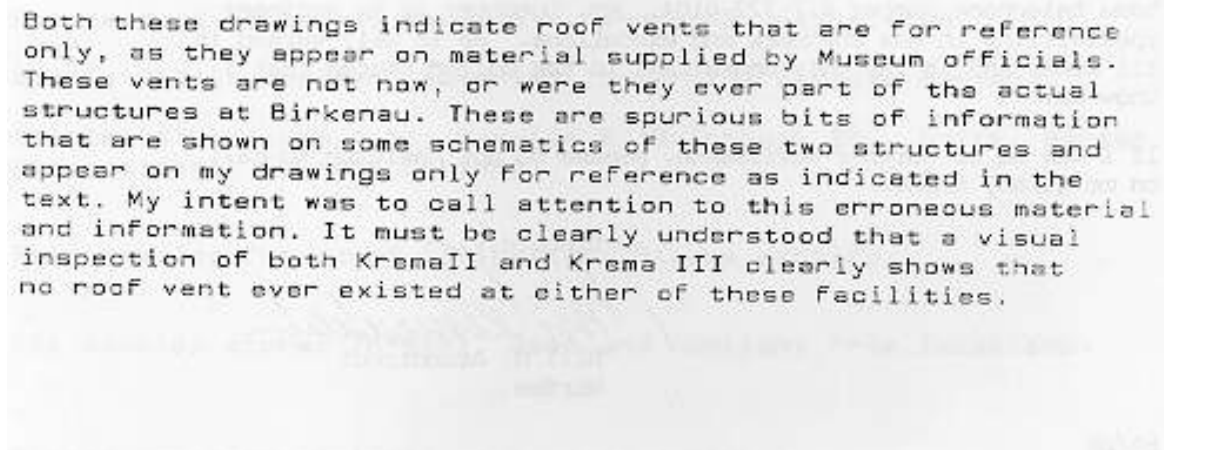
Both drawings indicate roof vents “for reference only,” based on museum material. Leuchter calls them spurious and says visual inspection clearly shows that no roof vent ever existed at either facility.
Very truly yours, Fred A. Leuchter Associates; Fred A. Leuchter Jr., Chief Engineer.
A.7 Appendix 7: Armontrout recommendation
Report context 3 passages
Letter of January 13, 1988, from Bill M. Armontrout, Warden, Missouri State Penitentiary, to Barbara Kulaszka.

Armontrout recommends Fred A. Leuchter regarding execution by gas chambers, calls him an engineer specializing in gas chambers and executions, says he is well versed, and calls him the only United States consultant Armontrout knows.
Armontrout offers further assistance and signs the letter as warden.
A.8 Appendix 8: instructions to Alpha Analytical
Report context 2 passages
The digital heading dates the letter March 9, 1998; the reproduced letter itself is dated March 9, 1988.

Enclosed are 32 material samples. All are for determination of “cyanate residue” except sample 12, which is for identification of the material.

Sample 32 is called the control sample. “Note blue color. Other samples should equal or exceed cyanate content.”
Bulk grinding eliminated the recorded surface-to-mass relationship
The letter gave Alpha Analytical numbered chunks and identified sample 32 only as a blue control expected to contain cyanide. James Roth, the laboratory manager who supervised the tests, later said the lab did not know which face of each thumb- to fist-sized chunk had been exposed. The chunks were broken up for subsampling. Those procedural points are separated from Roth's estimates in the procedure table.
Roth estimated that a surface reaction might extend only about 10 microns and said bulk crushing diluted that layer by orders of magnitude. That is evidence about what the procedure did, not a corrected surface concentration or a rule for what masonry should contain. With no recorded depth or surface-to-mass ratio, the grinding step eliminated the geometry needed to compare one reported number with another or with sample 32.
Sources: Markiewicz et al., 1994 · James Roth: later account of the laboratory procedure
Report context 7 passages

Sample 12 is gasket material; determine composition.

Sample 7 is sediment material; determine “cyanate content.”

Samples 1-11 and 13-32 are brick, mortar, and sediment, requested for “cyanate content.”

“Test results for court litigation. Please certify.”

The letter says all samples were stored in cool, damp, and sunlight-free locations.

“Please complete analysis as soon as possible.”
Fred A. Leuchter signs for Fred A. Leuchter Associates as “Chief Engineer.”
A.9 Appendix 9: laboratory certification
Report context 6 passages
Commonwealth of Massachusetts Department of Environmental Quality Engineering: “Certification for Chemical Analysis of Waters.”
Alpha Analytical Labs, laboratory MAD86, director Scott McLean; certificate dated March 15, 1988 and expiring September 15, 1988.
Primary drinking-water parameters: full certification for listed metals and organics; provisional certification for pesticides.
Secondary parameters: full certification includes cyanide among metals, minerals, nutrients, PCB, pesticides, organics, and phenolics; no provisional categories.
The department will accept results for the listed categories. Analyses outside the authorization may cause revocation; the original certificate must be displayed and remains subject to approval.
Signed by Joseph E. O'Brien, Ph.D., Director of Laboratory Certification, for the commissioner.
A.10 Appendix 10: IMT document L-022
Report context 3 report items

Appendix 10: Document International Military Tribunal, document L-022.
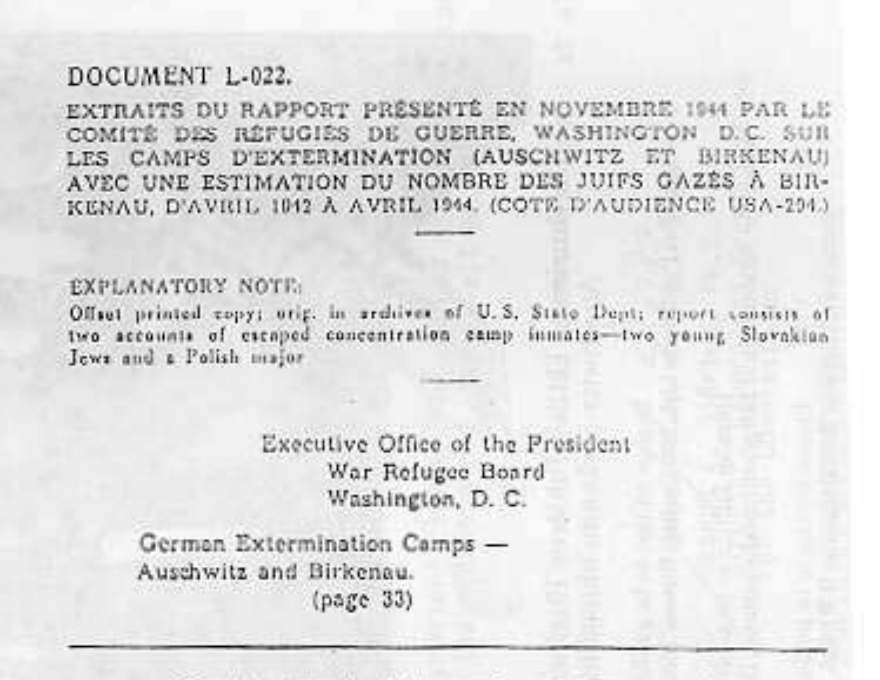
Explanatory note: an offset-printed exhibit in United States State Department archives; a report based on accounts of escaped camp inmates, two young Slovakian Jews and a Polish major; Executive Office of the President, War Refugee Board, Washington, D.C.
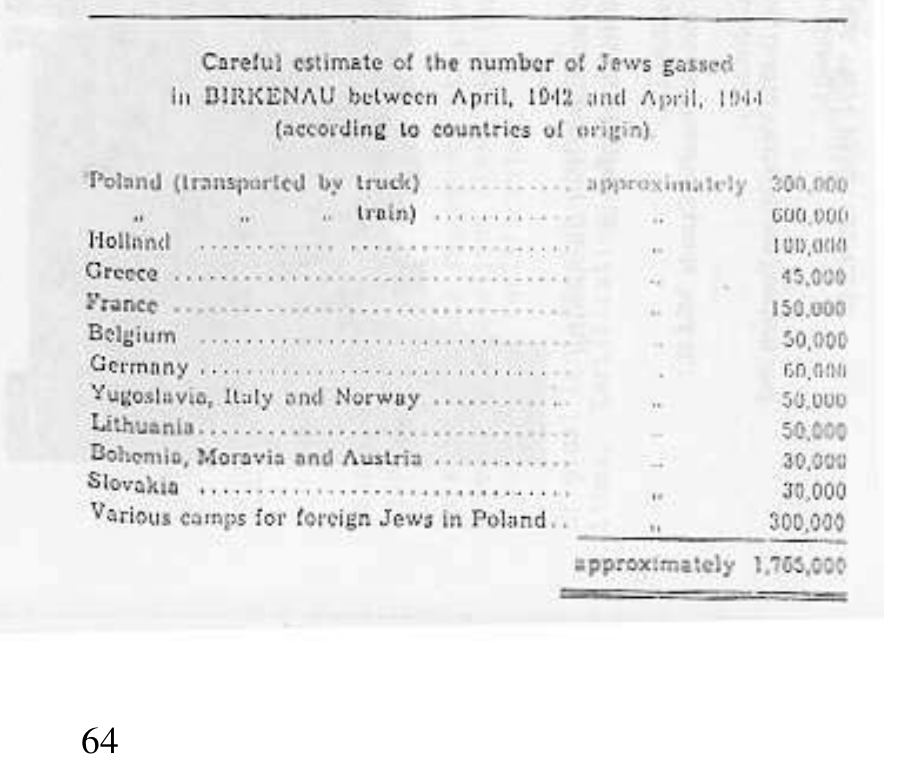
Sources cited in the corrections
Wartime records, technical literature, museum documentation, and scholarly interpretations are listed here with notes stating what each source supports.
- Auschwitz-Birkenau State Museum, The Leuchter Report
Site-specific review of Leuchter's occupancy, ventilation, chemistry, and cremation claims.
- German rules for the use of hydrocyanic acid, Document NI-9912
Leuchter printed this wartime fumigation document in his own appendix. The source tag resolves to the literal appendix crop in this dossier.
- Jan Markiewicz, Wojciech Gubała, and Jerzy Łabędź, cyanide study, 1994
Forensic study using documented sampling, negative controls, replicate determinations, and a method selected not to decompose iron blue.
- Bischoff letter stating nominal cremation capacities, June 28, 1943
A stated nominal 24-hour capacity, not proof that the maximum was continuously achieved.
- Crematorium II equipment inventory listing electric-motor blowers
Published facsimile of APMO BW 30/43, p. 10, signed by Bischoff and Thoma; it proves mechanical blowers were installed but does not by itself establish a room-specific air-change rate.
- Bischoff order for a gas-tight door for Leichenkeller 1 of Crematorium III, March 31, 1943
Auschwitz construction-office record, APMO BW 30/34, p. 100 and Nuremberg NO-4465.
- Pollok telegram ordering ten gas testers for Crematorium II, February 26, 1943
Auschwitz construction-office record, APMO BW 30/34, p. 48. The telegram proves an urgent order for ten gas testers; the displayed document does not identify the target gas.
- Crematorium II handover inventory listing four wire-mesh insertion devices and four wooden covers, March 31, 1943
Attachment to the handover record, APMO BW 30/43, p. 12; the displayed reproduction has a red box added around the two entries.
- Bischoff to Kammler, January 29, 1943, naming the Vergasungskeller and the supply/exhaust ventilation plant
Auschwitz construction-office record, APMO BW 30/34 and Nuremberg NO-4473.
- James Roth interview on Alpha Analytical's procedure, quoted in Irving v Penguin Books and Lipstadt, trial day 8
The trial transcript reproduces Roth's later account that Alpha received thumb- to fist-sized chunks, broke them up, did not know which face had been exposed, and thereby diluted a possible surface reaction. Roth's roughly 10-micron and 10,000- to 100,000-fold figures are presented as his estimates, not as a validated model of wartime masonry chemistry. The court also noted that the quoted documentary transcript might be incomplete.
- Richard Irmscher, “Nochmals: Die Einsatzfähigkeit der Blausäure bei tiefen Temperaturen” (1942)
Scanned wartime DEGESCH technical paper measuring Zyklon-carrier HCN release at temperatures from −18/−19°C to +15°C. Local facsimile pages 35–37 are shown in the correction.
- NIOSH Emergency Response Safety and Health Database: Hydrogen Cyanide
Boiling point, vapor pressure, relative vapor density, flammability, and emergency guidance.
- NIOSH Pocket Guide to Chemical Hazards: Hydrogen cyanide
Physical properties, exposure routes, flammability range, and respirator guidance.
- Leuchter Report Table I, specifications for HCN
Literal crop of the report's own table, including vapor density and the 6-41 percent flammability range.
- Auschwitz-Birkenau State Museum lesson on delousing chambers
Historical delousing practice and the mismatch between modern idealized specifications and wartime facilities.
- NIST Chemistry WebBook, hydrogen cyanide phase-change and vapor-pressure data
NIST SRD 69 compiles HCN boiling-point and vapor-pressure measurements. The data show measurable vapor pressure below the normal boiling point; they do not establish Leuchter's claimed 88.3°F wall-temperature rule.
- NIOSH Immediately Dangerous to Life or Health value for carbon monoxide
Documents lethal danger from carbon monoxide at ordinary atmospheric pressure.
- National Research Council, “Carbon Monoxide,” Acute Exposure Guideline Levels for Selected Airborne Chemicals, Volume 8 (2010)
The National Academies chapter reviews human, animal, and modeled carbon-monoxide concentration-time data. It publishes an AEGL-3 of 600 ppm for 30 minutes and discusses BSI and ISO lethal-exposure estimates, while identifying the assumptions and evidentiary limits behind those estimates.
- NIOSH, Atmosphere Management: human respiration and limits for closed systems
Technical review of oxygen consumption, carbon-dioxide production, activity, concentration limits, heat, and open versus closed atmosphere calculations.
- Auschwitz-Birkenau State Museum, history of the gas chambers
Site chronology, adaptations, construction, operating dates, and the museum's stated capacity figures.
- State Museum at Majdanek, historical timeline
Construction, procurement, and operation chronology for Majdanek's gas chambers.
- State Museum at Majdanek, “Former Camp Grounds”
The Museum separately identifies the gas-chamber building and states that the crematorium building was partially reconstructed after the SS set it on fire on July 22, 1944.
- The Leuchter Report, §3.17, description of the Majdanek gas-chamber-building doors
Leuchter's later site description says the four steel doors had gasket rabbets and opened outward. It directly contradicts the earlier statement that all alleged gas-chamber doors opened inward.
- State Museum at Majdanek, extermination history
Majdanek-specific institutional history of the gas chambers, agents used, crematoria, and open-air burning.
- Pat Shipman, Giraud Foster, and Margaret Schoeninger, “Burnt bones and teeth: an experimental study of color, morphology, crystal structure and shrinkage” (1984)
Controlled heating study published in the Journal of Archaeological Science. The authors heated bone and teeth from 20°C to 940°C and measured color, microscopic morphology, crystal structure, and shrinkage.
- Dario Innocenti et al., “Burning temperature and bone modification: The cremation dynamics”
Primary study of 100 human cadavers cremated at 600–1,200°C. The authors recorded morphological and color changes, fire-related fractures, and other thermal alteration of bone.
- Fritz Sander memorandum to J. A. Topf & Söhne on concentration-camp cremation ovens, September 14, 1942
Thuringian Main State Archive, J. A. Topf & Söhne Nr. 95, Bl. 37–39. The first-page facsimile says the existing muffle system was too slow for Auschwitz demand, describes filling individual muffles with several corpses, and begins a criticism of its interrupted operation.
- Jean-Claude Pressac, Auschwitz: Technique and Operation of the Gas Chambers, p. 95
Pressac's survey of Kori camp installations identifies five Majdanek muffles built as a single block.
- State Museum at Majdanek, post-liberation photograph of the new crematorium ovens
The Museum's July 1944 photograph shows the surviving row of five loading fronts in one brick installation.
- Jean-Claude Pressac, “The Deficiencies and Inconsistencies of the Leuchter Report” (December 12, 1988)
Contemporaneous technical-historical critique used for its sample-location inventory, site-phase warnings, Majdanek layout analysis, and identification of omitted records. Some of Pressac's 1988 chemical and biographical statements were later corrected; those claims are not adopted without separate support.
- Auschwitz-Birkenau State Museum, ground water level and burning pits
Drainage plan, 1944 aerial photography, and the clandestine Sonderkommando photograph directly answering the groundwater claim.
- Auschwitz-Birkenau State Museum, Crematorium I and gas chamber
Museum account distinguishing original fabric, wartime alterations, and postwar reconstruction.
- Auschwitz-Birkenau State Museum, Crematorium I chimney and 1944 air-raid-shelter conversion
Museum account reproducing the 1941 crematorium plan and the 1944 air-raid-shelter adaptation plan from its archives. The latter shows the new chamber division and labels the shelter ventilation; the Museum also records the wartime dismantling and 1947 reconstruction.
- Jean-Claude Pressac, Auschwitz: Technique and Operation of the Gas Chambers (1989), pp. 133 and 158
Pressac's reconstruction narrative and room plan distinguish the 78.2-m² original mortuary from the approximately 94-m² displayed room, identify the former corpse-washing room now included in the display, and cautiously label the observed stack as presumed air-raid-shelter ventilation. The linked transcription is checked against the preserved local scan of the published book.
- Auschwitz-Birkenau State Museum, “No holes for Zyklon B”
Construction inventory, witness evidence, and physical investigation of the introduction openings and wire-mesh devices.
- Order No. 61 for a provisional Crematorium II/III goods lift, February 15, 1943, reproduced by Jean-Claude Pressac
Pressac reproduces the work-order text and identifies its archival location as the metal-working file, Annex 15 of volume 11 of the Höss trial. It specifies a minimum 300-kg payload and completion on March 13, 1943; Pressac reports later replacement by a 1,500-kg Demag goods lift.
- State Museum at Majdanek, camp topography
Site-specific identification of the bathhouses, disinfection facilities, gas chambers, crematoria, and other sectors.